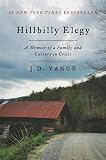
J.D. Vance is an American author and politician whose Hillbilly Elegy — a memoir about growing up in the Appalachian rust belt — became one of the most discussed American political memoirs of the 2010s and a cultural Rorschach test.
J.D. Vance published Hillbilly Elegy in 2016, a memoir about growing up in Middletown, Ohio — a rust belt town whose population had descended primarily from Appalachian Kentucky — and in Breathitt County, Kentucky, itself. The book describes family dysfunction, substance abuse (particularly his mother’s opioid addiction), poverty, and the social and cultural conditions of working-class white America that left many communities devastated by deindustrialization.
Hillbilly Elegy was immediately seized upon as an explanation for Donald Trump’s unexpected victory in the 2016 election: it appeared to provide an account of a population that many coastal Americans didn’t understand. This context made it one of the most discussed American books of its decade, and also generated significant criticism. Critics argued that Vance attributed to cultural failures conditions that were better explained by policy choices, and that his framework shifted responsibility from institutions to individuals and communities.
The book’s literary qualities are genuine: the portrait of his grandmother Mamaw, who provided the stability and encouragement that allowed him to attend Ohio State and eventually Yale Law School, is memorably drawn. Vance himself has become a political figure — elected to the U.S. Senate from Ohio in 2022 and chosen as Donald Trump’s running mate in 2024 — which has complicated retrospective readings of the memoir. It remains a significant document of a particular American social moment, whatever one thinks of its analysis.
A Book at the Center of a National Argument
Few memoirs have been so thoroughly co-opted by the political moment of their publication as Hillbilly Elegy, which arrived in 2016 just as the country was struggling to understand the forces behind a populist upheaval and the distress of working-class white America. Almost overnight the book was elevated from personal memoir to sociological key, embraced by commentators and readers searching for an explanation of communities that had felt invisible to the political and media establishment, and it became one of the most discussed books of its decade precisely because it seemed to answer an urgent national question. This reception was also the source of the fierce debate it provoked. The book’s central interpretive move — locating the roots of Appalachian and Rust Belt decline substantially in a culture of fatalism, family dysfunction, and what Vance framed as a crisis of personal responsibility — struck admirers as brave honesty and critics as a conservative deflection that let structural forces, deindustrialisation, and policy failures off the hook. Scholars of the region challenged its representativeness, arguing that one man’s family story was being asked to bear the weight of a sweeping cultural diagnosis. The controversy made the book a genuine cultural Rorschach test, read very differently depending on the politics of the reader.
Memoir, Adaptation, and Shifting Readings
As a piece of writing, Hillbilly Elegy succeeds most where it is most personal, and its lasting literary value lies in the specificity of its family portrait rather than in its broader claims. The figure of Mamaw — profane, fierce, and fiercely loyal — anchors the narrative emotionally, and Vance’s account of growing up amid instability, his mother’s addiction, and the saving interventions of his grandmother carries real and moving particularity. The book’s commercial success led to a Netflix film adaptation directed by Ron Howard, which largely stripped away the sociological argument to focus on the family melodrama, a choice that drew mixed reviews and underscored how much the book’s significance had always depended on its political framing rather than its story alone. That framing has only grown more fraught over time. As Vance moved into politics and aligned himself closely with the populist movement his book had been read as explaining, readers and critics have revisited the memoir in light of his subsequent positions, scrutinising the relationship between the analysis he offered in 2016 and the political identity he later adopted. The memoir thus exists now in a strange double light, read both as a document of its moment and as a prologue to a political career.
A Document of Its Time
Whatever one concludes about its arguments or its author’s later trajectory, Hillbilly Elegy endures as a significant artifact of a particular American juncture, a book whose very contestedness makes it historically valuable. It captured, and helped to crystallise, a national conversation about class, region, and the fracturing of the American social contract at a moment when those questions had moved suddenly to the centre of political life. Its account of the despair, pride, and resilience of one slice of working-class America resonated with many readers who saw their own families reflected in its pages, even as it angered others who felt their communities were being mischaracterised or scapegoated. The book’s combination of memoir and social commentary, and the enormous and divided response it generated, ensure its place in any history of how the United States grappled with the upheavals of the mid-2010s. Vance’s transformation from memoirist to senator to vice-presidential candidate has made it impossible to read the book in isolation from his politics, but that entanglement is itself part of the story. As both personal narrative and cultural lightning rod, Hillbilly Elegy remains a revealing, much-argued-over window onto a consequential American moment.
Where to Start with Vance
As an author, Vance is essentially the writer of a single book, so the recommendation is simply Hillbilly Elegy — but how a reader approaches it matters. It is best read as a personal memoir first, attending to the vivid, particular portrait of his family and especially his grandmother, and only secondarily as the sweeping cultural diagnosis it was widely received to be. Readers will get the most from it by engaging critically with its central argument about culture and personal responsibility, and by setting it alongside other accounts of Appalachia and the working class that emphasise the structural and economic forces the book tends to downplay; doing so turns a contested memoir into a useful entry into a larger debate. It is also worth reading with awareness of Vance’s subsequent political career, which has reshaped how the book is interpreted. Approached this way — as both a moving family story and a document whose claims invite scrutiny — Hillbilly Elegy rewards the reader as a revealing artifact of a particular and consequential American moment.
Reading Guides