Where to Start with Robert A. Heinlein: A Reading Guide
Where to start with Robert A. Heinlein — whether to begin with Stranger in a Strange Land, Starship Troopers, or The Moon Is a Harsh Mistress. A complete guide.

Robert A. Heinlein (1907–1988) is the American science fiction writer who, alongside Isaac Asimov and Arthur C. Clarke, constitutes the ‘Big Three’ of Golden Age science fiction. He won the Hugo Award four times (for Double Star, Starship Troopers, Stranger in a Strange Land, and The Moon Is a Harsh Mistress) and was named Grand Master by the Science Fiction and Fantasy Writers of America. Heinlein’s science fiction combines technical rigour (his near-future extrapolations are among the most carefully constructed in the genre) with explicit political philosophy — libertarian, individualist, and anti-authoritarian. His influence on science fiction is incalculable; his influence on American libertarian political thought is equally significant.
Where to Start: Stranger in a Strange Land (1961)
The essential Heinlein for most new readers — the Hugo Award-winning novel that became a counterculture bible. Valentine Michael Smith is the orphaned son of the first Mars expedition, raised from infancy by Martians and returned to Earth as an adult. He has no context for human culture: he does not understand property, jealousy, money, violence, or religion. His encounters with these things — mediated through a nurse named Jill Boardman and the journalist and worldly man Ben Caxton — allow Heinlein to conduct a satirical examination of 1960s American society from the perspective of someone with no reason to accept its assumptions.
Smith’s Martian powers (he can ‘discorporate’ objects and people, and his mental capacity is vastly beyond human limits) eventually develop into the founding of a religion — the Church of All Worlds — based on Martian philosophy. The novel’s second half becomes an examination of free love, communal living, and organised religion that was genuinely controversial in 1961 and reads as both prescient and dated.
Stranger in a Strange Land works as satire, as science fiction, and as a meditation on what makes us human. The word ‘grok’ — Martian for a total, empathetic understanding — is Heinlein’s most lasting contribution to the English language.
Starship Troopers (1959)
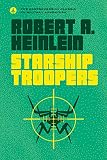
The founding text of military science fiction — and Heinlein’s most politically controversial novel. Juan ‘Johnnie’ Rico volunteers for the Mobile Infantry and is deployed against the Bugs in a war across the solar system. The combat sequences are well-rendered; the political philosophy (delivered in classroom sections by Rico’s history and moral philosophy teacher) argues that civic rights should be earned through service to the state, particularly military service.
The novel is explicitly didactic — Heinlein is arguing a position, not just telling a story — and readers who find his political philosophy repugnant will find the novel difficult. The Paul Verhoeven film (1997) is a deliberate parody of fascist aesthetics that mocks rather than celebrates the novel’s politics. The novel rewards reading in its original form, as an unironic argument, regardless of whether one agrees with it.
The Moon Is a Harsh Mistress (1966)
Heinlein’s best-constructed novel — a technically rigorous account of how a lunar colony might successfully revolt against Earth governance. Narrated by Mannie, a computer technician who becomes allied with the revolution, the novel covers the organisation of a cell structure, the political philosophy (de la Paz’s ‘rational anarchism’), the technical challenges of lunar warfare, and the first artificial intelligence to become politically conscious. The acronym TANSTAAFL entered the libertarian vocabulary from this novel.
Why Stranger in a Strange Land Is an Ideal First Book
For a reader new to Robert A. Heinlein, one of the towering figures of science fiction, Stranger in a Strange Land is an ideal first book because it is among his most famous and influential novels and a fine expression of his distinctive gifts, the bold ideas, the provocative social commentary, and the ambitious imagination. Stranger in a Strange Land follows a human raised by Martians who returns to Earth as an adult, seeing human society and its conventions with alien eyes, in a novel that became a countercultural touchstone. As an entry point it is ideal, for it is one of his best-known works and a perfect example of his provocative, idea-driven science fiction. It welcomes the newcomer with its compelling premise, its bold ideas, and its provocative social commentary, drawing the reader into his distinctive vision. It is among his major works and a fine representation of his gifts, so the new reader encounters Heinlein at his most characteristic. For the newcomer, then, Stranger in a Strange Land is an excellent starting point.
What to Expect as a New Reader
As a new reader, you can expect Stranger in a Strange Land to be a bold, provocative, and idea-driven work of science fiction. You can expect a compelling premise, for the novel follows a human raised by Martians who returns to Earth and sees human society with alien eyes. You can expect provocative social commentary, for the novel uses its premise to question and satirize human conventions, religion, sexuality, and politics. You can expect bold ideas, for the book is a vehicle for Heinlein’s provocative thinking, which became a countercultural touchstone. You can expect ambitious, talky, and philosophical storytelling, more concerned with ideas than action. You can expect a vision both of its time and ahead of it, which the reader may engage thoughtfully and critically. You can expect an influential and much-discussed novel. Expect, in short, a bold, provocative, and idea-driven work of science fiction, a fine introduction to Heinlein’s gifts.
Going Deeper After Your First Book
Once Stranger in a Strange Land has introduced you to Heinlein’s gifts, the reader who wishes to go deeper can explore his other novels, which span his long, influential, and varied career and reveal the range of his ideas and imagination. His other major works include his controversial and influential military science fiction, his celebrated novel of a lunar revolution often considered his finest, and his many beloved adventure novels, each marked by his bold ideas and provocative thinking, which readers may engage critically. Reading these after Stranger in a Strange Land deepens your appreciation of Heinlein’s distinctive gifts, the bold ideas, the provocative commentary, and the ambitious imagination. His characteristic strengths run through his work. Building your reading journey through Heinlein is a matter of following his fiction from Stranger in a Strange Land into his other novels. The reader who begins here and continues will encounter one of the most influential, and most debated, of the grand masters of science fiction.
Reading Robert A. Heinlein
Begin with Stranger in a Strange Land for Heinlein’s most culturally significant and most widely read work; read Starship Troopers for his military science fiction and most explicit political argument; read The Moon Is a Harsh Mistress for his most technically polished and most fully realised libertarian political novel. All three are standalones; all are foundational texts of American science fiction.
Frequently Asked Questions
Where should I start with Robert A. Heinlein?
Stranger in a Strange Land (1961) is the most widely recommended starting point for new readers — the Hugo Award-winning novel about Valentine Michael Smith, a human raised by Martians who returns to Earth and encounters human society as a complete alien, eventually founding a religion. Starship Troopers is the alternative for readers interested in military science fiction and political philosophy; The Moon Is a Harsh Mistress for readers who want his most fully realised libertarian political argument. All three can be read as standalones.
What is Stranger in a Strange Land about?
Stranger in a Strange Land follows Valentine Michael Smith — orphaned as an infant when his parents (part of the first Mars expedition) died, raised by Martians, returned to Earth as an adult with superhuman psychic abilities and no understanding of human culture. Smith encounters sex, religion, property, politics, and money for the first time, and his alien perspective allows Heinlein to critique American society in the 1960s with satirical force. The novel became a cult classic in the 1960s counterculture; the word 'grok' (to understand so thoroughly that observer and observed are one) entered English usage.
What is Starship Troopers about?
Starship Troopers (1959) follows Juan 'Johnnie' Rico from his enlistment in the Mobile Infantry through combat against the Bugs (an alien species) to his eventual officer commission. The novel is structured as a combination of combat narrative and political philosophy — much of it delivered in the form of classroom instruction. Heinlein argues for a society in which civic rights (including the right to vote) are earned through military service; the novel is both the founding text of military science fiction and one of the most politically controversial novels in the genre.
What is The Moon Is a Harsh Mistress about?
The Moon Is a Harsh Mistress (1966) follows a lunar colony's revolution against Earth governance, told by a computer technician named Mannie who becomes part of the revolution's leadership alongside a sentient computer named Mike and a political theorist called Professor Bernardo de la Paz. The novel is Heinlein's most fully developed libertarian political argument — it advocates for a minimal state, individual freedom, and voluntary association — and a technically sophisticated thriller about how to organise and execute a revolution. Its acronym TANSTAAFL ('There ain't no such thing as a free lunch') has entered general usage.