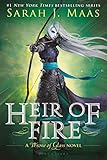
Editors Reads Verdict
Heir of Fire is the point at which the Throne of Glass series fully commits to being an epic fantasy rather than a YA adventure, expanding its world, its cast, and its emotional ambitions while centering a protagonist whose brokenness is treated with unusual candor.
What We Loved
- Celaena's grief and self-destruction are handled with more honesty than the genre typically allows
- Rowan Whitethorn is an exceptional addition to the cast — antagonistic in ways that serve the protagonist's growth
- The Valg mythology opens the series' cosmology to genuinely epic scale
- Manon Blackbeak's introduction as a POV character adds a morally complex new dimension
Minor Drawbacks
- The expanded cast means Celaena and Chaol share significantly less page time than in previous books
- The structural shift to multiple POVs requires adjustment from readers attached to the earlier focus
- Some of the Wendlyn sequences run longer than their narrative function requires
Key Takeaways
- → Power that has been suppressed through trauma cannot be reclaimed without confronting the trauma itself
- → Training under someone who refuses to coddle you is a form of respect
- → The most devastating empires are built on collaboration between human cruelty and supernatural force
- → A character can be both a villain's instrument and a person with genuine moral agency
- → Grief that goes unprocessed does not disappear — it waits, and it grows
| Author | Sarah J. Maas |
|---|---|
| Publisher | Bloomsbury Publishing |
| Pages | 565 |
| Published | September 2, 2014 |
| Language | English |
| Genre | Fantasy, Young Adult, Romance, Fiction |
| Difficulty | Beginner |
| Best For | Readers following the Throne of Glass series through Crown of Midnight; YA and adult fantasy readers interested in fae mythology, epic world-building, and morally layered protagonists. |
How Heir of Fire Compares
Heir of Fire at a glance against 3 similar books readers weigh alongside it.
| Book | Author | Rating | Best for |
|---|---|---|---|
| Heir of Fire (this book) | Sarah J. Maas | ★ 4.5 | Readers following the Throne of Glass series through Crown of Midnight |
| A Court of Thorns and Roses | Sarah J. Maas | ★ 4.2 | Fantasy romance readers who enjoy fae mythology, slow-burn romance, and |
| Crown of Midnight | Sarah J. Maas | ★ 4.5 | Readers who completed Throne of Glass and want to follow Celaena's deepening |
| Throne of Glass | Sarah J. Maas | ★ 4.3 | Young adult and adult fantasy readers, particularly fans of competitive |
Broken in Wendlyn
Heir of Fire opens with Celaena Sardothien at her worst. The events at the end of Crown of Midnight left her shattered in ways that she has not begun to process, and Maas does not skip the falling apart to get to the rising up. The Celaena readers meet at the start of this book is self-destructive, directionless, and deliberately squandering the mission she has been sent to Wendlyn to complete. It is the most psychologically honest portrait of depression and grief in the series, rendered without the narrative anxiety that often makes YA authors rush their characters through darkness.
What changes Celaena is Rowan Whitethorn, a fae warrior assigned to train her and thoroughly unimpressed by either her reputation or her self-pity. Their dynamic — adversarial, gradually respectful, eventually something more durable than either antagonism or romance — is one of the series’ great relationships, and Maas develops it with patience across the full length of the book.
The Valg and the World Behind the World
Heir of Fire significantly expands the Throne of Glass mythology. The Valg — ancient demonic beings from a world beyond the Wyrdgates — are revealed as the true force behind the King of Adarlan’s power. His conquests, his extermination of magic, his collars that suppress Grisha-like abilities: all of it connects to something older and more dangerous than a human tyrant.
This development transforms the series’ stakes. What began as a story about a girl assassin competing for the king’s favor has become an epic about the survival of an entire world. Maas handles the expansion with enough structural skill that it feels like revelation rather than retcon — the pieces were always there, and here they assemble into a picture with genuine gravity.
Manon Blackbeak Enters
One of Heir of Fire’s most significant contributions to the series is a character who has nothing to do with Celaena: Manon Blackbeak, a Witch heir riding a wyvern for the King of Adarlan’s new aerial cavalry. Manon’s POV chapters are written with a moral complexity that rivals Celaena’s own — she is ruthless by training and by self-conception, but not by nature, and the friction between those two things is one of the series’ most interesting ongoing tensions.
Her introduction here and full development across later books demonstrate that the Throne of Glass universe is large enough to hold multiple protagonists operating in genuine moral ambiguity, which is a more unusual achievement in YA than it might appear.
An Epic Taking Its Shape
By the end of Heir of Fire, the Throne of Glass series has completed its transition from YA adventure to fully realized epic fantasy. The cast is large, the world is rich with history and mythology, and the protagonist has emerged from her time in Wendlyn as someone visibly different from the assassin who entered. The series that follows will be darker, stranger, and more demanding — and the groundwork laid here makes all of it possible.
Our rating: 4.5/5 — The Throne of Glass series at full expansion, delivering Celaena’s most honest and emotionally demanding arc, an unforgettable new cast member in Rowan, and a mythology that earns the epic scale it claims.
The Series Expands Its World
Heir of Fire, the third book in Sarah J. Maas’s Throne of Glass series, is widely regarded as the installment where the saga grows from a fast-paced fantasy adventure into a sprawling epic. The narrative broadens considerably, splitting its focus across multiple storylines and introducing important new characters and settings, as the assassin heroine Celaena travels to a distant land to confront her past, master her powers, and reckon with who she is destined to become. The book deepens the world-building, the mythology, and the emotional stakes, and for many readers it is the volume that transforms the series into a true obsession. Maas leans into the high emotion, the slow-burning romance, the training-and-transformation arc, and the building sense of a much larger conflict to come, and the multiple threads converge toward a climax that reshapes the saga. This is immersive, romance-laced, twist-driven fantasy built for emotional investment, and Heir of Fire rewards the reader who has followed Celaena from the beginning with significant growth and revelation. It is firmly part of an ongoing series and must be read in sequence, since its expanded scope and character arcs depend entirely on the earlier books, and it carries the heightened drama and mature edge that define Maas’s enormously popular work. For invested fans, it is a turning point — the book where the series becomes epic.
Reading Guides
The Series Maas Was Always Writing
Heir of Fire is the first Throne of Glass volume that feels entirely like the series Maas was building toward. The lightness of the first book — the wit, the competition structure, the YA conventions — has been replaced by something that operates at epic scale without apology. The Valg threat, the fae mythology, the multiple continents and their different power structures: these are the foundations of a story that will take four more books to complete.
Maas’s decision to introduce Manon Blackbeak as a POV character here, rather than later, is significant. Manon’s world — the Witch Clans, the wyverns, the brutal hierarchies of a culture organized entirely around combat and loyalty — runs entirely parallel to Celaena’s storyline in this book. The two women do not meet in Heir of Fire. What they share is a thematic argument: both are products of environments that shaped them for purposes they did not choose, and both are discovering the gap between who they were made to be and who they might actually be.
Rowan and the Long Work of Recovery
The Rowan-Celaena dynamic is often described by readers as the series’ most important relationship, and Heir of Fire is where it is built. Their training is not a montage — Maas renders it as extended, difficult, and genuinely transformative in both directions. Rowan is changed by Celaena as much as she is changed by him, and the specificity of what each brings out in the other gives the relationship a texture that distinguishes it from the series’ more conventional romantic pairings.
The fae mythology introduced here through Rowan — the mating bonds, the court structures, the ancient history of the fae kingdoms — will shape the rest of the Throne of Glass series and echo through the ACOTAR world that Maas was developing simultaneously. The Prythian of ACOTAR and the Terrasen of Throne of Glass eventually reveal themselves as connected at a deep mythological level, and the groundwork for that connection is laid in these Wendlyn chapters.
Frequently Asked Questions
What is "Heir of Fire" about?
Celaena travels to the fae kingdom of Wendlyn to master her powers, while a new threat — the Valg, demonic beings from another world — descends on Adarlan with the King's devastating backing.
Who should read "Heir of Fire"?
Readers following the Throne of Glass series through Crown of Midnight; YA and adult fantasy readers interested in fae mythology, epic world-building, and morally layered protagonists.
What are the key takeaways from "Heir of Fire"?
Power that has been suppressed through trauma cannot be reclaimed without confronting the trauma itself Training under someone who refuses to coddle you is a form of respect The most devastating empires are built on collaboration between human cruelty and supernatural force A character can be both a villain's instrument and a person with genuine moral agency Grief that goes unprocessed does not disappear — it waits, and it grows
Is "Heir of Fire" worth reading?
Heir of Fire is the point at which the Throne of Glass series fully commits to being an epic fantasy rather than a YA adventure, expanding its world, its cast, and its emotional ambitions while centering a protagonist whose brokenness is treated with unusual candor.
Ready to Read Heir of Fire?
Check the current price on Amazon.
Check Price on Amazon (paid link)Prices and availability are subject to change. See Amazon for current price.
Review last updated: