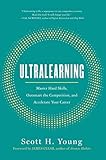
Editors Reads Verdict
Young's framework for intensive self-directed learning is one of the most practical books on accelerated skill acquisition. His nine principles are grounded in learning science and illustrated with vivid case studies.
What We Loved
- Nine concrete, science-backed principles that go beyond generic study advice
- Young's own MIT Challenge and language learning projects add credibility
- Excellent chapter on directness — the most underrated learning principle
- Covers both hard skills (programming, languages) and soft skills
Minor Drawbacks
- Ultralearning projects require significant time commitment — not for everyone
- Some principles overlap with existing deliberate practice literature
- The self-directed framing may underplay the value of good teachers
Key Takeaways
- → Metalearning: before starting, map the terrain of what you need to learn and why
- → Directness: practise the skill in the way you actually want to use it
- → Drill your weakest sub-skills rather than practising what you're already good at
- → Retrieval practice (testing yourself) beats re-reading by a wide margin
- → Feedback must be immediate and specific to accelerate skill acquisition
| Author | Scott Young |
|---|---|
| Publisher | HarperBusiness |
| Pages | 304 |
| Published | August 6, 2019 |
| Language | English |
| Genre | Self-Help, Productivity, Education |
| Difficulty | Intermediate |
| Best For | Career-changers, autodidacts, and ambitious learners who want to acquire hard skills faster than traditional education allows. |
How Ultralearning Compares
Ultralearning at a glance against 3 similar books readers weigh alongside it.
| Book | Author | Rating | Best for |
|---|---|---|---|
| Ultralearning (this book) | Scott Young | ★ 4.4 | Career-changers, autodidacts, and ambitious learners who want to acquire hard |
| Deep Work | Cal Newport | ★ 4.7 | Knowledge workers, writers, programmers, academics, and anyone whose job |
| Digital Minimalism | Cal Newport | ★ 4.5 | Anyone feeling controlled by their smartphone or social media and wanting a |
| Grit | Angela Duckworth | ★ 4.5 | Students, athletes, educators, parents, and anyone seeking to understand what |
Learning as a Competitive Advantage
Scott Young became internet-famous for completing MIT’s four-year computer science curriculum in twelve months, entirely through self-directed study. He followed that by learning four languages to conversational fluency in a year by immersing himself in countries where they’re spoken. Ultralearning is his attempt to codify the principles behind these experiments into a transferable methodology.
The premise is straightforward but underappreciated: in a world where skills determine careers and careers change rapidly, the ability to learn quickly and deeply is among the most valuable things you can develop. Ultralearning — intense, self-directed projects designed to master a skill as efficiently as possible — is one approach to developing that ability.
The Nine Principles
Young organises ultralearning around nine principles: Metalearning, Focus, Directness, Drill, Retrieval, Feedback, Retention, Intuition, and Experimentation. Two stand out as particularly original contributions.
Directness challenges the common approach of learning skills in the abstract before applying them. Young argues that the most effective learners practise the skill in the context where they want to use it, from the start. Want to learn to code? Build a project, not just exercises. Want to speak a language? Have conversations, not just grammar drills. The transfer from practice environment to real environment is always imperfect — so minimise that gap.
Drill addresses the tendency to practise what you’re already good at rather than what you’re weakest at. Deliberate drilling of specific sub-skills — the choke point in your performance — is uncomfortable and high-leverage.
Retrieval Over Re-Reading
Young’s chapter on retrieval practice — testing yourself on material rather than re-exposing yourself to it — is grounded in some of the most robust findings in learning science. Yet most people’s study habits are dominated by re-reading, highlighting, and passive review. The shift to active retrieval (flashcards, practice problems, self-testing without notes) can dramatically improve retention.
Who Should Read This
Ultralearning is not a book for casual learners. Its methods require significant time, discomfort, and self-discipline. But for career-changers, professionals navigating the skills economy, or anyone facing a significant learning challenge, it provides a framework far more specific and science-grounded than most study guides.
Metalearning: Drawing the Map First
The principle Young places at the head of his list, and the one that most distinguishes ultralearning from ordinary cramming, is metalearning — the practice of studying how a subject is learned before plunging into learning it. Before he attempted MIT’s computer science curriculum or a new language, Young invested time mapping the territory: identifying the concepts, facts, and procedures the skill comprises, finding how experts actually acquire it, and locating the best resources and the most efficient sequence. This front-loaded research, he argues, pays for itself many times over, because most failed learning projects fail not from lack of effort but from effort misdirected — hours poured into the wrong materials or the wrong order. Young recommends a rough rule of thumb for how much time to spend on this reconnaissance relative to the project’s length, and the deeper point is attitudinal: the ultralearner treats their own learning as a problem to be analyzed and optimized rather than a path to be trudged. Drawing the map first is unglamorous, but it is what turns raw determination into directed progress.
Feedback and the Discomfort of Being Wrong
Closely tied to Young’s emphasis on directness and drill is his insistence that aggressive, immediate feedback is indispensable, and that most learners instinctively avoid the very feedback that would help them most. Comfortable study — re-reading, nodding along to a lecture, practicing what one already does well — generates little useful information about where one is actually failing. Young argues for deliberately seeking out the harsh, specific, sometimes ego-bruising feedback that reveals errors in real time: the conversation in which a native speaker corrects you, the test that exposes exactly which concepts haven’t stuck, the critique that stings. He distinguishes between types of feedback — outcome, informational, and corrective — and warns against both the learner who avoids feedback to protect their self-image and the one who fixates on praise that carries no instructional content. The willingness to invite information about one’s own inadequacy, and to act on it immediately, is in his account a defining trait of the fast learner, and the reason so many people plateau is simply that they stop seeking it.
The Limits and Honest Caveats
For all its motivational force, Ultralearning is strengthened rather than weakened by the caveats a careful reader should keep in mind, and Young is more candid about them than the genre usually allows. His own headline projects — a CS curriculum in a year, four languages in a year — were undertaken by a person with unusual freedom, no competing obligations, and a temperament suited to monastic intensity, and the methods do not transpose cleanly onto a life crowded with a demanding job and family. The approach also suits skills that can be clearly defined, broken into components, and practiced directly; it offers less to domains where mastery is diffuse, tacit, or dependent on slow experience that cannot be compressed. And the sheer discomfort the method demands — sustained, deliberate engagement with one’s weaknesses — is precisely what most people find hardest to sustain. Young does not pretend his program is for everyone, and the honesty is welcome. Read with these limits in mind, the book is a toolkit to be adapted rather than a regimen to be copied.
Why It Stands Out in a Crowded Genre
The shelf of books promising faster, better learning is long and mostly forgettable, and what lifts Ultralearning above it is the combination of lived demonstration and grounding in genuine cognitive science. Young is not theorizing from an armchair; he has run the experiments on himself, documented them publicly, and built his principles from what actually worked, which lends the prescriptions a credibility that purely academic treatments lack. At the same time he leans on robust research — particularly the well-established superiority of retrieval practice and spaced repetition over passive review — rather than the pop-psychology folklore that fills lesser study guides. The result is a book that is simultaneously inspiring and specific, offering both the motivational example of what aggressive self-directed learning can achieve and a concrete, sequenced methodology for attempting it. For the right reader — disciplined, time-rich, facing a defined skill to conquer — it is among the most useful books on learning available, and even for those who cannot follow it to the letter, its principles reshape how one thinks about acquiring any new competence.
Final Verdict
A rigorous, well-researched, and genuinely motivating guide to self-directed learning. Young practices what he preaches, which gives the whole book a credibility most learning books lack.
Our rating: 4.4/5 — Essential reading for anyone serious about skill acquisition and self-directed mastery.
Frequently Asked Questions
What is "Ultralearning" about?
A strategy for aggressive, self-directed learning that can help you master hard skills quickly and advance your career in the process.
Who should read "Ultralearning"?
Career-changers, autodidacts, and ambitious learners who want to acquire hard skills faster than traditional education allows.
What are the key takeaways from "Ultralearning"?
Metalearning: before starting, map the terrain of what you need to learn and why Directness: practise the skill in the way you actually want to use it Drill your weakest sub-skills rather than practising what you're already good at Retrieval practice (testing yourself) beats re-reading by a wide margin Feedback must be immediate and specific to accelerate skill acquisition
Is "Ultralearning" worth reading?
Young's framework for intensive self-directed learning is one of the most practical books on accelerated skill acquisition. His nine principles are grounded in learning science and illustrated with vivid case studies.
Ready to Read Ultralearning?
Check the current price on Amazon.
Check Price on Amazon (paid link)Prices and availability are subject to change. See Amazon for current price.
Review last updated: