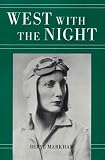
Beryl Markham was a British-Kenyan aviator and author whose West with the Night — a memoir of her life in colonial Kenya and her solo transatlantic flight — Ernest Hemingway praised as the best book written by a woman.
Beryl Markham grew up in colonial Kenya, trained racehorses, learned to fly, and in 1936 became the first person to complete a solo transatlantic flight from east to west — the harder direction, against prevailing winds, from England to Nova Scotia. West with the Night (1942) is her account of that life: the childhood on a farm in British East Africa, the horse training, the years as a bush pilot carrying mail, passengers, and supplies to remote African outposts, and the transatlantic crossing that made her briefly famous.
Ernest Hemingway read the book and wrote to a friend: “She has written so well, and marvellously well, that I was completely ashamed of myself as a writer.” The prose is of unusual quality — precise, rhythmic, and alert to the physical world in ways that suggest a writer who learned to observe before she learned to write. Whether Markham wrote it herself or had substantial help from her then-husband Raoul Schumacher has been debated; the consensus is that whatever collaboration occurred, the voice and experiences are authentically hers.
The book was published in 1942, went largely unnoticed, and was rediscovered in 1983 when a new edition became a surprise bestseller. Markham’s life story — she was raised by an African father figure more than her own father, lived as a horse trainer and aviator in colonial Kenya, had three marriages and numerous affairs — is as extraordinary as her prose, and the book holds both together with remarkable compression.
A Life Ahead of Its Time
Markham lived a life of extraordinary boldness and independence at a time when women, particularly in her colonial milieu, were expected to occupy far more circumscribed roles. Raised largely without a mother on a farm in British East Africa, she grew up running with local Nandi and Kipsigis children, learning to hunt and to speak African languages, an upbringing of unusual freedom that shaped her fearless, unconventional character. She became the first woman in Kenya to earn a professional horse-trainer’s licence, achieving considerable success in a male-dominated world before turning to aviation, where she worked as a bush pilot ferrying mail, supplies, and passengers, and scouting game from the air, across the vast and often dangerous African landscape. Her record-setting solo flight across the Atlantic from east to west in 1936 — the harder direction, against the prevailing winds — cemented her reputation as one of the daring aviation pioneers of the era. Markham flouted the conventions of her time not only in her professions but in her personal life, conducting numerous affairs and marriages with a disregard for propriety that scandalised some and fascinated others. Her existence reads like an adventure novel, and it is precisely this fearless, boundary-breaking life that gives her single book its remarkable substance.
The Mystery of West with the Night
Few literary memoirs carry as much intrigue around their authorship as West with the Night, and the question has shadowed the book since its rediscovery. The prose is so polished, so rhythmically assured and finely observed, that some have doubted whether Markham, who was not known primarily as a writer, could have produced it unaided, and suspicion has long centred on her third husband, the ghostwriter Raoul Schumacher, who may have contributed substantially to the text. The debate has never been conclusively resolved. What the consensus holds, however, is that whatever editorial or collaborative assistance Markham received, the voice, the experiences, and the sensibility of the book are authentically her own — no one else lived the life it describes or possessed the intimate knowledge of Africa, horses, and flight that animates every page. The controversy, rather than diminishing the work, has become part of its mystique, a fitting enigma for a woman whose whole life resisted easy categorisation. Ultimately the question of attribution matters less than the result: a memoir of rare beauty that captures a vanished world and an exceptional life with a power that has secured its place as a classic of the genre.
Rediscovery and Lasting Legacy
The story of West with the Night is, fittingly, a tale of near-loss and triumphant recovery. Published in 1942 amid the distractions of the Second World War, the book sold poorly and slipped into obscurity, and Markham herself fell into relative poverty and was largely forgotten in her later years. The book’s resurrection came decades later, after a restaurateur and editor encountered Ernest Hemingway’s famous letter praising it as the work of a writer who made him “ashamed” of his own craft, and arranged for a new edition in the early 1980s. That reissue became an unexpected bestseller and restored both the book and its author to wide acclaim, bringing Markham renewed recognition in the final years of her life before her death in 1986. Today West with the Night is regarded as a classic of memoir, travel writing, and aviation literature, celebrated for its luminous prose and its evocation of a colonial Africa that has since disappeared. Markham endures as a symbol of female courage and independence, and her book stands as a singular literary achievement — proof that a life lived with sufficient daring and observed with sufficient artistry can yield a work of lasting beauty.
Where to Start with Markham
Markham’s literary reputation rests almost entirely on a single book, which makes the recommendation straightforward: read West with the Night, her luminous memoir of life in colonial Kenya, horse training, bush flying, and her record-setting solo transatlantic flight. It can be read purely for the beauty of its prose and the drama of its events, and it stands among the finest works of memoir, travel, and aviation writing of the twentieth century. Readers captivated by her life may wish to supplement the memoir with biographies that fill in the parts of her story the book leaves out, including her tangled personal life and the debated question of the book’s authorship, as well as her appearances as a character in accounts of the colonial Kenya circle that included Karen Blixen. A posthumous collection of her short stories, The Splendid Outcast, gathers her shorter fiction for those who want more of her writing. But the essential Markham is West with the Night — begin there, and let its remarkable prose and even more remarkable life speak for themselves.
Reading Guides