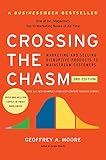
Crossing the Chasm
by Geoffrey A. Moore
4.2
The definitive guide to the critical gap in technology adoption — the chasm between early adopters and the mainstream market — and how to cross it.
Check Price on Amazon (paid link)American · b. 1946
Geoffrey A. Moore is an American business author and consultant whose Crossing the Chasm became essential reading for technology companies navigating early-market growth.
Geoffrey A. Moore published Crossing the Chasm in 1991, and while the specific technology examples in the original edition have aged, the framework it describes has remained one of the most practically useful models in technology marketing. Moore’s core insight is that the innovation adoption curve contains a critical discontinuity — a “chasm” — between the early adopters who embrace new technology enthusiastically and the pragmatic early majority who need proven solutions before committing. Most tech companies fail not from poor technology but from an inability to bridge that gap.
Moore’s prescription is specific and counter-intuitive: rather than expanding broadly after early adoption, companies should narrow their focus dramatically, targeting a single beachhead segment where they can dominate completely before using that foothold to expand. The military metaphor of the D-Day invasion — concentrated force at a specific point, then a breakout — is one of the book’s most memorable and useful illustrations. The framework has been applied across decades of technology cycles and continues to generate recognition in practitioners across the industry.
Crossing the Chasm is primarily a strategic and marketing text, and it asks relatively little of its readers in terms of prose enjoyment — it is functional rather than literary. Some practitioners argue that the framework requires modification for modern platform or SaaS businesses, and Moore has acknowledged that the chasm behaves differently in different market structures. But as a diagnostic for why promising technology companies stall, it remains as relevant as it was at publication.
Moore’s lasting significance rests on a single, powerful reframing that has shaped how the technology industry understands growth. Building on the established model of technology adoption — the bell curve running from innovators and early adopters through the early and late majority to laggards — Moore identified what others had missed: that the transition between these groups is not smooth but punctuated by a critical, often fatal gap. The “chasm” he named lies between the visionary early adopters, who embrace new technology for its transformative potential and tolerate its rough edges, and the pragmatic early majority, who will only adopt proven, complete solutions with established track records and reference customers. Because these two groups have fundamentally different psychologies and buying criteria, the strategies that win the early market actively fail in the mainstream one, and many promising companies, flush with early enthusiasm, stall and collapse precisely when they appear poised for breakout success. This diagnosis explained a pattern that had repeatedly baffled founders and investors, and it gave the industry a vocabulary — “crossing the chasm” — that has become so thoroughly embedded in technology strategy that it is now used almost unconsciously. The clarity and explanatory power of this single insight account for the book’s enduring authority.
Beyond diagnosing the problem, Moore’s most valuable and counterintuitive contribution is his prescription for crossing the chasm, which runs directly against the expansionist instincts of most ambitious technology companies. Rather than broadening their appeal to capture as much of the emerging mainstream market as possible, Moore argues that companies must do the opposite: narrow their focus dramatically to dominate a single, carefully chosen niche segment, a “beachhead” where they can become the undisputed market leader and assemble a complete solution and a base of reference customers. He invokes the military metaphor of the D-Day invasion, concentrating overwhelming force at one specific point to establish a foothold before breaking out to capture adjacent segments. The logic is that pragmatist buyers trust peers in their own industry far more than enthusiasts elsewhere, so total dominance of one niche creates the references and credibility needed to win the next, and the next. This disciplined focus is psychologically difficult for companies eager to grow fast and pursue every opportunity, which is precisely why so many fail to execute it. The beachhead strategy remains one of the most practically actionable frameworks in technology marketing, and it is the engine of the book’s lasting utility.
While Crossing the Chasm dominates his reputation, Moore has built a substantial career as a consultant, advisor, and author whose body of work maps the entire technology life cycle. He extended his foundational framework in subsequent books, including Inside the Tornado, which addresses the hypergrowth phase that follows a successful chasm crossing, and Dealing with Darwin, which examines how established companies must continually innovate to avoid decline. Across this work he developed a comprehensive vocabulary and set of models for understanding how technology markets evolve, how products and companies move through distinct stages, and how firms must adapt their strategies as they progress from startup to maturity. As a sought-after consultant and venture-capital advisor, he has applied these frameworks across decades of technology cycles, working with countless companies navigating the very transitions his books describe, and his ideas have informed generations of founders, executives, and investors in Silicon Valley and beyond. This continued engagement with the practical realities of technology strategy has kept his thinking current and lent his frameworks the authority of repeated real-world application. Moore stands as one of the most influential business strategists in the technology sector, a thinker whose models have become essential mental furniture for the industry.
The essential starting point is unquestionably Crossing the Chasm, the book that made his name and remains required reading for anyone bringing a new technology product to market; it best captures his defining insight about the gap between early adopters and the mainstream and his prescription for bridging it. Readers should approach it as a practical strategic handbook rather than a literary work, and should ideally seek out a more recent edition, as Moore has updated the examples over time to reflect contemporary technology markets. Those who absorb its lessons and want to understand the later stages of technology growth can continue with Inside the Tornado, which addresses the hypergrowth phase, and Dealing with Darwin, which focuses on innovation in established companies. Founders and marketers will find the beachhead strategy and the technology adoption life cycle immediately applicable to their own businesses. For anyone seeking to understand why promising technology companies stall on the verge of mainstream success, and what to do about it, Crossing the Chasm is the indispensable place to begin and the foundation on which the rest of his work builds.
by Geoffrey A. Moore
The definitive guide to the critical gap in technology adoption — the chasm between early adopters and the mainstream market — and how to cross it.
Check Price on Amazon (paid link)Disclosure: Amazon links on this page are affiliate links. If you purchase through them we earn a small commission at no extra cost to you.