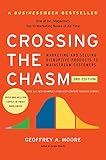
Editors Reads Verdict
Moore's technology adoption lifecycle framework remains the standard reference for understanding why promising technology products fail to reach mainstream markets. Essential for anyone in B2B technology.
What We Loved
- The chasm model explains an otherwise mysterious pattern in technology adoption
- Beachhead strategy is specific and actionable for B2B technology companies
- Revised editions have updated the examples while preserving the core model
- Highly influential in venture capital and technology marketing
Minor Drawbacks
- Primarily relevant to B2B technology products — less applicable elsewhere
- Some examples feel dated despite revisions
- The framework is better as a diagnostic than a precise prescription
Key Takeaways
- → The chasm separates early adopters (technology enthusiasts and visionaries) from the early majority (pragmatists)
- → Mainstream customers need references from other mainstream customers — creating a catch-22
- → The beachhead strategy: dominate one narrow segment completely before expanding
- → Positioning must shift dramatically when crossing from early adopters to pragmatists
- → Whole product concept: pragmatists need the complete solution, not just the core technology
| Author | Geoffrey A. Moore |
|---|---|
| Publisher | HarperBusiness |
| Pages | 288 |
| Published | January 1, 1991 |
| Language | English |
| Genre | Business, Marketing, Technology |
| Difficulty | Intermediate |
| Best For | Technology product managers, startup founders, and B2B marketers navigating the gap between early-adopter success and mainstream market penetration. |
How Crossing the Chasm Compares
Crossing the Chasm at a glance against 3 similar books readers weigh alongside it.
| Book | Author | Rating | Best for |
|---|---|---|---|
| Crossing the Chasm (this book) | Geoffrey A. Moore | ★ 4.2 | Technology product managers, startup founders, and B2B marketers navigating the |
| The Innovator's Dilemma | Clayton M. Christensen | ★ 4.3 | Business strategists, technology investors, executives, and founders who want |
| The Lean Startup | Eric Ries | ★ 4.4 | Startup founders, product managers, corporate innovators, and anyone launching |
| Zero to One | Peter Thiel | ★ 4.5 | Startup founders, aspiring entrepreneurs, venture investors, and anyone |
The Gap That Kills Technology Companies
Why do so many technology products that receive rave reviews from early adopters fail to reach mainstream markets? Why does impressive technical performance and enthusiastic early customers so often not translate into large-scale commercial success?
Geoffrey Moore, drawing on his extensive experience advising technology companies, identified the answer in the structure of technology adoption itself. His 1991 book, Crossing the Chasm, named the gap that explains these failures and provided the strategic framework for closing it.
The Technology Adoption Lifecycle
Moore extends the standard innovation diffusion curve — innovators, early adopters, early majority, late majority, laggards — to identify a critical discontinuity. The chasm lies between early adopters (visionaries who buy unproven technology for its transformative potential) and the early majority (pragmatists who buy proven technology to solve specific business problems).
These two groups have fundamentally different buying criteria. Visionaries want revolutionary change and accept risk and incompleteness. Pragmatists want evolutionary improvement, proven results, and the security of a large installed base. The gap between them is not just a matter of degree — it requires a completely different positioning, product, and sales approach.
The Beachhead Strategy
Moore’s prescription for crossing the chasm involves deliberate focus rather than broad market pursuit. The approach: identify a specific, bounded segment where your product can be the clear market leader, dominate that segment completely, and use it as a base for expansion. The bowling pin analogy — knock down the lead pin and the others follow — captures the logic.
This is counterintuitive for growth-hungry startups. But Moore argues that trying to cross the chasm by pursuing multiple segments simultaneously is like trying to cross a canyon with a series of small jumps: it cannot be done.
The Whole Product
The most subtle insight in the book is the whole product concept: mainstream buyers don’t just need your core technology — they need the complete solution to their problem, including complementary products, services, support, and references from similar buyers. Building or partnering to deliver the whole product is as important as the core technology itself.
Why Pragmatists Buy Differently
The psychological core of Moore’s framework, and the reason the chasm exists at all, is his insight that early-majority pragmatists and early-adopter visionaries are not merely positioned at different points on a smooth curve but inhabit genuinely incompatible mindsets. The visionary buys to get ahead, to seize a transformative advantage no competitor yet has, and is therefore willing to tolerate an unfinished product, to act as a partner in development, and to accept substantial risk in exchange for the possibility of a breakthrough. The pragmatist buys to keep up, to solve a concrete problem with minimal disruption, and is therefore deeply risk-averse, demanding proven results, established standards, and above all the reassurance of references from other pragmatists who have already succeeded with the product. This last requirement creates the cruelest feature of the chasm: pragmatists want to buy only what other pragmatists have already bought, a circular condition that strands a company with enthusiastic visionary endorsements that mean nothing to the very market it must win next. Moore’s enduring contribution is to show that crossing the chasm is fundamentally an exercise in earning the trust of people who are constitutionally suspicious of anything new.
Positioning and the Competitive Frame
A less-celebrated but practically vital portion of Crossing the Chasm concerns positioning, and here Moore offers counsel that runs against the instincts of technology founders proud of their product’s novelty. Pragmatist buyers, he argues, evaluate purchases by reference to established categories and existing alternatives; a product that claims to be entirely unprecedented gives them nothing to compare it against and therefore no comfortable basis for a decision. Moore’s prescription is to position the product within a market the buyer already understands, defining clearly what it competes with and why it is the superior choice for the targeted segment’s specific need. This involves naming a market category, identifying the competition the pragmatist will measure you against, and articulating a compelling reason to switch — work that engineering-driven companies often neglect because it feels like marketing rather than substance. The discipline of claiming a defensible position in the customer’s existing mental map, rather than asserting uniqueness that leaves the buyer disoriented, is one of the book’s most actionable and frequently ignored lessons.
A Framework That Outlived Its Examples
More than three decades after publication, Crossing the Chasm endures as canonical reading in venture capital and product strategy, and the reasons illuminate both its strengths and its limits. The original examples are now thoroughly dated — the technologies Moore cites belong to a bygone era of enterprise hardware and packaged software — yet the underlying structure has proven remarkably portable, applying as cleanly to modern software-as-a-service and platform businesses as to the products Moore originally studied. This durability comes from the fact that the framework describes human buying psychology rather than any particular technology, and human psychology has not changed. The book’s weaknesses are real: it is repetitive, the prose is dry and consultant-inflected, and critics note that not every product faces a chasm or benefits from the rigid beachhead discipline Moore prescribes. But for anyone bringing a genuinely new technology to a mainstream market, the central diagnosis and its strategic remedy remain indispensable vocabulary, which is why the book continues to be pressed into the hands of founders generation after generation.
Final Verdict
Crossing the Chasm remains the indispensable reference for understanding B2B technology marketing. Its framework has informed countless successful technology market strategies and is essential vocabulary in venture capital and product management.
Our rating: 4.2/5 — Dense but important. If you’re in B2B technology, the chasm framework is required knowledge.
Reading Guides
Frequently Asked Questions
What is "Crossing the Chasm" about?
The definitive guide to the critical gap in technology adoption — the chasm between early adopters and the mainstream market — and how to cross it.
Who should read "Crossing the Chasm"?
Technology product managers, startup founders, and B2B marketers navigating the gap between early-adopter success and mainstream market penetration.
What are the key takeaways from "Crossing the Chasm"?
The chasm separates early adopters (technology enthusiasts and visionaries) from the early majority (pragmatists) Mainstream customers need references from other mainstream customers — creating a catch-22 The beachhead strategy: dominate one narrow segment completely before expanding Positioning must shift dramatically when crossing from early adopters to pragmatists Whole product concept: pragmatists need the complete solution, not just the core technology
Is "Crossing the Chasm" worth reading?
Moore's technology adoption lifecycle framework remains the standard reference for understanding why promising technology products fail to reach mainstream markets. Essential for anyone in B2B technology.
Ready to Read Crossing the Chasm?
Check the current price on Amazon.
Check Price on Amazon (paid link)Prices and availability are subject to change. See Amazon for current price.
Review last updated: