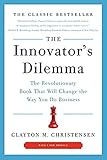
Editors Reads Verdict
Christensen's theory of disruptive innovation is one of the most influential ideas in business strategy of the past 30 years. Essential for understanding why good management decisions can doom a company.
What We Loved
- The disruptive innovation framework explained clearly with historical evidence
- Explains failures of great companies in ways that feel genuinely surprising
- The disk drive industry case study is one of the most rigorous in business literature
- Changed how strategists, investors, and founders think about competition
Minor Drawbacks
- The writing is dense and academic in places
- The disruptive innovation concept has been over-applied and occasionally misused since publication
- Prescriptions for incumbent firms are harder to execute than the theory suggests
Key Takeaways
- → Disruptive innovations initially underperform on mainstream metrics but overperform on emerging ones
- → Listening to your best customers can accelerate your disruption by newcomers
- → Sustaining innovations improve existing products; disruptive innovations reframe the market
- → Incumbents fail not from incompetence but from rational decisions made with wrong information
- → To respond to disruption, incumbents must create separate, autonomous units
| Author | Clayton M. Christensen |
|---|---|
| Publisher | Harvard Business Review Press |
| Pages | 288 |
| Published | January 1, 1997 |
| Language | English |
| Genre | Business, Management, Innovation |
| Difficulty | Advanced |
| Best For | Business strategists, technology investors, executives, and founders who want to understand how markets evolve and why leaders fall. |
How The Innovator's Dilemma Compares
The Innovator's Dilemma at a glance against 3 similar books readers weigh alongside it.
| Book | Author | Rating | Best for |
|---|---|---|---|
| The Innovator's Dilemma (this book) | Clayton M. Christensen | ★ 4.3 | Business strategists, technology investors, executives, and founders who want |
| Good to Great | Jim Collins | ★ 4.5 | Business leaders, managers, aspiring executives, and anyone interested in the |
| The Lean Startup | Eric Ries | ★ 4.4 | Startup founders, product managers, corporate innovators, and anyone launching |
| Zero to One | Peter Thiel | ★ 4.5 | Startup founders, aspiring entrepreneurs, venture investors, and anyone |
Clayton Christensen’s The Innovator’s Dilemma introduced the concept of disruptive innovation to the business world in 1997 and has not stopped influencing strategic thinking since. The central paradox the book investigates is both counterintuitive and well-evidenced: why do well-managed companies, doing everything correctly by the standards of good management, consistently lose their market leadership to new entrants? The answer Christensen provides is not incompetence or complacency — it is that the very practices that make companies great in established markets make them systematically vulnerable to attack from below.
The framework distinguishes two types of innovation. Sustaining innovations improve existing products along dimensions that mainstream customers value — better, faster, more reliable. Incumbents are naturally good at sustaining innovation; it is what their best customers demand and what their processes are optimised to deliver. Disruptive innovations initially perform worse by conventional metrics but introduce new value dimensions — usually simplicity, convenience, or dramatically lower cost — that appeal to overlooked or entirely new customers. They enter at the bottom of a market and improve steadily until they have displaced the incumbent. The dilemma for incumbents is that disruptive threats look unattractive by design: thin margins, wrong customer segments, inferior technology. Every rational management process steers away from them, straight toward eventual obsolescence.
The book’s most rigorous evidence comes from the hard disk drive industry, where Christensen tracked more than twenty-five years of data across multiple disruptive cycles. In each cycle, the incumbent leaders — who produced the best current-generation products and listened most carefully to their best customers — were displaced by new entrants who led the next wave. The pattern is so consistent across industries (steel minimills, mechanical excavators, computer hardware) that it reads less like a hypothesis and more like a documented law. Christensen’s prescriptions for incumbents — creating autonomous business units that can pursue disruptive opportunities without being filtered through the parent company’s resource allocation system — are sensible but harder to execute than the theory suggests, which explains why so few companies have successfully applied them.
The Innovator’s Dilemma is dense in places and its academic tone demands patience. The disruptive innovation concept has also been over-applied in the decades since publication, used to describe almost any competitive change, which has diluted the original precision. But read in its proper context — as a carefully argued, evidence-based theory of why successful companies fail — it remains one of the most important strategic frameworks in the business canon. Its core insight, that rational, well-managed organisations can be destroyed by the rational, well-managed decisions of their leaders, is as relevant to today’s technology markets as it was to the disk drive industry in 1997.
Why Great Companies Fail
Clayton Christensen’s The Innovator’s Dilemma is one of the most influential business books of the past several decades, and its central paradox is what made it famous: well-managed, successful companies can fail precisely because they do everything conventional wisdom says they should. Listening closely to their best customers, investing in their most profitable products, and pursuing higher margins, established firms repeatedly miss the “disruptive” technologies that begin in the unglamorous low end of the market and eventually overturn entire industries. Christensen built this argument on detailed case studies, most famously the disk-drive industry, and the result reshaped how a generation of executives thought about competition.
The Theory of Disruption
The book’s lasting contribution is its distinction between sustaining and disruptive innovation. Sustaining innovations improve existing products for existing customers; disruptive ones are initially worse by traditional measures, cheaper and simpler, dismissed by incumbents, yet they improve over time until they displace the established players. Christensen’s insight was that the very competencies and incentives that make a company successful in its core market make it structurally unable to respond to disruption, a dilemma that cannot be solved by simply working harder or managing better.
A Vocabulary That Conquered Business
Few business books have so thoroughly entered the language of their field. “Disruption” became one of the defining concepts of the technology era, invoked endlessly in boardrooms and pitch decks, and Christensen’s framework genuinely illuminated why so many dominant firms were toppled by upstarts they had ignored. For readers seeking to understand the dynamics of technological change and corporate decline, the book offers a powerful and clarifying lens.
Read With a Critical Eye
The book’s very influence has invited serious scrutiny, and readers should approach it critically. Historians and scholars, most notably Jill Lepore, have argued that Christensen’s case studies were selectively chosen and that the theory’s predictive power is weaker than its popularity suggests, with some “disrupted” companies surviving and some predictions failing to pan out. “Disruption” has also been stretched to justify almost anything. The smart approach is to treat the book as a provocative and useful framework rather than an iron law, valuable for the questions it raises more than for any guarantee of foresight.
Why It Still Matters
Despite the critiques, The Innovator’s Dilemma remains essential reading for anyone interested in business strategy, technology, and the life cycles of companies. Its core observation — that success can breed a dangerous blindness, and that the threats which destroy great firms often look trivial at first — is genuinely valuable and continues to shape how leaders think about change. Read alongside its critics, it is a stimulating and important book, a starting point for thinking clearly about innovation rather than the final word on it.
Reading Guides
Frequently Asked Questions
What is "The Innovator's Dilemma" about?
Why great companies can do everything right and still lose market leadership — and how new entrants use disruptive innovation to topple industry leaders.
Who should read "The Innovator's Dilemma"?
Business strategists, technology investors, executives, and founders who want to understand how markets evolve and why leaders fall.
What are the key takeaways from "The Innovator's Dilemma"?
Disruptive innovations initially underperform on mainstream metrics but overperform on emerging ones Listening to your best customers can accelerate your disruption by newcomers Sustaining innovations improve existing products; disruptive innovations reframe the market Incumbents fail not from incompetence but from rational decisions made with wrong information To respond to disruption, incumbents must create separate, autonomous units
Is "The Innovator's Dilemma" worth reading?
Christensen's theory of disruptive innovation is one of the most influential ideas in business strategy of the past 30 years. Essential for understanding why good management decisions can doom a company.
Ready to Read The Innovator's Dilemma?
Check the current price on Amazon.
Check Price on Amazon (paid link)Prices and availability are subject to change. See Amazon for current price.
Review last updated: