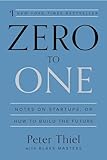
Editors Reads Verdict
One of the most intellectually stimulating business books of the decade. Thiel's contrarian questions force you to think more clearly about competition, monopoly, and what genuinely valuable companies look like. Essential for founders, investors, and anyone building something new.
What We Loved
- Every chapter contains at least one idea that rewires how you think about business
- Short (224 pages) — dense with insight, no filler
- The 'What important truth do few people agree with you on?' question alone is worth the price
- Contrarian framework is a useful counterbalance to mainstream startup advice
Minor Drawbacks
- Some arguments are deliberately provocative and need critical evaluation
- Silicon Valley-centric perspective — not always applicable to other contexts
- Philosophical sections can feel tangential
Key Takeaways
- → Competition is for losers — the goal is to build a monopoly in a new market
- → Going from 0 to 1 (creating something new) is harder and more valuable than 1 to n (copying)
- → Every great business is built on a secret — something important that most people don't see
- → The best companies begin with a small monopoly, then expand
- → Founders must be able to answer: 'What important truth do few people agree with you on?'
| Author | Peter Thiel |
|---|---|
| Publisher | Crown Business |
| Pages | 224 |
| Published | January 1, 2014 |
| Language | English |
| Genre | Business, Startups, Technology |
| Difficulty | Intermediate |
| Best For | Startup founders, aspiring entrepreneurs, venture investors, and anyone building something in technology or business who wants to think more originally. |
How Zero to One Compares
Zero to One at a glance against 3 similar books readers weigh alongside it.
| Book | Author | Rating | Best for |
|---|---|---|---|
| Zero to One (this book) | Peter Thiel | ★ 4.5 | Startup founders, aspiring entrepreneurs, venture investors, and anyone |
| Shoe Dog | Phil Knight | ★ 4.8 | Entrepreneurs, business students, sports fans, and anyone who wants to |
| The Hard Thing About Hard Things | Ben Horowitz | ★ 4.5 | Startup founders, CEOs, and senior managers navigating the unglamorous |
| The Lean Startup | Eric Ries | ★ 4.4 | Startup founders, product managers, corporate innovators, and anyone launching |
Peter Thiel opened his Stanford class on startups with a single question: what important truth do few people agree with you on? Most people struggle to answer it. They give safe, conventional responses. Thiel argues that the inability to think genuinely differently is exactly why most companies fail to create lasting value. Zero to One — assembled by Blake Masters from his notes on that Stanford class — is not a startup how-to guide but a philosophy of progress, built around the central distinction between horizontal progress (copying what works, going from 1 to n) and vertical progress (creating something genuinely new, going from 0 to 1). The companies that transform the world operate vertically; most businesses merely optimise what already exists.
The book’s most provocative argument is that competition is for losers. Conventional MBA wisdom glorifies competitive markets, but Thiel inverts this: perfect competition drives margins to zero, while genuine monopolies — companies so much better at something that competition becomes irrelevant — earn the kind of margins that allow them to invest, to plan, and to do great work. Google has operated as a near-monopoly for twenty years and earns extraordinary returns; airlines move billions of people and collectively scrape by on thin margins. The lesson is not to pursue anti-competitive behaviour but to start with a very small market you can dominate completely and then expand. Amazon began with books; Facebook began with Harvard; Thiel’s own PayPal began with eBay power sellers.
Perhaps the most generative idea in the book is the concept of the secret: every great business is built on a belief about the world that most people do not yet hold. PayPal’s secret was that people would trust a new form of digital money. Airbnb’s secret was that people would stay in strangers’ homes. These ideas looked crazy until they looked inevitable. Thiel challenges every reader to identify the secret their company is built on — because if there is no secret, if the company is simply copying an existing model in an already-crowded market, there is no genuine business, only a well-executed imitation. The seven questions framework at the book’s close — covering engineering superiority, timing, monopoly position, team quality, distribution, durability, and the secret itself — is the most compact company-evaluation tool in the startup canon.
Zero to One is short, deliberately provocative, and occasionally more interested in intellectual consistency than in practical nuance. Some of Thiel’s arguments require pushback; the Silicon Valley perspective is inescapable; the philosophical asides on Rene Girard and technological stagnation are not to everyone’s taste. But the core ideas — on competition, monopoly, secrets, and what separates companies that change the world from those that simply participate in it — are among the most clarifying in business literature. For founders, investors, and anyone building something genuinely new, it is essential reading.
Why Thiel Distrusts Competition
The book’s most provocative argument is its attack on competition itself. Most business advice assumes you win by competing better; Thiel argues the opposite — that competition is for losers, and that the genuinely valuable companies are monopolies that escape it by building something so new that no one else offers it. Going from one to many, copying what works, is what he calls horizontal progress; going from zero to one, creating something that did not exist, is the rarer vertical kind, and it is the only kind that creates lasting value. Whether or not one accepts the celebration of monopoly, the reframing is bracing and forces the reader to ask whether their idea is genuinely new or merely a variation on a crowded theme.
A Book of Contrarian Questions
More than a how-to, Zero to One is a set of provocations built around Thiel’s favourite interview question: what important truth do very few people agree with you on? The book rewards the entrepreneur not with a process but with a way of thinking — about secrets still left to discover, about the power of a bold long-term plan over iterative tinkering, about why the best companies look like cults of shared mission. It is short, aphoristic, and quotable, and its ideas have shaped a generation of founders.
How to Read It Critically
It should be read as one influential, opinionated perspective rather than received wisdom, and the reader does well to keep a sceptic’s distance. Thiel is a polarising figure whose celebration of monopoly and disdain for competition sit uneasily with other values, and survivorship bias haunts any book that reasons backward from a handful of spectacular successes. Taken as a provocation to think harder about what makes a venture genuinely new — and weighed against the messier reality most businesses inhabit — it remains one of the sharpest and most stimulating books written about startups and innovation.
A Founder’s Book of Mental Models
Stripped of its contrarian provocations, what lingers is a toolkit for thinking about new ventures: the insistence on a bold, specific vision over vague optimism; the idea that the most valuable businesses solve a problem no one else has even framed; the warning that imitation is a trap. These are mental models more than instructions, and their value is that they sharpen the questions a founder asks before committing years to an idea. Read in a couple of sittings and argued with rather than swallowed whole, Zero to One earns its place among the handful of startup books that genuinely change how readers think — even, and perhaps especially, where they end up disagreeing with its author.
Reading Guides
- Lean Startup vs Zero to One
- Books Like Zero to One
- 15 Best Books for Entrepreneurs (Ranked by Founders)
- Best Books as Gifts — The Complete Gift Guide for Every Reader
- Best Business Books of All Time: 23 That Every Leader Should Read (2026)
- Mark Zuckerberg Reading List: The Books Behind Meta
- Elon Musk
- Tim Ferriss Book Recommendations: The Essential Reading List
Frequently Asked Questions
What is "Zero to One" about?
Peter Thiel — PayPal co-founder, first outside Facebook investor — argues that true progress comes from creating something genuinely new (0 to 1), not copying what already works (1 to n). A contrarian framework for building companies that matter.
Who should read "Zero to One"?
Startup founders, aspiring entrepreneurs, venture investors, and anyone building something in technology or business who wants to think more originally.
What are the key takeaways from "Zero to One"?
Competition is for losers — the goal is to build a monopoly in a new market Going from 0 to 1 (creating something new) is harder and more valuable than 1 to n (copying) Every great business is built on a secret — something important that most people don't see The best companies begin with a small monopoly, then expand Founders must be able to answer: 'What important truth do few people agree with you on?'
Is "Zero to One" worth reading?
One of the most intellectually stimulating business books of the decade. Thiel's contrarian questions force you to think more clearly about competition, monopoly, and what genuinely valuable companies look like. Essential for founders, investors, and anyone building something new.
Ready to Read Zero to One?
Check the current price on Amazon.
Check Price on Amazon (paid link)Prices and availability are subject to change. See Amazon for current price.
Review last updated: