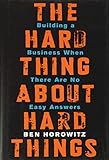
Editors Reads Verdict
The most honest book about startup leadership ever written. Horowitz doesn't pretend there are formulas — he shares what it actually feels like to lead through crises, and gives specific, hard-won tactical guidance.
What We Loved
- Brutally honest about the psychological toll of leadership
- Specific, tactical advice rather than abstract principles
- The distinction between Peacetime CEO and Wartime CEO is one of the most useful in management
- Hip-hop quotes as chapter epigraphs are surprisingly apt
Minor Drawbacks
- Primarily relevant to startup founders and tech executives
- Some advice is context-specific to hypergrowth environments
- The memoir sections occasionally interrupt the advice flow
Key Takeaways
- → There are no formulas for the hardest problems — only judgment built from experience
- → Wartime CEOs must break normal management rules to survive existential threats
- → Lay off people you need to lay off — delaying makes everything worse
- → Train your people; underdeveloped employees are your worst retention risk
- → Focus on what you can do, not what you can't — the Struggle is real but survivable
| Author | Ben Horowitz |
|---|---|
| Publisher | HarperBusiness |
| Pages | 304 |
| Published | January 1, 2014 |
| Language | English |
| Genre | Business, Entrepreneurship, Leadership |
| Difficulty | Intermediate |
| Best For | Startup founders, CEOs, and senior managers navigating the unglamorous realities of building and leading organisations under pressure. |
How The Hard Thing About Hard Things Compares
The Hard Thing About Hard Things at a glance against 3 similar books readers weigh alongside it.
| Book | Author | Rating | Best for |
|---|---|---|---|
| The Hard Thing About Hard Things (this book) | Ben Horowitz | ★ 4.5 | Startup founders, CEOs, and senior managers navigating the unglamorous |
| Radical Candor | Kim Scott | ★ 4.4 | Managers at all levels who want to give honest, caring feedback and build |
| The Lean Startup | Eric Ries | ★ 4.4 | Startup founders, product managers, corporate innovators, and anyone launching |
| Zero to One | Peter Thiel | ★ 4.5 | Startup founders, aspiring entrepreneurs, venture investors, and anyone |
Most business books describe how leadership works when things go reasonably well. Ben Horowitz’s The Hard Thing About Hard Things is about what happens when they don’t — when you have to lay off half your company, when your product is failing, when your best executive is a nightmare to manage but irreplaceable, when you’re not sure the company will survive the week. Horowitz was CEO of Opsware, a cloud computing company he built from near-death (the company survived the dot-com bust by weeks) to a $1.65 billion acquisition by HP, and he writes about that experience with a candour that is genuinely rare in business literature.
The book’s most affecting contribution is Horowitz’s description of the Struggle — the private psychological experience of leading a company through existential difficulty. He describes it without sentimentality: the 3am wake-ups, the inability to share the real picture with your team, the sense that you are the last person standing between the company and collapse. His message to other founders in the Struggle is simple and valuable: you are not alone, this is what it actually feels like, and the only way out is through. The authenticity of this account separates the book from anything else written about the psychology of leadership.
The book’s most famous analytical contribution is the distinction between Peacetime and Wartime CEOs. Peacetime CEOs build consensus, nurture culture, and invest in long-term capability. Wartime CEOs must override consensus, maintain intense focus on survival, and break the rules that normally make organisations healthy. The same behaviours that make a great peacetime leader can destroy a company in a crisis — and vice versa. Knowing which mode your company is in is a crucial diagnostic that most management frameworks simply ignore. Unlike most leadership books, Horowitz also gives specific tactical guidance: how to structure a layoff, how to handle a brilliant executive who is not scaling, how to manage a board, when to fire a friend. These are the questions no business school professor answers honestly.
The Hard Thing About Hard Things is primarily for startup founders and CEOs, and some of its advice is specific to hypergrowth technology environments. But the psychological honesty and tactical specifics are useful far beyond that context — anyone who has led people through difficulty will recognise Horowitz’s account and find value in his hard-won perspective. The hip-hop chapter epigraphs, which initially seem incongruous, end up working: they capture a spirit of dealing with adversity that maps precisely onto what Horowitz is describing.
Advice From the Trenches, Not the Podium
What sets Horowitz’s book apart from the usual run of business literature is its refusal to traffic in tidy success stories. He writes from the perspective of a CEO who nearly went under more than once, and his subject is precisely the part most management books skip: what to do when everything is going wrong, when you have to lay off friends, demote a loyal lieutenant, or keep a company alive through a collapse. The promise of the title is honest — there is no formula for the hard things, only judgment under pressure — and the value of the book is its willingness to sit in that discomfort rather than resolve it.
The Wartime CEO
One of Horowitz’s most quoted distinctions is between the “peacetime” CEO, who optimises and expands when conditions are good, and the “wartime” CEO, who must make brutal, fast decisions when the company’s survival is at stake. The framework captures something most leadership writing misses: that the skills which build a company in good times can be exactly wrong in a crisis. Much of the book is a field guide to wartime leadership — managing your own psychology, telling hard truths, making decisions with imperfect information.
Honest About the Loneliness
The book is unusually candid about the emotional reality of running a company in trouble: the sleeplessness, the isolation, the weight of decisions that affect hundreds of livelihoods. Horowitz does not pretend leadership is clean or that good people always win, and that honesty is what readers in the trenches respond to. His advice is specific and hard-edged rather than inspirational, which makes it more useful to someone actually facing these problems than the typical motivational fare.
Who Should Read It
This is a book for people building or running companies, especially in hard moments, rather than for the casual reader seeking general life lessons. Its examples are drawn from the specific world of venture-backed technology startups, and some of its advice is shaped by that context. But its core insight — that the genuinely hard parts of leadership have no playbook, and that surviving them is a matter of nerve, honesty, and judgment — travels well, and has made it one of the most trusted books among founders who have actually had to face the situations it describes. Few business books are as candid about fear, doubt, and the loneliness of command, and that honesty is precisely why readers in the middle of their own hard things tend to trust it over the tidier success stories that crowd the shelf.
Reading Guides
- Books Like The Hard Thing About Hard Things
- 15 Best Books for Entrepreneurs (Ranked by Founders)
- Best Books on Leadership: 15 Essential Reads for Managers and Leaders (2026)
- Best Business Books of All Time: 23 That Every Leader Should Read (2026)
- Mark Zuckerberg Reading List: The Books Behind Meta
- Tim Ferriss Book Recommendations: The Essential Reading List
Frequently Asked Questions
What is "The Hard Thing About Hard Things" about?
Building a business when there are no easy answers — a memoir and management guide from one of Silicon Valley's most respected venture capitalists.
Who should read "The Hard Thing About Hard Things"?
Startup founders, CEOs, and senior managers navigating the unglamorous realities of building and leading organisations under pressure.
What are the key takeaways from "The Hard Thing About Hard Things"?
There are no formulas for the hardest problems — only judgment built from experience Wartime CEOs must break normal management rules to survive existential threats Lay off people you need to lay off — delaying makes everything worse Train your people; underdeveloped employees are your worst retention risk Focus on what you can do, not what you can't — the Struggle is real but survivable
Is "The Hard Thing About Hard Things" worth reading?
The most honest book about startup leadership ever written. Horowitz doesn't pretend there are formulas — he shares what it actually feels like to lead through crises, and gives specific, hard-won tactical guidance.
Ready to Read The Hard Thing About Hard Things?
Check the current price on Amazon.
Check Price on Amazon (paid link)Prices and availability are subject to change. See Amazon for current price.
Review last updated: