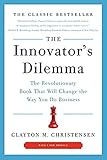
Clayton M. Christensen was an American business theorist whose The Innovator's Dilemma introduced the concept of disruptive innovation and remains essential reading in business strategy.
Clayton Christensen was a professor at Harvard Business School whose 1997 book The Innovator’s Dilemma became one of the most cited and discussed business books of the past thirty years. The central argument is counterintuitive and powerful: well-managed companies, doing exactly what good management theory prescribes — listening to customers, investing in quality, pursuing profits — can still be destroyed by new entrants who initially offer inferior, cheaper products. Christensen called these “disruptive innovations” and documented the pattern across industries from disk drives to steel to excavators.
The framework illuminated something real about how markets and technologies evolve, and it gave business leaders and investors a vocabulary for a pattern that had previously been poorly understood. Silicon Valley adopted it enthusiastically, and the word “disruption” entered general usage partly because of Christensen’s influence. The book is dense and research-grounded rather than breezy, and rewards careful reading more than a quick skim.
Critics have noted that the concept of disruptive innovation has been stretched so far in popular usage as to lose precision, and that some of Christensen’s specific predictions have not aged well. Jill Lepore’s 2014 New Yorker essay offered a pointed empirical challenge to several of his case studies. Christensen responded, and the debate is itself instructive. Whatever its limitations, The Innovator’s Dilemma remains a foundational text for anyone trying to understand why incumbents fail and how markets transform.
Refining the Theory: Jobs to Be Done
Christensen did not rest on his original framework but spent the rest of his career sharpening and extending it, and among his most enduring later contributions is the “Jobs to Be Done” theory of customer behaviour, developed across several works including Competing Against Luck (2016). The core idea is deceptively simple: customers do not really buy products; they “hire” them to make progress in a particular circumstance, to do a job. His famous illustration involves a fast-food chain puzzling over how to sell more milkshakes, only to discover that many were “hired” by commuters to make a long, dull morning drive more bearable — a job for which the relevant competition was not other milkshakes but bananas, bagels, and boredom. The lesson is that genuine innovation comes from understanding the underlying job a customer is trying to accomplish, rather than from improving product attributes or studying customer demographics. This framework gave managers a more humane and causal way to think about why people choose what they choose, and it has been widely adopted in product design and marketing, complementing the disruption theory with a sharper account of where new growth actually comes from.
How Will You Measure Your Life?
In his final years, Christensen turned the analytical rigour he had applied to corporations toward the question of how to live a good life, producing one of his most beloved works, How Will You Measure Your Life? (2012). Born from a lecture to graduating Harvard MBAs and shaped by his own confrontation with serious illness, the book argues that the same theories that explain why companies succeed or fail can illuminate personal questions of career, relationships, and integrity. He warned against the seductions of short-term thinking and marginal compromises, observing that the logic of “just this once” has led many capable people into ethical and personal ruin, and he urged readers to invest deliberately in the relationships and values that ultimately determine happiness. A devout member of the Church of Jesus Christ of Latter-day Saints, Christensen wrote with a moral seriousness and humility unusual among management thinkers, and the book revealed the principled, generous character that students and colleagues consistently described. It widened his audience well beyond business and demonstrated his conviction that rigorous thinking should serve not only profit but a well-lived life.
A Lasting Place in Management Thought
Christensen’s influence on the language and practice of business has been extraordinary; few academic theorists have so thoroughly entered everyday vocabulary, to the point that “disruption” became one of the defining buzzwords of the technology age — often, to his own frustration, misused to describe any novelty or upheaval rather than the specific process he had carefully defined. Repeatedly named among the most influential management thinkers in the world, he shaped how a generation of executives, entrepreneurs, and investors understood competition, technological change, and the vulnerability of even the best-run firms. The scholarly debates over the precision and predictive power of his theory are genuine and ongoing, and they form part of his legacy as much as the acclaim does, for they testify to the seriousness with which his ideas were taken. When he died in 2020, he was mourned not only as a towering intellectual figure but as a teacher of rare warmth and conscience, remembered for insisting that the purpose of management theory was, in the end, to help people and institutions do better and more honest work.
Where to Start with Christensen
The natural entry point is The Innovator’s Dilemma, the book that introduced disruptive innovation and remains essential for anyone trying to understand why successful companies fail, though readers should be prepared for a research-driven, sometimes dense argument rather than a breezy business read. Those who want the practical sequel — what to do once you grasp the threat — should follow it with The Innovator’s Solution. Readers more interested in customers and innovation than in incumbents and disruption will get the most from Competing Against Luck, which lays out the “Jobs to Be Done” framework in accessible form. And anyone curious about Christensen the moral thinker rather than the strategist should read How Will You Measure Your Life?, his short, deeply personal application of rigorous reasoning to questions of career, family, and integrity — the best introduction to the character behind the theories. Together these books show a thinker equally concerned with how organizations succeed and how individuals ought to live.
Reading Guides