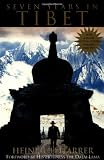
Heinrich Harrer was an Austrian mountaineer and explorer whose Seven Years in Tibet — a memoir of his years in Lhasa after escaping a British internment camp — became one of the most celebrated and widely read travel memoirs of the twentieth century.
Heinrich Harrer was an accomplished Austrian mountaineer — part of the first team to climb the north face of the Eiger in 1938 — who was in India on a climbing expedition in September 1939 when the Second World War began. As an Austrian citizen, he was interned by the British in a prisoner of war camp at Dehra Dun. In 1944, after several escape attempts, he and Peter Aufschnaiter successfully broke out and crossed the Himalayas into Tibet — a journey of extraordinary physical difficulty.
Seven Years in Tibet (1952) is the account of that journey and the seven years Harrer subsequently spent in Lhasa, where he became a tutor and friend to the young Fourteenth Dalai Lama. The book captures a world — the Tibet of the 1940s, the last years before the Chinese occupation — that was already vanishing at the time of writing. Harrer’s access to the Dalai Lama, and his account of Tibetan court culture and religious life, gives the book a historical value that transcends its adventure narrative.
The memoir was adapted as a film in 1997 with Brad Pitt, which renewed interest in the book. Harrer’s reputation was complicated by the revelation in the 1990s that he had been a member of the SS, a fact he concealed for decades. He acknowledged the membership while disputing its significance to his subsequent life and convictions. He died in 2006 at ninety-three. Seven Years in Tibet remains one of the most vivid accounts of Tibet before its absorption into China.
A Witness to a Lost Tibet
The enduring historical value of Harrer’s work lies in its preservation of a world that has since been irrevocably transformed. He arrived in Lhasa in the mid-1940s, during the final years of an independent Tibet that still functioned as a secluded theocratic society largely untouched by the modern world, and he remained there until the eve of the Chinese invasion that would shatter that order forever. His memoir captures, with the immediacy of firsthand observation, the rhythms of Tibetan court life, the rituals and festivals of Tibetan Buddhism, the workings of a remote and tradition-bound society, and the texture of daily existence in a city few Westerners had ever entered. Because the Tibet he described was so soon afterward absorbed and remade, his account has acquired the character of an irreplaceable historical record, a window onto a vanished civilisation. Harrer wrote with a keen eye for detail and a genuine respect for the culture that had received him, and his book has been valued not only as adventure but as ethnography, one of the most complete portraits available of old Tibet in the moment before its independence ended. This documentary quality has secured the work a place far beyond the shelf of ordinary travel memoirs.
The Friendship with the Dalai Lama
At the heart of Seven Years in Tibet, and central to its lasting appeal, is the unusual relationship that developed between Harrer and the young Fourteenth Dalai Lama. Then a curious boy in his early teens, the Dalai Lama summoned the Austrian to the Potala Palace and made him a tutor and companion, eager to learn about the outside world — its geography, science, machinery, and customs — from one of the few Westerners in his isolated kingdom. Harrer taught him about everything from world events to the workings of motion-picture projectors, and the bond between the two men endured for the rest of Harrer’s life, surviving the Dalai Lama’s exile and Harrer’s later controversies. This friendship gives the memoir much of its warmth and its unique vantage point, offering an intimate glimpse of the future spiritual leader as a bright, inquisitive, isolated young man on the cusp of the responsibilities and exile that awaited him. The relationship also lent Harrer a measure of moral authority in his later advocacy for the Tibetan cause, and it remains one of the most affecting elements of a story that might otherwise be remembered chiefly for its adventure and its shadows.
A Complicated Legacy
Harrer’s life resists easy summary, marked as it is by genuine achievement and by a concealed past that emerged only late. As a mountaineer he belonged to the elite of his era, a member of the first party to conquer the formidable north face of the Eiger, and as an explorer and writer he produced one of the twentieth century’s most celebrated adventure memoirs. Yet the disclosure in the 1990s that he had joined Nazi organisations, including the SS, before the war cast a long shadow over his reputation and prompted difficult reassessments of the man behind the beloved book. Harrer maintained that his membership had been opportunistic and inconsequential to his real convictions, pointing to a postwar life of friendship with the Dalai Lama and advocacy for Tibet, but the revelation permanently complicated his image and remains part of any honest account of him. What endures, despite the controversy, is the book itself: an extraordinary record of escape, survival, and immersion in a hidden world, and an irreplaceable portrait of Tibet in its last years of independence. Harrer’s legacy is thus genuinely double — a compromised man who nonetheless left behind a work of lasting historical and human importance.
Reading Guides