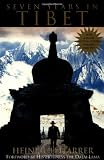
Editors Reads Verdict
An extraordinary adventure narrative that doubles as a unique historical document — one of the very few Western accounts of pre-invasion Tibet, written by a man who lived there for years and knew the Dalai Lama personally.
What We Loved
- The escape and Himalayan crossing sequence is among the great adventure narratives in the language
- Harrer's access to Lhasa and the Dalai Lama makes this a historically irreplaceable account
- The portrait of Tibetan society, culture, and daily life before the Chinese invasion is vivid and respectful
- The writing, translated from German, is surprisingly fluid and immediate
Minor Drawbacks
- Harrer's wartime Nazi party membership, revealed decades later, casts a shadow on the book's reception
- The early mountaineering sections (before the escape) are less compelling than what follows
- Some descriptions of Tibetan religious practice reflect a 1950s European perspective that has aged unevenly
Key Takeaways
- → The Tibetan plateau was effectively isolated from the modern world until the Chinese invasion of 1950
- → The young Dalai Lama was fascinated by Western technology and science — Harrer built him a cinema and a generator
- → Tibetan society was organised around monastic Buddhism in ways that Europeans had no framework to understand
- → The Chinese invasion of 1950–51 destroyed a civilisation that had existed largely unchanged for centuries
| Author | Heinrich Harrer |
|---|---|
| Publisher | Jeremy P. Tarcher |
| Pages | 314 |
| Published | January 1, 1953 |
| Language | English |
| Genre | Travel, Memoir, Adventure |
| Difficulty | Beginner |
| Best For | Readers interested in adventure narrative, Himalayan history, Tibetan Buddhism, and one of the most extraordinary personal journeys of the twentieth century. |
How Seven Years in Tibet Compares
Seven Years in Tibet at a glance against 3 similar books readers weigh alongside it.
| Book | Author | Rating | Best for |
|---|---|---|---|
| Seven Years in Tibet (this book) | Heinrich Harrer | ★ 4.4 | Readers interested in adventure narrative, Himalayan history, Tibetan Buddhism, |
| In Patagonia | Bruce Chatwin | ★ 4.4 | Readers who value literary prose over conventional travel narrative, and anyone |
| Into the Wild | Jon Krakauer | ★ 4.3 | Readers interested in adventure nonfiction, wilderness literature, and the |
| The Snow Leopard | Peter Matthiessen | ★ 4.5 | Readers drawn to literary travel writing with a spiritual dimension — those who |
In 1939, Heinrich Harrer was part of an Austrian mountaineering team attempting the north face of Nanga Parbat in British India when Germany invaded Poland and Britain declared war. The team was interned in a British prisoner-of-war camp in Dehra Dun, from which Harrer and his companion Peter Aufschnaiter escaped in 1944 after multiple attempts. What followed was a twenty-one-month crossing of some of the highest and most hostile terrain on earth — the Himalayas in winter — on foot, with inadequate equipment and almost no food, until the two men finally reached Lhasa, the forbidden city at the heart of Tibet. Seven Years in Tibet, written after Harrer’s eventual return to Europe, is one of the few first-hand accounts of a world that would be destroyed within years of his departure.
The escape and crossing sequence — the first third of the book — is adventure writing of the highest order. Harrer and Aufschnaiter are not prepared for what they attempt; they succeed because they are stubborn, experienced mountaineers, and because they have no realistic alternative. The physical hardships are rendered with the matter-of-fact directness of a man who survived them rather than with the retrospective dramatisation of a writer constructing suspense. The cold, the hunger, the hostile terrain, the constant risk of detection and deportation — all are present as facts, not as occasions for heroism, which makes the heroism more apparent.
Reaching Lhasa in 1946, Harrer and Aufschnaiter found a city that had had almost no sustained contact with the West and no particular reason to want any. They were allowed to remain by a combination of good timing, useful skills, and a fortuitous introduction to the Tibetan aristocracy. Harrer’s most important connection was the young Dalai Lama, then in his early teens, who was intensely curious about the outside world and enlisted Harrer as a kind of tutor in Western science, geography, and technology. Their friendship — which lasted until the Chinese invasion forced the Dalai Lama’s flight in 1959 — is the emotional centre of the book, and Harrer renders the young man’s intelligence and warmth with evident affection.
The book’s historical significance is difficult to overstate. Harrer lived in Lhasa for five years, witnessed its social and religious life, and left just before the Chinese occupation that would systematically dismantle what he had seen. His account — supplemented by photographs and detailed observation of Tibetan customs, governance, and daily life — is among the most complete records of pre-invasion Tibet available. The discovery, decades after publication, that Harrer had been a member of the Nazi SS was a genuine complication to the book’s legacy, and he later acknowledged it without adequate explanation. Readers who choose to engage with the book despite this history will find it an irreplaceable document of a world that no longer exists.
A Window onto a Vanished World
The enduring value of Seven Years in Tibet rests above all on its character as an irreplaceable record of a society on the verge of disappearance, captured by one of the very few Westerners ever to live within it. Harrer arrived in Lhasa in the mid-1940s, during the final years of an independent, secluded theocratic Tibet that still functioned according to traditions essentially untouched by the modern world, and he remained until the eve of the Chinese invasion that would shatter that order forever. His memoir preserves, with the immediacy of firsthand observation, the rhythms of the Tibetan court, the elaborate rituals and festivals of Tibetan Buddhism, the workings of a remote and intricate social hierarchy, and the texture of daily existence in a city that had admitted almost no foreigners. Because the world he documented was so soon afterward dismantled, his account has acquired the weight of historical testimony, a window onto a civilization that no longer exists in the form he knew. Harrer wrote with a keen observational eye and a genuine respect for the culture that had received him, and the book functions as ethnography as much as adventure, one of the fullest portraits available of old Tibet in the moment before its independence ended. This documentary quality, more than the drama of the escape that precedes it, is what secures the book a place far beyond the shelf of ordinary travel memoirs.
The Friendship with the Dalai Lama
At the emotional heart of Seven Years in Tibet lies the remarkable relationship that developed between Harrer and the young Fourteenth Dalai Lama, then a curious boy in his early teens isolated within the vast Potala Palace. Hungry for knowledge of the outside world, the young ruler summoned the Austrian and made him a tutor and companion, eager to learn about geography, science, mechanics, and the customs of distant lands from one of the few Westerners in his secluded kingdom. Harrer taught him about everything from world events to the workings of motion-picture projectors and automobiles, and the bond between the two endured, in spirit, long after the Dalai Lama’s flight into exile. This friendship gives the memoir much of its warmth and its singular vantage point, offering an intimate glimpse of the future spiritual leader as a bright, inquisitive, isolated young man on the threshold of the immense responsibilities and the eventual exile that awaited him. The relationship lends the book a human tenderness that balances the rigors of the journey and the strangeness of the world Harrer entered, and it transforms what might have been a mere chronicle of adventure and observation into a story of genuine human connection across an immense cultural divide. It is this friendship, rendered with evident affection, that many readers remember most.
A Complicated and Enduring Legacy
An honest assessment of Seven Years in Tibet must hold together its genuine achievement and the shadow cast over it by the later revelation of its author’s past. As adventure writing, the book is of the highest order, its account of the escape from a British internment camp and the punishing twenty-one-month winter crossing of the Himalayas rendered with a matter-of-fact directness that makes its heroism all the more apparent. As historical record, it is, as noted, irreplaceable. Yet the discovery decades after publication that Harrer had been a member of the SS before the war complicated his image and the book’s legacy in ways that cannot be dismissed, and his subsequent acknowledgment of that membership, offered without fully adequate explanation, leaves a genuine moral question hanging over the man if not over the work itself. Readers are right to hold this history in view rather than setting it aside. What endures despite the complication is the book’s value as testimony: an extraordinary story of survival and immersion in a hidden world, and a uniquely complete portrait of Tibet in its last years of independence. The legacy is thus double, a compromised man who nonetheless left behind a work of lasting historical and human importance, and readers who engage with it clear-eyed about both dimensions will find it a profoundly rewarding document of a vanished civilization.
Our rating: 4.4/5 — An irreplaceable firsthand record of pre-invasion Tibet and a gripping survival narrative, anchored by the author’s remarkable friendship with the young Dalai Lama, though shadowed by the later revelation of his Nazi past.
Reading Guides
- Books Like Seven Years in Tibet: Himalayan Adventure and Escape Narratives
- Books Like In Patagonia: Literary Adventure Travel at Its Finest
- Books Like The Snow Leopard: Spiritual and Himalayan Travel Narratives
- Books Like West with the Night: Aviation and Adventure Memoirs
- Best Travel Books of All Time: 20 Essential Reads for Every Kind of Wanderer
Frequently Asked Questions
What is "Seven Years in Tibet" about?
Austrian mountaineer Heinrich Harrer escapes a British prisoner-of-war camp in India during World War II and, after a twenty-one-month crossing of the Himalayas, reaches Lhasa — where he becomes a tutor and friend to the young Dalai Lama as the Chinese invasion closes in.
Who should read "Seven Years in Tibet"?
Readers interested in adventure narrative, Himalayan history, Tibetan Buddhism, and one of the most extraordinary personal journeys of the twentieth century.
What are the key takeaways from "Seven Years in Tibet"?
The Tibetan plateau was effectively isolated from the modern world until the Chinese invasion of 1950 The young Dalai Lama was fascinated by Western technology and science — Harrer built him a cinema and a generator Tibetan society was organised around monastic Buddhism in ways that Europeans had no framework to understand The Chinese invasion of 1950–51 destroyed a civilisation that had existed largely unchanged for centuries
Is "Seven Years in Tibet" worth reading?
An extraordinary adventure narrative that doubles as a unique historical document — one of the very few Western accounts of pre-invasion Tibet, written by a man who lived there for years and knew the Dalai Lama personally.
Ready to Read Seven Years in Tibet?
Check the current price on Amazon.
Check Price on Amazon (paid link)Prices and availability are subject to change. See Amazon for current price.
Review last updated: