Bestseller
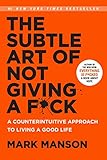
The Subtle Art of Not Giving a F*ck
by Mark Manson
4.4
A counterintuitive approach to living a good life — stop trying to be positive all the time and instead focus on what truly matters.
Check Price on Amazon (paid link)American · b. 1984
Mark Manson is an American blogger-turned-author whose The Subtle Art of Not Giving a F*ck became a global bestseller by applying counterintuitive stoic and existentialist ideas to modern self-improvement.
Mark Manson built a substantial following as a blogger before The Subtle Art of Not Giving a F*ck, published in 2016, became one of the best-selling self-help books of the decade — selling over 12 million copies and spending years on the New York Times bestseller list. The book’s central argument is a productive provocation: that the relentless positivity of mainstream self-help is itself a form of suffering, because it requires the constant assessment of how well you’re doing, and that accepting negative experience — uncertainty, failure, mortality — is more psychologically sustainable than trying to eliminate it.
The book borrows selectively from Stoicism, existentialism, and Buddhism and packages the ideas in deliberately casual, profane prose. That packaging is both the book’s strength and its limitation. The accessible tone and irreverent humor make ideas like Camus’s absurdism or the Stoic relationship to control feel genuinely fresh and applicable to contemporary anxiety. The trade-off is that the philosophy is often simplified and the argument is looser than the authors Manson is drawing on. Readers who proceed to the actual sources will find considerably more depth.
The self-help genre criticism is that the book sometimes contradicts itself — telling you what to care about while insisting that caring is the problem — and that the examples lean heavily on male experience. Some of the personal anecdotes also feel selected to make Manson look more insightful in retrospect than anyone actually is in the moment. But as a corrective to toxic positivity and an accessible gateway to more substantive philosophical traditions, The Subtle Art is more useful than most of what surrounds it on the self-help shelf.
Manson’s rise is itself a parable of the internet age, and it helps explain both the strengths and the limits of his work. Before he was a publishing phenomenon he was a blogger, building an audience through frank, profane, often confrontational posts about dating, relationships, and personal development that cut against the relentlessly cheerful tone of mainstream self-help. That voice — the wisecracking friend who tells you the uncomfortable truth rather than flattering you — was honed in the comment-driven, attention-scarce environment of the web, and it transferred directly to the page. The viral essay that became the seed of The Subtle Art of Not Giving a Fck* demonstrated that an enormous audience was hungry for exactly this counterintuitive, irreverent register, and the book’s record-breaking sales confirmed it on a global scale. His follow-up, Everything Is Fcked: A Book About Hope* (2019), extended his reach into questions of meaning, despair, and the psychology of hope in a culture of comfort, while his widely watched videos and articles kept him at the centre of the digital self-improvement conversation. Manson’s career is a case study in how online writing has reshaped the path to becoming a major nonfiction author.
Manson’s central insight as a writer is not the originality of his ideas but the freshness of his framing, and this is both his great strength and the source of his harshest criticism. The bones of his philosophy are old and respectable: the Stoic distinction between what we can and cannot control, the existentialist insistence that we must choose our values and accept the responsibility that comes with freedom, the Buddhist recognition that suffering is intensified by our resistance to it. What Manson contributes is translation — stripping these traditions of their forbidding vocabulary and delivering them in blunt, funny, contemporary language to readers who would never pick up Seneca, Camus, or a treatise on Buddhism. His core argument, that a meaningful life requires choosing carefully what to care about rather than trying to care about everything or nothing, is genuinely useful and genuinely ancient. Purists object that the simplification distorts the source material and that the profane packaging trades depth for accessibility. But Manson has never claimed to be a philosopher; he positions himself as a populariser, and judged on that basis he is unusually effective, having drawn millions toward ideas they might otherwise never have encountered.
Manson’s impact on the self-help genre has been substantial, helping to define a now-pervasive style sometimes called “anti-self-help” — work that rejects affirmations, vision boards, and the gospel of relentless positivity in favour of acceptance, limitation, and unsentimental realism. He gave voice to a widespread fatigue with the upbeat conventions of the industry, arguing that the constant pressure to feel good and achieve more is itself a source of misery, and that a degree of comfort with failure, uncertainty, and negative emotion is the actual foundation of resilience. This stance struck a powerful chord with a generation skeptical of easy optimism, and his influence is visible in the wave of similarly irreverent, realism-driven personal-development writing that followed. The legitimate criticisms remain — the internal contradictions, the male-skewed examples, the occasional substitution of attitude for substance — and a thoughtful reader holds his pronouncements loosely. Yet Manson’s enduring contribution is to have made a more honest, less saccharine conversation about happiness commercially viable, and to have served, for many readers, as an accessible doorway into the deeper philosophical traditions from which his best ideas are borrowed.
The obvious entry point is The Subtle Art of Not Giving a Fck*, the global bestseller that defines his reputation and best captures his blunt, irreverent, counterintuitive approach to happiness and values. Readers who connect with its central argument — that a good life depends on choosing carefully what to care about — will find a natural follow-up in Everything Is Fcked: A Book About Hope*, which is more ambitious and wide-ranging, tackling questions of meaning, despair, and the psychology of hope in a comfortable but anxious culture. Those who prefer their Manson in smaller, free doses can explore the essays and articles on his website and newsletter, where his style was first honed and where much of his thinking continues to develop. A useful way to get the most from him is to treat his books as a gateway rather than a destination, following his irreverent summaries back to the Stoic, existentialist, and Buddhist sources he draws upon, where the same ideas are explored with far greater depth and nuance.
by Mark Manson
A counterintuitive approach to living a good life — stop trying to be positive all the time and instead focus on what truly matters.
Check Price on Amazon (paid link)guide
Where to start with Mark Manson — how to approach The Subtle Art of Not Giving a F*ck, his essential counterintuitive self-help book. A complete reading guide.
list
Finished The Subtle Art? These 15 books push back on toxic positivity and explore what actually makes life meaningful — with the same honesty and lack of sentiment.
Disclosure: Amazon links on this page are affiliate links. If you purchase through them we earn a small commission at no extra cost to you.