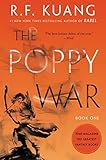
R.F. Kuang is an American fantasy author whose novels interrogate imperialism, race, and trauma through brilliantly researched alternate histories and sharp literary satire.
R.F. Kuang arrived with The Poppy War, a dark fantasy inspired by twentieth-century Chinese history that combined a brutal military narrative with a coming-of-age story and unflinching depictions of atrocity. The book established her as one of the most ambitious voices in contemporary fantasy — willing to go places other authors in the genre avoid. Her follow-up, Babel, is even more formally daring: an alternate history set in a silver-magic-powered Oxford that functions as an extended meditation on colonialism, translation, and complicity. It is dense, angry, and rigorously argued, and it divided readers sharply between those who found it brilliant and those who found it didactic.
Yellowface marks a significant departure — a contemporary literary satire set in publishing, following a white writer who steals and publishes a dead Asian American colleague’s manuscript. It’s faster and sharper than her fantasy work, skewering publishing industry performativity and social media outrage cycles with genuine wit. Some critics found its satire blunt; others found it an overdue dissection of a real problem.
Kuang’s work rewards serious engagement. She is not primarily an entertainment writer — her novels have arguments to make, and they press those arguments hard. Readers looking for escapist fantasy may find her work exhausting. Readers willing to meet the books on their own terms will find a major talent.
A Rising Star of Contemporary Fiction
R. F. Kuang is rightly counted among the most acclaimed and talked-about young authors in contemporary fiction, a writer whose ambitious, intelligent, and provocative work spans epic fantasy and sharp literary satire. Celebrated for her formidable intellect, her engagement with history, colonialism, and power, and her willingness to tackle difficult and uncomfortable themes, Kuang has achieved remarkable success and critical acclaim at a young age. Her novels combine compelling storytelling with serious ideas and a fearless critical edge, and she has quickly established herself as a major and distinctive voice in both genre and literary fiction.
The Poppy War
Kuang first made her name with The Poppy War, a dark, ambitious epic fantasy inspired by twentieth-century Chinese history, including the Sino-Japanese War and its atrocities. Following a war orphan who rises through a military academy and discovers terrible powers, the trilogy confronts war, genocide, colonialism, and the corrupting nature of power with unflinching brutality and moral complexity. Drawing on real and harrowing history, the series announced Kuang as a bold new voice unafraid to engage with darkness and to use fantasy as a vehicle for serious historical and ethical inquiry.
Babel and the Critique of Empire
Kuang’s novel Babel brought her wide acclaim and major awards, a dark academia fantasy set in an alternate Victorian Oxford where translation and silver-working fuel the power of the British Empire. A passionate exploration of language, colonialism, complicity, and resistance, the novel combines rich world-building and academic atmosphere with a searing critique of imperialism and the violence underlying institutions of knowledge and power. Ambitious, angry, and intellectually rigorous, Babel exemplifies Kuang’s distinctive fusion of compelling fantasy with serious political and historical argument, and it confirmed her major reputation.
Engagement With History and Power
A defining feature of Kuang’s work is its deep engagement with history, colonialism, and the dynamics of power and oppression. She draws on real historical events and structures to inform her fiction, and her novels grapple seriously with imperialism, racism, violence, and complicity, refusing easy comfort or simple resolution. This willingness to confront difficult and painful histories, and to use fiction to interrogate systems of power, gives her work its intellectual weight and its moral urgency, and it has made her a significant voice in discussions about the politics and possibilities of contemporary fiction.
Literary Satire
Kuang has also demonstrated striking range and versatility, moving beyond fantasy into sharp contemporary satire with Yellowface, a biting novel about racism, cultural appropriation, and ambition in the publishing industry. Provocative and darkly funny, the book skewers the literary world itself and confronts uncomfortable questions about race, authorship, and success. This move into literary satire revealed another dimension of Kuang’s talent and her fearless willingness to tackle controversial subjects, and it broadened her audience while reinforcing her reputation as a writer unafraid to provoke and challenge.
Intellect and Ambition
What unites Kuang’s varied work is its formidable intellectual ambition. A scholar as well as a novelist, she brings serious learning and rigorous thought to her fiction, engaging with academic ideas, historical scholarship, and pressing contemporary debates. Her novels are demanding and unafraid of complexity, trusting readers to engage with difficult material and challenging ideas. This combination of intellectual seriousness with genuine storytelling power and emotional force is the hallmark of her work and a key reason she has attracted both critical acclaim and a passionate readership at such an early stage in her career.
R.F. Kuang’s Enduring Appeal
R. F. Kuang has rapidly established herself as one of the most exciting and important young authors in contemporary fiction, admired for her ambition, her intelligence, and her fearless engagement with difficult themes. For newcomers, Babel offers a powerful and self-contained introduction to her work, while The Poppy War is the gateway to her epic fantasy trilogy and Yellowface showcases her satirical edge. For readers seeking intelligent, provocative, and richly imagined fiction that confronts history, power, and injustice without flinching, R. F. Kuang is among the most compelling authors writing today. Still early in her career, she is a writer whose future work is awaited with keen anticipation by a rapidly growing readership.
Expanding the Shelf
Among the next titles to reach for are The Burning God and The Dragon Republic.
Reading Guides