Where to Start with R.F. Kuang: A Reading Guide
Where to start with R.F. Kuang — whether to begin with The Poppy War, Babel, or Yellowface. A complete reading guide to the bestselling fantasy and literary novelist.

R.F. Kuang (born 1996) is the American novelist, academic, and translator who — with The Poppy War (2018), published when she was twenty-two — emerged as one of the most significant voices in contemporary fantasy and literary fiction. Her work is characterised by a willingness to engage with historical atrocity (particularly in relation to China and colonialism), formal ambition, and a dark moral seriousness that distinguishes her from most commercial fantasy. Babel (2022) won the Nebula Award for Best Novel; Yellowface (2023) became her widest crossover success. She is completing a PhD at the University of Oxford.
Where to Start: Babel (2022)
The essential Kuang for new readers — a standalone novel set in an alternate 1836 where Britain’s imperial supremacy is literally powered by silver bars inscribed with matched words in two languages. The silver bars harness the semantic gap between languages — the untranslatable meanings that fall between equivalent words — and release it as magical energy. Britain’s Babel, the Royal Institute of Translation at Oxford, is the centre of this power.
Robin Swift is a Chinese boy raised in England by Professor Lovell specifically for his language skills: a native speaker of Mandarin and Cantonese trained in Latin, Greek, and eventually Arabic. He arrives at Oxford to find himself simultaneously privileged and surveilled — more capable than most of his cohort, undeniably useful to the empire, and asked to participate in a system that maintains itself through the exploitation of the peoples whose languages it mines.
Kuang uses the silver bar system as a sustained metaphor for how empires extract value from colonised cultures while maintaining the fiction of offering something in return. The academic setting — the beauty of Oxford, the genuine pleasures of intellectual community — makes the violence of the underlying structure more disturbing, not less. The novel is a critique of institutions that use merit to conceal extraction.
The Poppy War (2018)
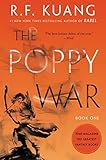
Kuang’s debut — and the first of her darkest and most ambitious work. Rin, a war orphan who tests into the military academy against all expectation, discovers that she can summon gods — the deities of Chinese mythology — and that this power has been suppressed throughout Chinese history because it drives its users mad. The first half is a school fantasy; the second half is a war novel based on the Nanjing Massacre. The tonal shift is deliberate and devastating; readers who approach the first half as a conventional magic school fantasy are unprepared for what the second half requires.
Yellowface (2023)
Kuang’s literary thriller — her most accessible and most widely read book. June Hayward, a mediocre white novelist, watches her friend and rival Athena Liu die. She takes Athena’s unpublished manuscript, The Last Front, and publishes it as her own. The novel is June’s narration of the events that follow: social media attention, critical success, and the escalating accusation that she has committed cultural appropriation. June’s narration is self-serving, unreliable, and darkly funny. A sharp satire of publishing racism, social media accountability, and the specific moral economy of literary fiction. Entirely standalone; no fantasy background required.
Why Babel Is the Ideal First Book
For a reader new to R.F. Kuang, Babel is the ideal first book because it is among her most acclaimed and ambitious novels and a fine expression of her distinctive gifts, the intellectual depth, the formal ambition, and the powerful engagement with language, power, colonialism, and resistance. Babel imagines an alternate nineteenth-century Oxford where translation, through enchanted silver, is the engine of empire, and follows a group of students drawn into questions of complicity, loyalty, and revolution. As an entry point it is ideal, for it showcases Kuang’s gift for combining immersive storytelling with serious ideas and sharp political and historical engagement. It welcomes the newcomer with its compelling premise, its intellectual richness, and its emotional and political force, drawing the reader into her ambitious and thoughtful fiction. It is among her most celebrated works and a fine representation of her gifts, so the new reader encounters Kuang at her most characteristic. For the newcomer, then, Babel is an excellent starting point.
What to Expect as a New Reader
As a new reader, you can expect Babel to be an ambitious, intellectually rich, and politically powerful work of fantasy. You can expect intellectual depth, for the novel is steeped in ideas about language, translation, and the workings of power, set in an alternate nineteenth-century Oxford. You can expect an inventive premise, for in Kuang’s world translation, through enchanted silver, is the very engine of empire. You can expect serious themes, for the novel engages colonialism, complicity, exploitation, identity, and resistance with force and nuance. You can expect emotional and dramatic power, for the intellectual ambition is matched by a gripping, often tragic story of friendship, loyalty, and revolution. You can expect immersive, dark-academia atmosphere. You should be prepared for some dark and violent material and pointed political argument. Expect, in short, an ambitious, intellectually rich, and politically powerful work of fantasy, a striking introduction to Kuang’s gifts.
Going Deeper After Your First Book
Once Babel has introduced you to Kuang’s gifts, the reader who wishes to go deeper can explore her notably varied body of work, which ranges across epic fantasy and sharp contemporary satire while remaining marked by her intelligence and her engagement with power and history. Her acclaimed Poppy War trilogy is a brutal, ambitious epic fantasy drawing on Chinese history and the horrors of war, while her contemporary novel Yellowface is a biting, satirical exploration of race, ambition, and the publishing world, showing her range. Reading these after Babel deepens your appreciation of Kuang’s distinctive gifts, the intellectual depth, the ambition, and the powerful engagement with power, history, and identity. Her characteristic strengths run through her work, even as she moves between very different kinds of story. Building your reading journey through Kuang is a matter of following her fiction from Babel into the Poppy War trilogy and Yellowface. The reader who begins here and continues will find one of the most ambitious and intellectually engaged writers of her generation.
Reading R.F. Kuang
Begin with Babel for the most fully realised and most accessible version of Kuang’s sensibility; read The Poppy War if you want her most ambitious series, with the understanding that its second half is significantly darker and more historically graphic than the first. Yellowface is the best option for readers with no interest in fantasy.
Frequently Asked Questions
Where should I start with R.F. Kuang?
Babel (2022) is the most widely recommended starting point for readers new to Kuang — a standalone novel set in an alternate 1830s Oxford where silver bars inscribed with matched words in two languages power a technological economy, and where a Chinese student named Robin Swift arrives at the Royal Institute of Translation to discover that the system his education has prepared him to serve is built on extraction and violence. Babel is Kuang's most fully realised single novel and most accessible starting point. The Poppy War is the alternative for readers who want her most ambitious series.
What is The Poppy War trilogy about?
The Poppy War trilogy (The Poppy War, The Dragon Republic, The Burning God) follows Rin, a war orphan from rural China who tests into the prestigious Sinegard military academy, discovers she has shamanic powers, and is drawn into a war of civilisational consequence. The trilogy is based on modern Chinese history — particularly the Second Sino-Japanese War and the Rape of Nanking — rendered in a fantasy world. Kuang does not soften the historical violence; the second and third books in particular deal with atrocities with unflinching directness. Her most ambitious work and her darkest.
What is Babel about?
Babel (2022) is set in an alternate 1836 where a technology based on silver bars — each inscribed with matched words in two languages, whose semantic gap releases magical power — underlies British imperial supremacy. Robin Swift, a Chinese orphan raised in England specifically for his language skills, arrives at Babel (the fictional Royal Institute of Translation at Oxford) and discovers that the system he has been prepared to serve is built on the exploitation of colonised peoples and the extraction of their languages and knowledge. The novel is a sustained critique of imperialism, academic complicity, and the violence that underlies civilised institutions.
Is Yellowface different from Kuang's fantasy fiction?
Yellowface (2023) is entirely different from Kuang's fantasy work — a contemporary literary thriller about a white author who steals a dead Chinese American writer's manuscript and publishes it as her own. The novel is a satire of publishing industry racism, cultural appropriation, and the social media pile-on, narrated by the white author with increasingly unreliable self-justification. It is Kuang's most commercially successful and most widely discussed book; it requires no knowledge of her fantasy work and is accessible to readers with no interest in fantasy.