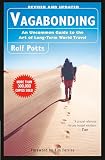
American travel writer and author of Vagabonding, the influential guide to long-term travel that helped launch a generation of location-independent lifestyles.
Rolf Potts is an American travel writer whose 2002 book Vagabonding: An Uncommon Guide to the Art of Long-Term World Travel became one of the most influential travel books of its era and a foundational text for the location-independence and digital nomad movements. Tim Ferriss, who credits it as a major influence on The 4-Hour Workweek, helped bring it to a new generation of readers, and its core message — that long-term travel is an achievable choice, not a luxury reserved for the wealthy — continues to resonate.
Vagabonding is less a practical guide to destinations than a philosophical argument about how to approach travel and, by extension, life. Potts distinguishes between tourism (buying a prepackaged experience) and vagabonding (an open-ended engagement with the world that prioritizes time over money and experience over comfort). He argues that most people can afford extended travel if they rethink their financial priorities, and provides both the mindset and practical tools to make it possible.
Potts has traveled extensively across Southeast Asia, South America, North Africa, and beyond, and has written for National Geographic Traveler, Outside, Sports Illustrated, and many other publications. His writing combines the practical with the philosophical, grounding its arguments in specific, vivid experience. He has also written Marco Polo Didn’t Go There, a collection of travel essays that examines the gap between the romantic idea of travel and its often complicated reality. For anyone considering stepping off the conventional career path for extended exploration, Potts’s work is essential preparation.
A Philosophy of Time Over Money
The intellectual core of Potts’s work, and the source of its lasting influence, is a deceptively simple reframing: that the chief obstacle to long-term travel is not money but the way we think about time and priorities. Drawing on a lineage of thinkers from Thoreau to Walt Whitman, Vagabonding argues that most ordinary people could afford extended travel if they were willing to value freedom and experience over consumption and status, to simplify their lives and redirect the money they spend on possessions toward the purchase of unstructured time. This is less a budgeting trick than a quiet critique of consumer culture, an invitation to recognise that the conventional trade of one’s healthiest years for material accumulation is a choice rather than a necessity. Potts insists that vagabonding is available to almost anyone — the student, the worker between jobs, the person willing to live frugally — and that the real barriers are psychological: fear, inertia, and the assumption that the open-ended journey is a luxury reserved for the rich or the retired. By reframing long-term travel as a matter of values rather than wealth, Potts gave readers not merely permission but a coherent philosophy for stepping off the expected path.
Tourism Versus Vagabonding
Central to Potts’s thinking is a sharp distinction between tourism and vagabonding, two fundamentally different ways of engaging with the world. Tourism, in his account, is the purchase of a prepackaged, time-compressed experience, a consumer transaction in which the traveller moves quickly through curated highlights, insulated from genuine contact with place and people and anxious to extract maximum sights from minimum time. Vagabonding is its opposite: an open-ended, unhurried, deliberately unstructured engagement that prioritises depth over breadth, immersion over efficiency, and serendipity over itinerary. The vagabonder travels slowly, lingers, allows plans to dissolve, and treats discomfort, uncertainty, and the unexpected not as failures but as the very substance of meaningful travel. This distinction connects Potts to a long tradition of thoughtful travel writing that questions the romantic mythology of the road, and in his essay collection Marco Polo Didn’t Go There he turns a self-aware, often humorous eye on the gap between travel’s idealised image and its messy reality. Potts is no naive enthusiast; he understands the contradictions and disappointments of travel, and his honesty about them is part of what makes his advocacy persuasive rather than merely aspirational.
Influence on a Movement
Though published before the era of ubiquitous smartphones and remote work, Vagabonding proved remarkably prophetic and became a foundational text for the location-independence and digital-nomad movements that flourished in the following decades. Its influence was amplified when Tim Ferriss credited it as a key inspiration for The 4-Hour Workweek, introducing Potts’s ideas to a vast new audience of entrepreneurs and lifestyle-design enthusiasts seeking to escape the conventional office and travel while they worked. The book’s core message — that extended, open-ended travel is an achievable choice rather than an impossible dream — anticipated and helped shape a whole subculture of people who reorganised their lives around mobility and experience. Beyond his signature book, Potts has continued to shape thinking about travel through his journalism, his teaching, his podcast, and projects exploring the history and meaning of travel, establishing himself as one of the form’s most thoughtful contemporary practitioners. His enduring contribution has been to articulate, more clearly and durably than almost anyone, why and how a person might step away from the expected trajectory of work and accumulation to engage the wider world on their own terms.
Where to Start with Potts
The essential starting point is Vagabonding, the book that made his name and remains the fullest statement of his philosophy of long-term, independent travel; it works equally well as practical preparation and as an inspiring argument for rethinking one’s priorities, and it is the natural first read for anyone contemplating an extended journey. Readers who connect with its ideas and want to experience Potts as a narrative travel writer rather than a guide should turn to Marco Polo Didn’t Go There, his collection of essays that brings wit, honesty, and self-awareness to the realities of travel, puncturing romantic illusions while affirming travel’s deeper value. Those interested in his reflections on the meaning and history of travel can explore his later work and his ongoing journalism and podcasting, which extend the inquiry he began in Vagabonding. For the would-be long-term traveller, however, Vagabonding is both the indispensable handbook and the philosophical foundation, the book to read before stepping off the conventional path into a longer, slower, more open engagement with the world.
Reading Guides