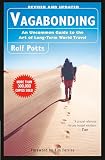
Editors Reads Verdict
The best practical guide to independent long-term travel, and the only one that addresses the philosophical question of why you should do it alongside the logistical question of how. Potts is persuasive, unromantic, and specific.
What We Loved
- Potts addresses both the why and the how — most travel guides only cover the latter
- The argument that travel is a choice rather than a luxury is rigorously made and practically useful
- The chapter on simplifying your life before you leave is the most useful pre-travel advice available
- Specific, honest, and free of the romanticisation that makes most travel writing useless as practical guidance
Minor Drawbacks
- Some practical information (visa processes, budget figures) has dated since the 2003 publication
- Potts's perspective is shaped by his specific life situation and may not translate directly to readers with dependants or careers with less flexibility
- The book is better at inspiring travel than at preparing you for the hard parts
Key Takeaways
- → Long-term travel is not a luxury — it is a choice that most people in developed countries can afford
- → The main obstacle to travel is not money but the consumer commitments that keep you in place
- → Vagabonding requires simplifying your life before you leave — not after you return
- → The longer you travel, the cheaper it becomes — fixed costs disappear and slow travel costs less than rushing
- → Travel is not an escape from real life but an engagement with a larger version of it
| Author | Rolf Potts |
|---|---|
| Publisher | Villard Books |
| Pages | 224 |
| Published | January 7, 2003 |
| Language | English |
| Genre | Travel, Self-Help, Lifestyle |
| Difficulty | Beginner |
| Best For | Anyone who has thought about taking months off to travel but has talked themselves out of it — Potts makes a systematic case for why the obstacles are mostly self-imposed and how to address each one. |
How Vagabonding Compares
Vagabonding at a glance against 3 similar books readers weigh alongside it.
| Book | Author | Rating | Best for |
|---|---|---|---|
| Vagabonding (this book) | Rolf Potts | ★ 4.4 | Anyone who has thought about taking months off to travel but has talked |
| Eat, Pray, Love | Elizabeth Gilbert | ★ 4.1 | Readers drawn to travel memoir, post-divorce or major life transition |
| Into the Wild | Jon Krakauer | ★ 4.3 | Readers interested in adventure nonfiction, wilderness literature, and the |
| The Motorcycle Diaries | Ernesto Che Guevara | ★ 4.3 | Readers interested in Latin American history, the formative experiences of |
Rolf Potts spent years travelling extensively through Asia, the Middle East, and the Americas before writing Vagabonding as a practical and philosophical guide to doing what he had done. The book was famously cited by Tim Ferriss in The 4-Hour Work Week as a foundational influence, which brought it a readership well beyond the backpacker subculture for which it might initially have seemed intended. What distinguishes it from the large category of travel inspiration books is that Potts makes a rigorous argument rather than simply depicting travel as wonderful and leaving the reader to figure out the rest.
The central argument is that long-term independent travel — vagabonding — is not a privilege available only to the wealthy or the unattached. It is a choice, and the primary obstacle is not money but commitment to consumer goods, fixed expenses, and a definition of success that requires accumulation rather than experience. Potts calculates — with specific numbers that have aged somewhat but remain directionally accurate — that a person earning an ordinary salary can fund six months of Southeast Asian travel by working for a year with intention and eliminating discretionary spending. The maths is less interesting than the psychological observation that underlies it: most people do not travel because they have convinced themselves they cannot, and the conviction is usually false.
The practical sections of the book cover the logistics of preparing for extended travel — simplifying your life, dealing with health insurance and finances, managing relationships with people who think you are making a mistake — with a specificity that most travel writing avoids. The sections on how to travel once you have arrived are equally useful: Potts argues for slowness, for staying in one place long enough to understand it, for resisting the itinerary impulse that turns travel into a checklist rather than an experience. The longer you stay in one country, he notes, the cheaper it becomes — fixed-cost destinations charge you more per day when you rush through them.
The philosophical sections draw on Whitman, Thoreau, Twain, and Kerouac, and situate vagabonding in a long tradition of American travel as self-education. Potts is careful not to romanticise: he is honest about loneliness, about the frustrations of budget travel, about the difficulty of returning to ordinary life after months of total freedom. Vagabonding was published in 2003 and some of its practical information has dated, but the argument at its core — that extended travel is a choice available to more people than choose it, and that the transformation it produces is available in no other way — remains as persuasive as it was when Potts first made it.
Time Over Money
The intellectual core of Vagabonding, and the insight that has given it such lasting influence, is a deceptively simple reframing of what actually prevents most people from undertaking long-term travel. The obstacle, Potts argues, is not money but the way we think about time, priorities, and the meaning of success. Drawing on a lineage of American thinkers from Thoreau to Whitman, he contends that extended travel is available to almost anyone willing to value freedom and experience over consumption and status, to simplify their life, reduce their fixed expenses, and redirect the money spent on possessions toward the purchase of unstructured time. This is less a budgeting trick than a quiet critique of consumer culture, an invitation to recognize that the conventional trade of one’s healthiest years for material accumulation is a choice rather than a necessity. Potts insists that the real barriers to vagabonding are psychological, fear, inertia, and the unexamined assumption that the open-ended journey is a luxury reserved for the wealthy or the unencumbered, and he marshals both argument and example to dismantle them. By recasting long-term travel as a matter of values rather than means, he hands the reader not merely permission but a coherent philosophy for stepping off the expected path, and it is this reframing, more than any specific logistical advice, that accounts for the book’s enduring resonance.
A Philosophy of Slow, Open-Ended Travel
Beyond the question of how to afford extended travel, Vagabonding offers a distinctive vision of how such travel should actually be conducted, and this philosophy is as valuable as its economic argument. Potts draws a sharp distinction between tourism, the purchase of a prepackaged, time-compressed experience in which the traveler hurries through curated highlights, and vagabonding, an open-ended, unhurried, deliberately unstructured engagement with the world that prizes depth over breadth and immersion over efficiency. He argues for slowness, for staying in one place long enough to understand it, for allowing plans to dissolve and serendipity to operate, and for treating discomfort, uncertainty, and the unexpected not as failures but as the very substance of meaningful travel. This ethic connects him to a thoughtful tradition that questions the romantic mythology of the road even as it celebrates the road’s transformative power, and Potts is careful never to oversell the experience, acknowledging the loneliness, frustration, and disorientation that genuine long-term travel entails, including the difficulty of reentering ordinary life afterward. His insistence that the value of travel lies in the patient, open-ended encounter rather than the accumulation of sights gives the book a maturity that distinguishes it from mere wanderlust inspiration, and it offers the would-be traveler not just the means to go but a wiser sense of what to do once they have gone.
A Foundational Text for a Movement
Though published before the era of ubiquitous smartphones and remote work, Vagabonding proved remarkably prophetic and became a foundational text for the location-independence and digital-nomad movements that flourished in the following two decades. Its influence was amplified when Tim Ferriss credited it as a key inspiration for his own enormously popular work, introducing Potts’s ideas to a vast new audience of entrepreneurs and lifestyle-design enthusiasts seeking to escape the conventional office and travel while they worked. The book’s central message, that extended, open-ended travel is an achievable choice rather than an impossible dream, anticipated and helped shape an entire subculture of people who reorganized their lives around mobility and experience. While some of its specific practical information, on costs, finances, and logistics, has inevitably dated since 2003, the philosophical heart of the book has not aged at all, and it continues to be discovered and recommended by new generations of travelers. Its enduring achievement is to have articulated, more clearly and durably than almost anyone, why and how a person might step away from the expected trajectory of work and accumulation to engage the wider world on their own terms. As both practical guide and philosophical manifesto, Vagabonding remains the essential starting point for anyone contemplating the leap into long-term travel, and a persuasive argument that the leap is within reach of far more people than ever attempt it.
Our rating: 4.4/5 — A persuasive, philosophically grounded guide to long-term travel whose central insight, that the obstacle is not money but how we value time, remains as liberating and influential as when it was written.
Reading Guides
Frequently Asked Questions
What is "Vagabonding" about?
A practical and philosophical guide to long-term travel — arguing that extended independent travel is not a luxury but a choice, and that most people can afford it if they are willing to rethink their relationship to money, time, and consumer culture.
Who should read "Vagabonding"?
Anyone who has thought about taking months off to travel but has talked themselves out of it — Potts makes a systematic case for why the obstacles are mostly self-imposed and how to address each one.
What are the key takeaways from "Vagabonding"?
Long-term travel is not a luxury — it is a choice that most people in developed countries can afford The main obstacle to travel is not money but the consumer commitments that keep you in place Vagabonding requires simplifying your life before you leave — not after you return The longer you travel, the cheaper it becomes — fixed costs disappear and slow travel costs less than rushing Travel is not an escape from real life but an engagement with a larger version of it
Is "Vagabonding" worth reading?
The best practical guide to independent long-term travel, and the only one that addresses the philosophical question of why you should do it alongside the logistical question of how. Potts is persuasive, unromantic, and specific.
Ready to Read Vagabonding?
Check the current price on Amazon.
Check Price on Amazon (paid link)Prices and availability are subject to change. See Amazon for current price.
Review last updated: