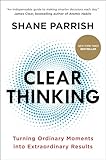
Shane Parrish is a Canadian author and creator of the Farnam Street blog whose book Clear Thinking distills mental models and decision-making frameworks into practical guidance.
Shane Parrish built a devoted following with his Farnam Street blog and podcast, which focus on mental models, decision-making, and the application of cross-disciplinary thinking to real-world problems. Clear Thinking is his most focused and practical book: an argument that most of our failures come not from lack of intelligence but from defaulting to automatic, reactive thinking when situations call for deliberate reasoning, and a framework for building habits that create conditions for better decisions.
The book draws on behavioral psychology, business cases, and philosophical traditions to identify common thinking traps — the bias toward action, social conformity, status defense — and to propose practices for countering them. Parrish writes with clarity and practical orientation, and the book is structured to be actually usable rather than merely inspiring. His emphasis on building good processes rather than trying to make better in-the-moment decisions is a genuinely useful distinction.
Clear Thinking covers ground familiar to readers of behavioral economics and decision science — Kahneman, Thaler, and Cialdini cover much of the underlying research more rigorously. Parrish’s contribution is synthesis and practical application rather than new insight. For readers who want a well-organized introduction to evidence-based decision-making with concrete takeaways, it is a strong entry point. For those who have already read widely in the space, the ground will be familiar.
Farnam Street and the Mental Models Movement
Parrish’s influence extends well beyond any single book, resting principally on Farnam Street, the blog and broader media enterprise he built into one of the most respected destinations for thinking about thinking. Named after the street in Omaha where Warren Buffett’s Berkshire Hathaway is headquartered, the project began as a personal effort to learn more deliberately and grew into a hugely popular platform dedicated to mental models, decision-making, and the cultivation of wisdom drawn from across disciplines. Parrish popularised the concept of building a “latticework of mental models” — a phrase associated with Buffett’s partner Charlie Munger — arguing that the best thinkers draw on fundamental principles from many fields, physics, biology, economics, psychology, to understand problems more clearly than any single specialty allows. Through long-form essays, curated reading, and his widely listened-to podcast featuring in-depth conversations with leading thinkers, he assembled a community of readers committed to lifelong learning and better judgement. This body of freely available work, accumulated over more than a decade, is arguably his most significant contribution, having introduced an enormous audience to the practice of cross-disciplinary thinking and established him as a trusted curator and synthesiser of ideas about how to think and decide well.
The Synthesizer’s Role
Parrish’s distinctive value lies not in original research but in the underrated and genuinely useful work of synthesis, the gathering, organising, and translating of scattered insights into accessible, actionable form. He is candid about this; his books and essays draw openly on the research of cognitive scientists, behavioural economists, philosophers, and successful practitioners, distilling their findings into clear frameworks and memorable principles that ordinary readers can apply. In an information environment overflowing with content but starved of clarity, this curatorial function has real worth: Parrish reads widely and deeply, identifies what is most important and durable, and presents it without the jargon and density of the original sources. His emphasis on the practical — on building good processes and habits rather than relying on willpower or in-the-moment brilliance — reflects an orientation toward usefulness over novelty. Critics rightly note that readers already steeped in the literature of decision science will find little new in his work, and that the underlying ideas are treated more rigorously by their originators. But for the many readers who will never read Kahneman or Munger directly, Parrish serves as an effective and trustworthy gateway, and the skill of translating complex ideas into usable wisdom should not be underestimated.
A Voice for Deliberate Thinking
At the heart of Parrish’s project is a consistent and increasingly relevant message: that in a world engineered for distraction, reactivity, and speed, the capacity for slow, deliberate, independent thought has become a rare and valuable advantage. His work repeatedly returns to the distinction between automatic, default-driven reactions and considered, reflective judgement, and to the conviction that most failures stem not from a lack of intelligence but from a failure to engage our better thinking when it matters. He champions intellectual humility, the willingness to seek out disconfirming evidence, the discipline of separating decisions from outcomes, and the cultivation of character traits that support clear judgement. This emphasis on thinking as a skill that can be deliberately developed, rather than a fixed trait, is empowering, and it has resonated with a wide audience of professionals, leaders, and lifelong learners seeking to make better decisions in their work and lives. Through his writing, podcast, and courses, Parrish has positioned himself as an advocate for a more thoughtful, intentional way of engaging with the world, and his consistent promotion of these values has made him a notable figure in the broader contemporary conversation about wisdom, rationality, and good judgement.
Where to Start with Parrish
The best entry point depends on a reader’s preference. Those who want his ideas in a single, structured volume should begin with Clear Thinking, his most focused book, which distils his thinking on decision-making and the management of one’s reactive tendencies into a practical, well-organised guide; it is ideal for readers new to the subject. Those already familiar with behavioural economics, however, may find more value in exploring the vast archive of Farnam Street essays freely available online, which range across mental models, learning, and decision-making and represent the fullest expression of his curatorial gift. Readers who enjoy long-form conversation should sample his podcast, The Knowledge Project, in which he interviews accomplished thinkers and practitioners in depth. His earlier compact volumes on mental models offer concise reference guides to the cross-disciplinary frameworks he champions. Whichever the format, Parrish reliably delivers clear, practical synthesis aimed at helping readers think and decide better. For a quick, structured introduction, Clear Thinking is the natural starting point; for ongoing engagement, the Farnam Street blog and podcast are where his project lives most fully.
Reading Guides