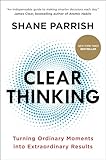
Editors Reads Verdict
Parrish's first book delivers the distilled wisdom of fifteen years of Farnam Street content into a coherent decision-making framework — more synthesized and narrative-driven than the blog, and more practically focused than most decision science books.
What We Loved
- The biological defaults framework is precise and immediately recognizable
- Parrish's writing is cleaner and more direct than most productivity book prose
- The combination of mental models with character as foundation is unusual and right
- Short chapters enable reading in segments without losing continuity
Minor Drawbacks
- Readers of Farnam Street will find much material familiar
- Some concepts are drawn from sources Parrish is more transparent about in the blog
- The character-first argument could be more rigorously supported
Key Takeaways
- → Most bad decisions happen not from stupidity but from biological defaults taking control
- → Emotional, social, ego, and inertia defaults undermine judgment in predictable ways
- → Character — integrity, honesty with yourself — is the foundation of clear thinking
- → Position yourself to make better decisions before high-stakes moments
- → A strong filter for what information you consume shapes what you're capable of thinking
| Author | Shane Parrish |
|---|---|
| Publisher | Portfolio |
| Pages | 288 |
| Published | October 3, 2023 |
| Language | English |
| Genre | Self-Help, Decision Making |
| Difficulty | Intermediate |
| Best For | Professionals and leaders who want to make better decisions, fans of Farnam Street and mental models, and readers interested in practical decision science. |
How Clear Thinking Compares
Clear Thinking at a glance against 3 similar books readers weigh alongside it.
| Book | Author | Rating | Best for |
|---|---|---|---|
| Clear Thinking (this book) | Shane Parrish | ★ 4.3 | Professionals and leaders who want to make better decisions, fans of Farnam |
| The Obstacle Is the Way | Ryan Holiday | ★ 4.3 | Readers who want an accessible introduction to Stoic philosophy through a |
| Think Again | Adam Grant | ★ 4.3 | Leaders, professionals, and anyone interested in how intellectual humility and |
| Thinking, Fast and Slow | Daniel Kahneman | ★ 4.6 | Investors, doctors, lawyers, managers, policymakers, and any curious person who |
The Farnam Street Synthesis
Shane Parrish spent a decade and a half building Farnam Street into one of the internet’s most respected destinations for decision-making and learning content. Clear Thinking is his attempt to synthesize that accumulated wisdom into a coherent, book-length argument rather than a collection of excellent essays.
The book’s central claim is about ordinary moments: most consequential decisions don’t feel consequential when you make them. The choice to respond angrily in a meeting, to skip the preparation for a conversation you think will be easy, to avoid a difficult truth because it’s uncomfortable — these are the decisions that compound into outcomes. Clear thinking isn’t about the high-stakes moments you prepare for. It’s about the ordinary moments you don’t.
The Default Problem
Parrish’s framework centers on four biological defaults that undermine thinking: the emotion default (acting on feelings before understanding their source), the ego default (protecting self-image over pursuing truth), the social default (following what others around us are doing), and the inertia default (continuing what we’ve been doing regardless of whether it’s working).
These defaults are not character flaws. They are evolutionary inheritances that served our ancestors well in environments where fast response mattered more than accurate response. In modern decision-making environments — where the costs of hasty emotional response are high and the options for accurate deliberation are available — they’re usually liabilities.
Character as Foundation
The book’s most unconventional argument is that clear thinking is built on character first and technique second. Parrish argues that no decision-making framework survives contact with motivated reasoning, self-deception, and ego protection. The techniques only work for people who are genuinely committed to seeing clearly rather than confirming what they already believe — and that commitment is a character trait, not a cognitive skill.
This argument will frustrate readers looking for techniques they can apply without changing who they are. It will resonate with readers who recognize how often they know what the right decision is and find reasons to make a different one.
The Positioning Framework
Parrish’s practical sections on positioning — making decisions in advance of high-stakes moments, creating rules that prevent default behaviors before they arise — are the book’s most immediately actionable. The idea of “safeguards” — pre-committed rules that trigger in specific circumstances — provides a concrete mechanism for operationalizing the character-first argument.
Creating the Space Between Stimulus and Response
The most practical insight underlying Parrish’s entire framework is that clear thinking begins not with better analysis but with the ability to interrupt the automatic — to insert a deliberate pause between a triggering event and one’s reaction to it. The four defaults all operate at speed, hijacking judgment before reflection has a chance to engage; the angry retort, the ego-protecting denial, the herd-following choice, and the inertial drift all happen in the instant before a person has consciously decided anything. Parrish argues that the master skill is recognizing the moments that require thinking in the first place, because most poor decisions are not the result of flawed reasoning but of reasoning never being summoned at all. He offers concrete tactics for building this pause: noticing the physiological signs of an activated default, deliberately slowing down when the stakes are unclear, and treating strong emotion as a signal to wait rather than a license to act. This emphasis on self-management as the precondition for good judgment is what gives the book its distinctive character — it locates the leverage point before the decision, in the management of one’s own reactive nature.
Defining the Problem Before Solving It
When Parrish turns from managing the defaults to the act of decision itself, his most valuable counsel concerns the unglamorous work that precedes any choice: defining the problem correctly and being clear about what one is actually trying to achieve. He observes that people rush to generate and evaluate options before they have established what success would even look like, and that an enormous share of bad outcomes trace back to solving the wrong problem with admirable rigor. Parrish presses readers to articulate their goals explicitly, to distinguish the real problem from its symptoms, and to resist the seductive pull of the first plausible solution that presents itself. He advocates for actively seeking out disconfirming evidence and inviting dissent, treating the search for reasons one might be wrong as a discipline rather than a threat — a direct application of his character-first thesis, since only a person secure enough to want the truth will genuinely look for it. The framework is not novel in its individual components, many drawn from the decision-science tradition Parrish has long curated, but its integration into a coherent sequence is genuinely useful.
Synthesis Over Originality
It is fair to say that Clear Thinking offers little that is strictly new to a reader already steeped in the literature of cognitive bias, decision science, and behavioral psychology, and Parrish himself does not pretend otherwise. His gift, honed over years of distilling other thinkers on Farnam Street, is synthesis and articulation — taking ideas scattered across academic psychology, philosophy, and the writings of investors and operators, and reassembling them into a clean, memorable, usable whole. The value of such a book lies not in revelation but in compression and framing: the four defaults give a name and a structure to failure modes the reader has experienced but never organized, and the character-first argument reframes familiar material in a way that lands with unusual force. Readers seeking cutting-edge research or rigorous theoretical novelty will find the book thin; readers seeking a practical, well-organized handbook that turns dispersed wisdom into something they can actually apply on a Monday morning will find it among the better entries in a crowded field. Parrish knows exactly what kind of book he is writing, and executes it cleanly.
The Mundane Stakes of Good Judgment
What ultimately distinguishes Clear Thinking from the high-drama decision books that dwell on momentous, once-in-a-career choices is Parrish’s insistence that the decisions which shape a life are overwhelmingly small, frequent, and unremarked. The compounding effect of ordinary moments — how one responds to a slight, whether one prepares for a conversation assumed to be easy, whether one tells an uncomfortable truth — is, in his account, where outcomes are actually determined, long before any dramatic crossroads arrives. This reframing carries a quiet motivational charge, because it implies that the leverage available to anyone is enormous and immediate: not the rare opportunity to make one brilliant strategic call, but the daily opportunity to refuse a default and think clearly when no one is watching. It also raises the standard, since it means clear thinking cannot be reserved for special occasions but must become a default of its own, built through repetition and safeguarded by character. For readers willing to accept that the work is continuous rather than occasional, the book offers a genuinely useful operating system for the ordinary decisions that compound into a life.
Our rating: 4.3/5 — A mature, well-synthesized decision-making guide that goes beyond technique to address the character foundations that good judgment actually requires.
Frequently Asked Questions
What is "Clear Thinking" about?
Farnam Street founder Shane Parrish distills the most important principles for making better decisions, identifying and overcoming the defaults that undermine clear thinking.
Who should read "Clear Thinking"?
Professionals and leaders who want to make better decisions, fans of Farnam Street and mental models, and readers interested in practical decision science.
What are the key takeaways from "Clear Thinking"?
Most bad decisions happen not from stupidity but from biological defaults taking control Emotional, social, ego, and inertia defaults undermine judgment in predictable ways Character — integrity, honesty with yourself — is the foundation of clear thinking Position yourself to make better decisions before high-stakes moments A strong filter for what information you consume shapes what you're capable of thinking
Is "Clear Thinking" worth reading?
Parrish's first book delivers the distilled wisdom of fifteen years of Farnam Street content into a coherent decision-making framework — more synthesized and narrative-driven than the blog, and more practically focused than most decision science books.
Ready to Read Clear Thinking?
Check the current price on Amazon.
Check Price on Amazon (paid link)Prices and availability are subject to change. See Amazon for current price.
Review last updated: