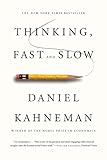
Editors Reads Verdict
A landmark work in psychology and economics. Dense in places but endlessly illuminating — Kahneman reveals how our minds work with the precision of a scientist and the accessibility of a master storyteller.
What We Loved
- Nobel laureate author — the highest possible credibility
- Backed by decades of original research
- Applicable to investing, medicine, law, and everyday decisions
- Changes how you evaluate your own thinking permanently
Minor Drawbacks
- 499 pages — a significant time investment
- Some chapters feel more academic than practical
- Several findings have faced replication challenges since publication
Key Takeaways
- → System 1 (fast, intuitive) and System 2 (slow, deliberate) govern all thinking
- → Cognitive biases are systematic errors, not random — you can predict and correct them
- → Loss aversion: losses hurt roughly twice as much as equivalent gains feel good
- → The planning fallacy causes almost everyone to underestimate time and cost
- → We are much less rational than standard economics assumes
| Author | Daniel Kahneman |
|---|---|
| Publisher | Farrar, Straus and Giroux |
| Pages | 499 |
| Published | January 1, 2011 |
| Language | English |
| Genre | Psychology, Behavioural Economics, Science |
| Difficulty | Intermediate |
| Best For | Investors, doctors, lawyers, managers, policymakers, and any curious person who wants to understand why smart people make bad decisions. |
How Thinking, Fast and Slow Compares
Thinking, Fast and Slow at a glance against 3 similar books readers weigh alongside it.
| Book | Author | Rating | Best for |
|---|---|---|---|
| Thinking, Fast and Slow (this book) | Daniel Kahneman | ★ 4.6 | Investors, doctors, lawyers, managers, policymakers, and any curious person who |
| Influence | Robert Cialdini | ★ 4.7 | Anyone who negotiates, sells, manages people, or simply wants to understand why |
| Nudge | Richard Thaler & Cass Sunstein | ★ 4.5 | Policy makers, business leaders, and anyone curious about how environment |
| Predictably Irrational | Dan Ariely | ★ 4.4 | Anyone interested in why people make the decisions they do — consumers, |
When Daniel Kahneman won the Nobel Prize in Economics in 2002 — as a psychologist — it signalled that the study of human decision-making had been permanently transformed. Thinking, Fast and Slow is his life’s work distilled into one extraordinary volume, built around the central distinction between two modes of thought. System 1 is fast, automatic, emotional, and unconscious — it recognises faces, reads emotional tone, drives on an empty road, and forms first impressions. System 2 is slow, deliberate, logical, and effortful — it does long division, reads a contract carefully, and navigates a complex argument. Understanding which system is operating at any moment is the foundation of better decision-making, and understanding how System 1 systematically misleads us is what makes this book genuinely transformative.
The book documents dozens of cognitive biases — systematic errors produced by System 1’s shortcuts — with the precision and authority that decades of original research provides. Anchoring causes the first number you encounter to disproportionately influence your judgment. The availability heuristic leads you to assess probability by how easily examples come to mind, which is why plane crashes feel more dangerous than car crashes despite the statistics. Loss aversion — the finding that losses hurt roughly twice as much as equivalent gains feel pleasurable — explains why people hold losing stocks too long, why negotiations stall, and why most people refuse fair gambles. The planning fallacy reliably causes individuals and organisations to underestimate the time, cost, and risk of future projects while overestimating benefits. WYSIATI — What You See Is All There Is — describes System 1’s habit of constructing confident narratives from incomplete information, which is the mechanism behind everything from poor hiring decisions to political overconfidence.
The book’s most consequential scientific contribution is Prospect Theory, the model Kahneman developed with Amos Tversky showing that people evaluate outcomes relative to reference points rather than in absolute terms. This insight overturned standard economic theory, which assumed rational actors maximise absolute utility. Prospect Theory explains a long list of economic puzzles: why people pay for insurance they don’t need, why cab drivers stop driving when they hit a daily income target rather than working longer on high-demand days, and why the framing of an identical choice — gain versus loss — produces systematically different decisions. The theory earned Kahneman his Nobel and built the entire field of behavioural economics.
Thinking, Fast and Slow is a long book at 499 pages, and some readers find the middle sections more academic than they need. Several of the individual findings have also faced replication challenges since publication, which Kahneman has acknowledged with unusual intellectual honesty. But the core framework — the dual-system model of cognition and its implications for bias, decision-making, and economic behaviour — is among the most important contributions to understanding the human mind of the past half-century. Read it for the framework, and you will evaluate your own thinking differently for the rest of your life.
The Two Systems, and Why the Framing Matters
The organising idea is deceptively simple: the mind runs on two systems. System 1 is fast, automatic, and intuitive — it reads emotion on a face, completes the phrase “bread and…”, and reacts before you decide to. System 2 is slow, effortful, and deliberate — it multiplies seventeen by twenty-four, fills in a tax form, checks an argument. The trouble is that System 2 is lazy and easily depleted, so it routinely endorses whatever System 1 hands it. Most of the book is a catalogue of the predictable ways this goes wrong: anchoring, where an arbitrary number warps a later estimate; availability, where vivid examples distort our sense of frequency; the framing effect, where the same odds feel different described as a gain or a loss. Kahneman’s achievement is to make these not party tricks but a coherent account of a mind that is systematically, not randomly, biased.
Reading It Well
The book is long, dense, and occasionally repetitive, and it is best read slowly, a chapter or two at a time, rather than consumed in a rush. Kahneman is candid that knowing about a bias does not immunise you against it — he confesses his own susceptibility throughout — so the practical value lies less in self-correction than in learning to recognise the conditions under which judgment is likely to fail, especially in others and in institutions. Readers should also know that some of the priming studies Kahneman cited have fared poorly in the replication crisis that followed, a point he himself later acknowledged; the core findings on heuristics and prospect theory, the work that won the Nobel, remain robust. Read critically, it is still the single best map of how human judgment actually works.
What You Take Away
The lasting gift of the book is not a checklist of biases to memorise but a kind of humility about the mind. Once you have absorbed Kahneman’s account, you read polls, advertisements, expert forecasts, and your own confident hunches differently — alert to the anchors, the vivid stories, and the easy fluency that masquerade as judgment. It is a book that changes the texture of everyday thinking, which is rare, and it pairs naturally with the wider literature on decision-making it helped inspire. For all its length and occasional dryness, it stands as the definitive popular account of how we actually decide, by one of the few psychologists ever to win a Nobel Prize in economics for the work.
Reading Guides
- Thinking, Fast and Slow vs Blink
- Books Like Thinking, Fast and Slow: Cognitive Science, Bias, and How We Actually Make Decisions
- 15 Books Like Deep Work to Read Next
- 15 Books Like Grit to Read Next
- 15 Books Like Outliers to Read Next
- 15 Books Like Atomic Habits to Read Next
- 15 Books Like Four Thousand Weeks to Read Next
- 15 Books Like Mindset to Read Next
Frequently Asked Questions
What is "Thinking, Fast and Slow" about?
Nobel laureate Daniel Kahneman explains the two systems that drive the way we think — and reveals how our intuitive System 1 thinking leads us astray in predictable, correctable ways.
Who should read "Thinking, Fast and Slow"?
Investors, doctors, lawyers, managers, policymakers, and any curious person who wants to understand why smart people make bad decisions.
What are the key takeaways from "Thinking, Fast and Slow"?
System 1 (fast, intuitive) and System 2 (slow, deliberate) govern all thinking Cognitive biases are systematic errors, not random — you can predict and correct them Loss aversion: losses hurt roughly twice as much as equivalent gains feel good The planning fallacy causes almost everyone to underestimate time and cost We are much less rational than standard economics assumes
Is "Thinking, Fast and Slow" worth reading?
A landmark work in psychology and economics. Dense in places but endlessly illuminating — Kahneman reveals how our minds work with the precision of a scientist and the accessibility of a master storyteller.
Ready to Read Thinking, Fast and Slow?
Check the current price on Amazon.
Check Price on Amazon (paid link)Prices and availability are subject to change. See Amazon for current price.
Review last updated: