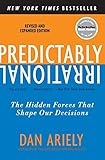
Editors Reads Verdict
Ariely's accessible exploration of behavioural economics is packed with fascinating experiments. The revelation that our irrationality is systematic and predictable — not random — is the key insight that makes it actionable.
What We Loved
- Engaging, accessible writing about genuinely important research findings
- The anchor effect and FREE! effect chapters are immediately eye-opening
- Ariely's own story and personal experiments add texture and credibility
- Each chapter has practical implications for design, marketing, and personal decisions
Minor Drawbacks
- Some experiments have had replication challenges since publication
- The prescriptions for overcoming irrationality are less developed than the diagnosis
- Some conclusions have been qualified in subsequent research
Key Takeaways
- → Our decisions are influenced by arbitrary anchors we consciously dismiss as irrelevant
- → FREE! creates disproportionate emotional responses that distort rational choice
- → Social norms and market norms operate differently — mixing them is costly
- → Expectations shape perception: knowing what you're tasting changes how it tastes
- → Procrastination and self-control failures are predictable and can be countered with commitment devices
| Author | Dan Ariely |
|---|---|
| Publisher | HarperCollins |
| Pages | 304 |
| Published | February 19, 2008 |
| Language | English |
| Genre | Psychology, Behavioural Economics, Science |
| Difficulty | Beginner |
| Best For | Anyone interested in why people make the decisions they do — consumers, marketers, policymakers, and anyone curious about the gap between intended and actual behaviour. |
How Predictably Irrational Compares
Predictably Irrational at a glance against 3 similar books readers weigh alongside it.
| Book | Author | Rating | Best for |
|---|---|---|---|
| Predictably Irrational (this book) | Dan Ariely | ★ 4.4 | Anyone interested in why people make the decisions they do — consumers, |
| Blink | Malcolm Gladwell | ★ 4.3 | Anyone curious about the mechanics of intuition, snap judgment, and the |
| The Paradox of Choice | Barry Schwartz | ★ 4.2 | Anyone feeling overwhelmed by modern abundance of options, or interested in the |
| Thinking, Fast and Slow | Daniel Kahneman | ★ 4.6 | Investors, doctors, lawyers, managers, policymakers, and any curious person who |
The Systematic Nature of Irrationality
If human irrationality were random, it would average out and be relatively unimportant. Dan Ariely’s crucial insight is that our irrationality is neither random nor occasional — it is systematic and predictable. The same cognitive biases produce the same errors across different people, different contexts, and different cultures. This predictability is what makes behavioural economics powerful: if you can predict errors, you can design around them.
Ariely is one of the most gifted communicators in behavioural science, and Predictably Irrational is his most accessible work — a tour through a dozen key findings from his own and others’ research, rendered in engaging prose with minimal jargon.
The Power of Anchoring
The book opens with one of the most counterintuitive findings in decision research: arbitrary numbers anchor our subsequent estimates and choices in powerful ways. When Ariely asked his MIT students to write down the last two digits of their Social Security numbers before bidding on items, the students with high-ending numbers consistently bid substantially more than those with low-ending numbers. They knew the social security numbers were irrelevant — and they were anchored by them anyway.
This has profound implications for negotiations, pricing, salary discussions, and any situation where a first number is put on the table.
FREE! and the Zero-Price Effect
Perhaps the most practically useful chapter concerns the irrational power of FREE. When something is free, our demand for it increases disproportionately — beyond what rational price sensitivity would predict. Ariely demonstrates this with a series of experiments comparing purchases at different prices. The drop from 1 cent to zero produces a much larger increase in demand than the drop from 2 cents to 1 cent — which is equivalent in economic terms but completely different psychologically.
Understanding the zero-price effect explains why free shipping converts better than proportional discounts, why free samples create sales, and why “buy one get one free” outperforms “50% off both.”
Social vs. Market Norms
One of the book’s most insightful chapters distinguishes social norms (the implicit reciprocity of friendly relationships) from market norms (explicit transactional exchange). These operate by completely different rules, and mixing them has costs. When a lawyer offers to do pro-bono work for a charity, he agrees. When the charity offers to pay him below his market rate, he declines. The introduction of money converts a social norm into a market comparison — and the market comparison is always unflattering.
Final Verdict
Predictably Irrational is one of the most enjoyable books in the behavioural economics genre and a natural companion to Kahneman’s Thinking, Fast and Slow. Some research has faced replication challenges, but the core insights into systematic irrationality remain important and well-documented.
Our rating: 4.4/5 — Fascinating, accessible, and practically useful. One of the best introductions to behavioural economics available.
We Are Not as Rational as We Think
Dan Ariely’s central argument is in his title: human beings are not the rational calculators that classical economics assumes, but we are not randomly irrational either — our mistakes follow consistent, predictable patterns that can be studied and even anticipated. Through a series of ingenious experiments, Ariely demonstrates how systematically our judgments go astray: how the mere presence of a decoy option changes what we choose, how “free” exerts an irrational pull, how the first price we see anchors everything after it, and how social and market norms operate by entirely different rules. The pleasure of the book is watching familiar behaviour revealed as far stranger than we assume.
Experiments You Remember
What makes the book stick is the cleverness and memorability of its studies. Ariely has a gift for designing simple experiments that expose a counterintuitive truth — the way people will work harder for no pay than for low pay, the way ownership inflates what we think our possessions are worth, the way expectations literally change how something tastes or how well a medicine works. These are not abstract findings but vivid, repeatable demonstrations, and they give the reader a set of tools for noticing their own predictable irrationality in everyday life.
Practical Without Being Preachy
Behind the entertainment is a practical purpose. Ariely argues that if our irrationality is predictable, then we can design our choices, our policies, and our institutions to account for it — nudging ourselves toward better decisions about money, health, and honesty rather than pretending we are more rational than we are. The book is an accessible entry point to behavioural economics, and it influenced a wave of thinking about how to structure choices in the real world.
How to Read It
Readers should know that some studies in the broader field of social psychology have faced replication challenges in the years since, and the careful reader holds the specific findings a little more lightly than the book’s confident tone invites. But the core message — that our irrationality is systematic, and that understanding its patterns can help us decide better — remains robust and genuinely useful. As an entertaining, eye-opening introduction to how people actually make decisions, Predictably Irrational is one of the most engaging popular books in its field, and a lasting favourite for readers who want to understand the hidden forces shaping their everyday choices.
Reading Guides
Frequently Asked Questions
What is "Predictably Irrational" about?
A behavioural economist reveals the hidden forces that shape our decisions — and why we repeatedly make the same irrational choices despite knowing better.
Who should read "Predictably Irrational"?
Anyone interested in why people make the decisions they do — consumers, marketers, policymakers, and anyone curious about the gap between intended and actual behaviour.
What are the key takeaways from "Predictably Irrational"?
Our decisions are influenced by arbitrary anchors we consciously dismiss as irrelevant FREE! creates disproportionate emotional responses that distort rational choice Social norms and market norms operate differently — mixing them is costly Expectations shape perception: knowing what you're tasting changes how it tastes Procrastination and self-control failures are predictable and can be countered with commitment devices
Is "Predictably Irrational" worth reading?
Ariely's accessible exploration of behavioural economics is packed with fascinating experiments. The revelation that our irrationality is systematic and predictable — not random — is the key insight that makes it actionable.
Ready to Read Predictably Irrational?
Check the current price on Amazon.
Check Price on Amazon (paid link)Prices and availability are subject to change. See Amazon for current price.
Review last updated: