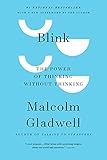
Editors Reads Verdict
Gladwell's investigation of rapid cognition is fascinating and readable, though its main thesis is genuinely two-sided: intuition is sometimes brilliant and sometimes catastrophically wrong. The tension between these two poles gives the book intellectual honesty.
What We Loved
- The thin-slicing research is genuinely fascinating and counterintuitive
- Gladwell's storytelling is as engaging as ever
- The cases of intuition failing (implicit bias, snap race judgments) are courageously included
- The expert intuition chapters (Gottman's marriage prediction) are memorable
Minor Drawbacks
- The central thesis is somewhat incoherent — sometimes intuition is good, sometimes bad, when?
- Some research has faced replication challenges
- The prescriptions for improving intuition are underdeveloped
Key Takeaways
- → Thin-slicing: our adaptive unconscious can make accurate judgments from small slices of experience
- → Expert intuition is reliable when it comes from genuine pattern recognition built over years of experience
- → Intuition fails systematically in the presence of implicit bias and unfamiliar situations
- → Sometimes more information produces worse decisions — we can deliberate our way to error
- → The conditions under which thin-slicing is reliable are specific and knowable
| Author | Malcolm Gladwell |
|---|---|
| Publisher | Little, Brown |
| Pages | 296 |
| Published | January 11, 2005 |
| Language | English |
| Genre | Psychology, Popular Science, Self-Help |
| Difficulty | Beginner |
| Best For | Anyone curious about the mechanics of intuition, snap judgment, and the boundary between useful instinct and dangerous bias. |
How Blink Compares
Blink at a glance against 3 similar books readers weigh alongside it.
| Book | Author | Rating | Best for |
|---|---|---|---|
| Blink (this book) | Malcolm Gladwell | ★ 4.3 | Anyone curious about the mechanics of intuition, snap judgment, and the |
| Predictably Irrational | Dan Ariely | ★ 4.4 | Anyone interested in why people make the decisions they do — consumers, |
| The Tipping Point | Malcolm Gladwell | ★ 4.3 | Marketers, social scientists, policy-makers, and anyone seeking to understand |
| Thinking, Fast and Slow | Daniel Kahneman | ★ 4.6 | Investors, doctors, lawyers, managers, policymakers, and any curious person who |
The Hidden Intelligence of Fast Thinking
Malcolm Gladwell writes popular science as a narrative journalist, and at his best, he can make psychological research feel like a thriller. Blink is one of his best. It investigates the phenomenon of rapid intuitive cognition — the split-second judgments we make before conscious deliberation kicks in — and asks: when should we trust them?
The answer is more nuanced than the book’s subtitle (“The Power of Thinking Without Thinking”) initially suggests. Gladwell’s genuine insight is that rapid cognition is powerful in some conditions and deeply unreliable in others — and distinguishing between them is the real intellectual challenge.
Thin-Slicing
The core concept is thin-slicing: the ability of the unconscious mind to find patterns in situations based on very thin slices of experience. John Gottman’s research on marriage is the book’s most striking illustration: after coding just a few minutes of a couple’s conversation, trained observers can predict with over 90% accuracy whether the couple will still be together fifteen years later. A four-minute video slice contains enough signal for surprisingly reliable long-term prediction.
The same phenomenon appears in art authentication (an expert’s instant gut reaction that a “Getty kouros” was fake, later confirmed through analysis), medical diagnosis, and military decision-making. The rapid cognition of genuine experts reflects years of internalised pattern recognition that can outpace deliberative analysis.
When Intuition Fails
Gladwell’s intellectual honesty shows in his extensive treatment of cases where thin-slicing produces catastrophic errors. The Amadou Diallo case — where police officers shot an unarmed man in the automatic activation of racial threat perception — illustrates how implicit bias can hijack rapid cognition and produce lethal outcomes.
The Warren Harding Effect — the tendency to respond to tall, attractive, presidential-looking men as leadership candidates regardless of actual competence — shows how thin-slicing applies to irrelevant features in high-stakes decisions.
The Question Gladwell Can’t Quite Answer
The book’s central limitation is that it fails to provide a reliable guide to when rapid cognition should be trusted. Thin-slicing works for expert pattern recognition in familiar domains and fails in the presence of bias or unfamiliarity — but identifying which situation you’re in requires the kind of deliberate analysis that thin-slicing is supposed to replace.
The Research Behind the Book
Gladwell draws on a wide range of psychological research in Blink, but the most important intellectual debt is to the work on expert intuition developed by psychologists including Gary Klein and Daniel Kahneman. Klein’s research on naturalistic decision-making — how experienced firefighters, chess players, and military commanders make rapid decisions in complex environments — provides the foundation for Gladwell’s argument that expert thin-slicing is real. Kahneman’s work on cognitive biases and the failures of intuition provides the foundation for the counter-argument.
What Gladwell captures, and what makes Blink genuinely useful rather than simply entertaining, is that both bodies of research are correct. Expert intuition in familiar domains, built on genuine pattern recognition from thousands of hours of experience, is reliable. Intuitive responses to unfamiliar situations, or responses that engage implicit biases rather than domain expertise, are systematically unreliable. The challenge is knowing which kind of intuition you are using at any given moment, and this is harder than it sounds.
Gladwell’s Own Intellectual Honesty
The chapter on implicit bias and the Amadou Diallo case is unusual for a popular science book in 2005. Gladwell is explicit that the racial threat perception that triggered the shooting of an unanmed man was not aberrant — it was the normal operation of a cognitive system that had been loaded with racial associations through ordinary social exposure. The Warren Harding effect shows how the same cognitive system produces corporate leadership selections that prioritize appearance over competence. These are not comfortable chapters, and Gladwell does not try to make them comfortable.
He is also candid about the limits of his own prescription. The book asks how people can become better at using rapid cognition, but the honest answer is that the conditions under which thin-slicing is reliable are largely not under individual control. You cannot decide to be an expert in a domain you have not mastered. You cannot easily override implicit biases that operate below conscious awareness. These limitations do not undermine the book’s descriptive value, but they explain why the prescriptive chapters are its weakest.
Placing Blink in Gladwell’s Work
Blink is the Gladwell book most directly in conversation with mainstream cognitive psychology. Read alongside Daniel Kahneman’s Thinking, Fast and Slow — which covers much of the same research in greater depth — it functions as a readable introduction to a body of knowledge that Kahneman then completes. Gladwell’s contribution is to make the research feel urgent and applicable; Kahneman’s is to make it rigorous and complete. The two books together give readers a fuller picture than either provides alone.
Published in 2005, Blink was Gladwell’s second book and his second consecutive number-one bestseller, demonstrating that the audience he had found with The Tipping Point was following him rather than simply responding to a single idea.
Final Verdict
Blink is a fascinating exploration of rapid cognition that raises important questions even if it doesn’t fully resolve them. Read it for the research and the stories; apply it carefully and critically.
Our rating: 4.3/5 — Intellectually engaging but imprecise in its prescriptions. The cases are compelling; the framework benefits from reading Kahneman alongside it.
Reading Guides
Frequently Asked Questions
What is "Blink" about?
An exploration of the power of intuitive snap judgments — when they are reliable, when they fail, and how thin-slicing works in experts and everyday people.
Who should read "Blink"?
Anyone curious about the mechanics of intuition, snap judgment, and the boundary between useful instinct and dangerous bias.
What are the key takeaways from "Blink"?
Thin-slicing: our adaptive unconscious can make accurate judgments from small slices of experience Expert intuition is reliable when it comes from genuine pattern recognition built over years of experience Intuition fails systematically in the presence of implicit bias and unfamiliar situations Sometimes more information produces worse decisions — we can deliberate our way to error The conditions under which thin-slicing is reliable are specific and knowable
Is "Blink" worth reading?
Gladwell's investigation of rapid cognition is fascinating and readable, though its main thesis is genuinely two-sided: intuition is sometimes brilliant and sometimes catastrophically wrong. The tension between these two poles gives the book intellectual honesty.
Ready to Read Blink?
Check the current price on Amazon.
Check Price on Amazon (paid link)Prices and availability are subject to change. See Amazon for current price.
Review last updated: