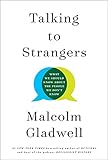
Editors Reads Verdict
Gladwell's most serious book since The Tipping Point examines the mechanisms underlying famous misreadings of strangers — from the Brock Turner case to the arrest of Sandra Bland — with unusually direct acknowledgment of how race complicates every encounter.
What We Loved
- The Amanda Knox and Ana Montes case studies are among Gladwell's finest narrative work
- The 'default to truth' concept is psychologically well-supported
- The coupling research — behavior is context-dependent, not universal — is genuinely important
- More willing than his earlier books to engage with race and institutional power
Minor Drawbacks
- The Sandra Bland chapter has been criticized for some of its interpretive choices
- The thesis requires accepting that multiple disparate phenomena share a single mechanism
- The audiobook format (designed to be heard) is better than the print version for some listeners
Key Takeaways
- → Default to truth: humans are evolutionarily wired to believe people are telling the truth
- → Transparency illusion: we assume that inner states are visible in outer expressions — they often aren't
- → Coupling: behavior is coupled to specific contexts — change the context and the behavior changes
- → Mismatched facial expressions (Neville Chamberlain with Hitler) are more common than we admit
- → Brief interactions between strangers are systematically prone to misreading across social difference
| Author | Malcolm Gladwell |
|---|---|
| Publisher | Little, Brown |
| Pages | 386 |
| Published | September 10, 2019 |
| Language | English |
| Genre | Psychology, Narrative Nonfiction |
| Difficulty | Beginner |
| Best For | General nonfiction readers interested in psychology, social dynamics, and the specific ways human cognition fails when we encounter unfamiliar people. |
How Talking to Strangers Compares
Talking to Strangers at a glance against 3 similar books readers weigh alongside it.
| Book | Author | Rating | Best for |
|---|---|---|---|
| Talking to Strangers (this book) | Malcolm Gladwell | ★ 4.0 | General nonfiction readers interested in psychology, social dynamics, and the |
| Blink | Malcolm Gladwell | ★ 4.3 | Anyone curious about the mechanics of intuition, snap judgment, and the |
| David and Goliath | Malcolm Gladwell | ★ 4.1 | General nonfiction readers interested in psychology, underdog narratives, and |
| Outliers | Malcolm Gladwell | ★ 4.5 | Anyone curious about the sociology of success, parents thinking about their |
Three Concepts About Strangers
Malcolm Gladwell frames Talking to Strangers around the death of Sandra Bland, a Black woman found dead in a Texas jail cell after a traffic stop that should have been routine. Working backward from that outcome, he identifies three mechanisms that make our interactions with strangers systematically unreliable.
Default to truth: humans are evolutionarily disposed to believe what they’re told. We do not approach strangers with baseline suspicion — we approach them with baseline trust, and we require substantial evidence before updating to distrust. This disposition is generally adaptive (societies function on it) and occasionally catastrophic (it allows con artists to operate, analysts to miss spies, police to trust their own impressions).
Transparency: we assume that inner states are visible in outer expressions. A person who looks innocent is innocent; a person who looks guilty is guilty. Research consistently shows that facial expressions and internal states are poorly correlated — the assumption of transparency leads to systematic misreading.
Coupling: behavior is coupled to specific contexts. Suicide rates in England dropped dramatically after the switch from coal gas to natural gas, not because suicidal people found other methods but because the specific method — gas ovens — was the one accessible in the specific context where suicidal impulses arose. Remove the method and the impulse often doesn’t find another.
The Most Serious Gladwell
Talking to Strangers is Gladwell’s most direct engagement with race in America, and the Sandra Bland frame gives the book a moral weight that his earlier titles rarely achieved. The mechanisms he describes — default to truth, transparency illusion, coupling — apply to all stranger interactions, but their consequences in encounters between police and Black civilians are particular and catastrophic in ways that Gladwell acknowledges directly.
The Contested Territory
The Sandra Bland chapter has received the most criticism, with some commentators arguing that Gladwell’s framing of the traffic stop attributes too much to miscommunication and too little to institutional racism. The criticism has merit. Gladwell’s mechanisms are real, but they operate within social contexts that those mechanisms alone don’t explain.
Our rating: 4.0/5 — Gladwell’s most morally serious book — the stranger-interaction mechanisms are real and important, the race engagement is more direct than his previous work, and the case studies are characteristically compelling.
Reading Guides
- 15 Books Like Outliers to Read Next
- All Malcolm Gladwell Books Ranked: Which One Should You Read First? (2026)
The Sandra Bland Case as Frame
Gladwell opens Talking to Strangers not with an abstract principle but with a specific event: the 2015 traffic stop in Prairie View, Texas, in which state trooper Brian Encinia stopped Sandra Bland for a minor lane-change violation and, through an escalating series of misreadings, ended up arresting her. Bland was found dead in her cell three days later. The medical examiner ruled her death a suicide.
Gladwell uses this case because it brings together all three of his proposed mechanisms — default to truth, transparency illusion, and coupling — in a single event that has been thoroughly documented through dashcam footage, cell phone recordings, and subsequent investigation. He argues that Encinia misread Bland’s behaviour as threatening because he was applying the transparency illusion to a person whose legitimate frustration he coded as aggression, and because the specific context of the traffic stop — the coupling of that roadside environment with escalating confrontation — made a de-escalation path difficult to find.
The argument is not that Encinia’s racism was irrelevant. It is that the mechanisms Gladwell identifies operate within and amplify the racial dynamics of the encounter. Critics who argue that the book attributes too much to cognitive mechanisms and too little to structural racism are making a point that Gladwell partially acknowledges without fully integrating.
The Case Studies
The book’s strongest sections are its more extended case studies. The analysis of the Amanda Knox case — in which Knox’s behaviour after the murder of her roommate Meredith Kercher was systematically misread by investigators across multiple countries because she did not perform grief in the expected way — is a compelling demonstration of how the transparency illusion produces catastrophic errors. Knox was not acting guilty; she was acting the way someone with Knox’s specific personality and cultural background acts when under extreme stress, which does not match the cultural script for innocent behaviour.
The analysis of Ana Montes, the DIA Cuba analyst who spied for Cuban intelligence for seventeen years while receiving performance awards from her supervisors, illustrates the default to truth. Montes gave off signals that colleagues, in retrospect, recognised as suspicious. But each individual signal was explainable in isolation, and the threshold of accumulated suspicion required to doubt a trusted colleague is extremely high — so high that human social functioning depends on it being high.
Why This Book Matters
Talking to Strangers is Gladwell’s most direct engagement with the social and institutional failures that produce specific, documented harm to specific people. It is less comfortable than his earlier books, and the discomfort is appropriate. The mechanisms he describes are not remote academic constructs; they are the cognitive patterns that determine how police encounters escalate, how intelligence agencies miss their own moles, and how ordinary misreadings of ordinary strangers can produce irreversible consequences.
Talking to Strangers was published in September 2019 and became a number-one New York Times bestseller. It remains Gladwell’s most direct engagement with race and institutional power, and the most consequential of his books for readers thinking about how social structures shape individual encounters.
Frequently Asked Questions
What is "Talking to Strangers" about?
Malcolm Gladwell examines how our faulty assumptions about strangers — particularly our default to truth and our coupling of behavior to context — lead to systematic errors with devastating consequences.
Who should read "Talking to Strangers"?
General nonfiction readers interested in psychology, social dynamics, and the specific ways human cognition fails when we encounter unfamiliar people.
What are the key takeaways from "Talking to Strangers"?
Default to truth: humans are evolutionarily wired to believe people are telling the truth Transparency illusion: we assume that inner states are visible in outer expressions — they often aren't Coupling: behavior is coupled to specific contexts — change the context and the behavior changes Mismatched facial expressions (Neville Chamberlain with Hitler) are more common than we admit Brief interactions between strangers are systematically prone to misreading across social difference
Is "Talking to Strangers" worth reading?
Gladwell's most serious book since The Tipping Point examines the mechanisms underlying famous misreadings of strangers — from the Brock Turner case to the arrest of Sandra Bland — with unusually direct acknowledgment of how race complicates every encounter.
Ready to Read Talking to Strangers?
Check the current price on Amazon.
Check Price on Amazon (paid link)Prices and availability are subject to change. See Amazon for current price.
Review last updated: