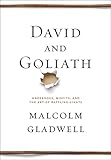
Editors Reads Verdict
Gladwell's fourth book deploys his characteristic narrative skill on a genuinely interesting central thesis — that our intuitive models of advantage and disadvantage systematically mislead us — though critics have questioned whether the supporting evidence fully carries the argument.
What We Loved
- The core insight — that advantages can be disadvantages and vice versa — is genuinely interesting
- Gladwell's narrative instincts are as sharp as ever — each case study is engaging
- The dyslexia research and the inverted-U curve are the book's strongest sections
- Accessible to general audiences without condescending
Minor Drawbacks
- The evidence for some causal claims is weaker than the narrative confidence implies
- Some critics have disputed the accuracy of specific case studies
- The thesis is sometimes stated more strongly than the evidence supports
Key Takeaways
- → The inverted-U curve: advantages produce diminishing returns beyond a certain point
- → Desirable difficulties — challenges that must be overcome — build capacities unavoidable advantages don't
- → Small ponds can be more productive of achievement than large ponds
- → Apparent weaknesses can generate compensatory strengths that genuine advantages do not
- → Institutional power has a point of diminishing returns that legitimate authority does not
| Author | Malcolm Gladwell |
|---|---|
| Publisher | Little, Brown |
| Pages | 305 |
| Published | October 1, 2013 |
| Language | English |
| Genre | Psychology, Narrative Nonfiction |
| Difficulty | Beginner |
| Best For | General nonfiction readers interested in psychology, underdog narratives, and the counterintuitive dimensions of success and failure. |
How David and Goliath Compares
David and Goliath at a glance against 3 similar books readers weigh alongside it.
| Book | Author | Rating | Best for |
|---|---|---|---|
| David and Goliath (this book) | Malcolm Gladwell | ★ 4.1 | General nonfiction readers interested in psychology, underdog narratives, and |
| Blink | Malcolm Gladwell | ★ 4.3 | Anyone curious about the mechanics of intuition, snap judgment, and the |
| Outliers | Malcolm Gladwell | ★ 4.5 | Anyone curious about the sociology of success, parents thinking about their |
| Talking to Strangers | Malcolm Gladwell | ★ 4.0 | General nonfiction readers interested in psychology, social dynamics, and the |
The Counterintuitive Advantage
The story of David and Goliath, Gladwell argues in his opening chapter, has always been misread. We assume Goliath had every advantage and David had none. In fact, David’s sling — a ranged weapon against an armored close-combat fighter — was a decisive advantage. David won not despite his apparent weakness but because of his tactical asymmetry.
This reframing establishes the book’s central project: examining how our intuitive models of advantage and disadvantage mislead us. The basketball team that pressed full-court every game and won the tournament despite having worse players. The dyslexic entrepreneur who built compensatory skills that the non-dyslexic never developed. The student who chose a lesser university and thrived, versus the equally talented student who chose the elite school and struggled.
The Inverted-U Curve
Gladwell’s best analytical tool in David and Goliath is the inverted-U relationship: the observation that the relationship between advantage and outcome is not linear. Up to a certain point, more resources, more intelligence, better institutions, larger class sizes — more of any good thing — produces better outcomes. Beyond that point, more produces worse outcomes. The optimal point differs for different variables.
The inverted-U explains why wealthy parents with unlimited resources for their children can produce offspring who struggle to generate their own motivation. It explains why class sizes below a certain threshold don’t improve educational outcomes. It explains why overwhelming military power can produce effective resistance rather than surrender.
Where the Critics Push Back
David and Goliath has been more contested by social scientists than Gladwell’s earlier books. The specific causal claims — that dyslexia produces entrepreneurial success, that attending a less prestigious institution produces better career outcomes — are debatable. The case studies, while narratively compelling, are selected to support the thesis rather than systematically assembled.
Gladwell’s characteristic response to such criticism is that he’s writing for general audiences, not academic ones. Whether that defense fully justifies the confidence with which he states uncertain findings is a question readers should bring to the book.
The Value Despite the Caveats
The central insight — that our intuitive models of advantage are too simple — is real and important regardless of whether every supporting example holds up. Gladwell at his best makes readers think differently about familiar things, and David and Goliath does that consistently.
Our rating: 4.1/5 — A characteristically engaging Gladwell investigation of a genuinely interesting thesis, with compelling case studies and an important central insight, despite evidentiary questions that attentive readers should hold in mind.
Reading Guides
- 15 Books Like Outliers to Read Next
- All Malcolm Gladwell Books Ranked: Which One Should You Read First? (2026)
The Underdogs Gladwell Chose
The case studies Gladwell assembled for David and Goliath are drawn from a wider historical and geographic range than his earlier books. Alongside the American stories — basketball teams, university choices, careers — he includes material on the dyslexia research of Rosalie Maggio, the civil rights movement’s Birmingham campaign of 1963, and the British Army’s counterinsurgency strategy in Northern Ireland during the Troubles. The breadth of the examples is deliberate: Gladwell is arguing that the dynamic of apparent weakness producing actual advantage is not culturally specific but structural.
The Northern Ireland section is among the book’s most carefully researched and most interesting. Gladwell argues, drawing on academic work by political scientists including Ivan Arreguin-Toft, that excessive military force used against civilian populations tends to generate resistance rather than compliance — that the British Army’s use of internment and the Bloody Sunday shootings served to increase support for the IRA rather than diminish it. This is a specific application of the inverted-U argument: institutional power has a point beyond which more force produces worse outcomes, not because it fails to intimidate but because it destroys the legitimacy that makes compliance willing rather than coerced.
The Dyslexia Research
The chapters on dyslexia and entrepreneurship are the book’s most empirically grounded section. Research has shown that dyslexia is substantially over-represented among successful entrepreneurs, trial lawyers, and others in fields requiring oral persuasion and creative problem-solving. The proposed mechanism is compensatory: children who cannot read normally are forced, in childhood, to develop alternative information-gathering strategies — listening, persuading, observing — that turn out to be highly valuable in adult professional contexts. The obstacle of dyslexia produces compensatory capabilities that the non-dyslexic never develops.
Gladwell presents this not as an argument that dyslexia is desirable but as evidence that disadvantages are not uniformly negative, and that the relationship between early challenge and later capability is more complex than the linear model of advantage implies.
Reception and the Accuracy Question
David and Goliath received more critical pushback from academics and journalists than any of Gladwell’s previous books. Specific case studies — including his account of civil rights lawyer Jay Freireich — were disputed by their subjects. His interpretation of the desirability of difficulties research was challenged by the researchers whose work he was citing. The Guardian and other publications ran detailed factual critiques.
Gladwell’s position, consistently stated, is that he is a journalist writing for a general audience, not an academic writing for specialists, and that the level of evidentiary precision appropriate for the two contexts differs. This position has both merit and limits: it is a legitimate defense of the popular-science genre, and it is also a way of avoiding accountability for specific factual claims. Attentive readers will want to hold both truths at once.
Frequently Asked Questions
What is "David and Goliath" about?
Malcolm Gladwell argues that what we consider disadvantages — dyslexia, class backgrounds, weak institutions — can become hidden sources of strength in the right circumstances.
Who should read "David and Goliath"?
General nonfiction readers interested in psychology, underdog narratives, and the counterintuitive dimensions of success and failure.
What are the key takeaways from "David and Goliath"?
The inverted-U curve: advantages produce diminishing returns beyond a certain point Desirable difficulties — challenges that must be overcome — build capacities unavoidable advantages don't Small ponds can be more productive of achievement than large ponds Apparent weaknesses can generate compensatory strengths that genuine advantages do not Institutional power has a point of diminishing returns that legitimate authority does not
Is "David and Goliath" worth reading?
Gladwell's fourth book deploys his characteristic narrative skill on a genuinely interesting central thesis — that our intuitive models of advantage and disadvantage systematically mislead us — though critics have questioned whether the supporting evidence fully carries the argument.
Ready to Read David and Goliath?
Check the current price on Amazon.
Check Price on Amazon (paid link)Prices and availability are subject to change. See Amazon for current price.
Review last updated: