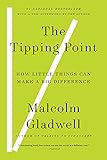
Editors Reads Verdict
Gladwell's first and most influential book introduced the viral spread model to popular culture. The Connector/Maven/Salesperson typology and the Stickiness Factor have become permanent additions to marketing and social science vocabulary.
What We Loved
- The epidemic model for idea spread is genuinely useful and widely applicable
- Three agent types (Connectors, Mavens, Salesmen) are memorable and practically useful
- The Power of Context chapter on crime reduction is compelling
- Made social network theory accessible before social media made it universal
Minor Drawbacks
- Some academic critics find the model oversimplified
- Network science research since publication has complicated some conclusions
- The prescriptions for creating tipping points are harder to apply than the description suggests
Key Takeaways
- → Social epidemics spread through three agent types: Connectors, Mavens, and Salesmen
- → The Stickiness Factor: small changes to message design can dramatically increase memorability
- → The Power of Context: environment and situation shape behaviour more than individual character
- → A small number of highly connected people can drive enormous social change
- → Tipping points occur when all three factors (agent, stickiness, context) align
| Author | Malcolm Gladwell |
|---|---|
| Publisher | Little, Brown |
| Pages | 304 |
| Published | March 1, 2000 |
| Language | English |
| Genre | Psychology, Sociology, Popular Science |
| Difficulty | Beginner |
| Best For | Marketers, social scientists, policy-makers, and anyone seeking to understand how ideas and behaviours spread through social networks. |
How The Tipping Point Compares
The Tipping Point at a glance against 3 similar books readers weigh alongside it.
| Book | Author | Rating | Best for |
|---|---|---|---|
| The Tipping Point (this book) | Malcolm Gladwell | ★ 4.3 | Marketers, social scientists, policy-makers, and anyone seeking to understand |
| Blink | Malcolm Gladwell | ★ 4.3 | Anyone curious about the mechanics of intuition, snap judgment, and the |
| Freakonomics | Steven D. Levitt | ★ 4.3 | Anyone curious about economics and the hidden forces shaping everyday decisions |
| Influence | Robert Cialdini | ★ 4.7 | Anyone who negotiates, sells, manages people, or simply wants to understand why |
The Book That Named a Phenomenon
Malcolm Gladwell published The Tipping Point in 2000, just before social media would render its concepts universally familiar. He borrowed the epidemiological term “tipping point” — the moment at which an epidemic crosses the threshold from contained to explosive — and applied it to social phenomena: why did crime rates in New York drop dramatically in the early 1990s? Why did Hush Puppies become fashionable again almost overnight? Why did Paul Revere’s midnight ride succeed in rousing the countryside when William Dawes’s identical ride did not?
The book’s framework answers these questions through three factors: the Law of the Few, the Stickiness Factor, and the Power of Context.
The Law of the Few
Not everyone spreads ideas equally. Gladwell identifies three types of exceptional individuals who drive social epidemics. Connectors know an extraordinary number of people across different social worlds and facilitate the jump of ideas between worlds. Mavens are information brokers who collect knowledge and share it enthusiastically. Salesmen are persuaders with unusual charisma and the ability to move people from interest to action.
Paul Revere succeeded and William Dawes didn’t not because of the content of their message but because Revere was a Connector who knew the right people in every town along his route.
The Stickiness Factor
The second factor concerns whether a message actually lodges in memory and motivates behaviour — its “stickiness.” Gladwell examines how Sesame Street and Blue’s Clues were engineered for maximum child stickiness through systematic testing and revision. Small changes to presentation can make the difference between forgettable and unforgettable.
The Power of Context
The third factor is the environment in which behaviour occurs. Gladwell’s analysis of New York’s crime drop credits the Broken Windows Theory: the city’s decision to aggressively address visible disorder (broken windows, graffiti, fare-jumping) changed the environmental cues that signal whether crime is acceptable. Context shapes behaviour in ways that overpower individual character.
Gladwell the New Yorker Writer
Malcolm Gladwell was born on September 3, 1963, in England and grew up in Ontario, Canada. He joined The New Yorker as a staff writer in 1996, four years before The Tipping Point appeared, and much of the book’s argument was developed through magazine pieces he had written over those years. His background is in journalism rather than academia, which shapes the book in both its virtues and its limitations: the writing is exceptional, the stories are carefully chosen, and the framework is applied with more narrative confidence than empirical caution.
The book arrived at a specific cultural moment — 2000, one year before the mainstream adoption of Google and two years before Friendster, MySpace, and the social networks that would make its core concepts part of everyday vocabulary. Gladwell was describing viral spread before the word “viral” had acquired its digital meaning. Readers who encountered the book in its first decade experienced the novelty of the framework itself; readers who come to it now often find they already know the vocabulary without knowing where it came from. That it named things people were already experiencing is one reason the book has lasted.
Context and Reception
The Tipping Point spent over four years on the New York Times bestseller list, a run that reflected both the accessibility of the writing and the genuine usefulness of the framework for practitioners in marketing, public health, and political organizing. The book’s influence on how organizations think about diffusion — particularly in public health communication and social marketing — has been substantial enough that academic researchers have both built on it and critiqued it in peer-reviewed literature.
The most significant academic criticism is that the framework overstates the importance of individual influencers relative to network structure. Network scientists, particularly Duncan Watts, have argued that ideas spread more like random sparks igniting dry tinder than like a chain of contacts from a single Connector. This critique does not invalidate Gladwell’s observations about individual roles, but it does suggest that the theory is more partial than the book implies.
The Book’s Enduring Vocabulary
Whatever the academic debate, the vocabulary of The Tipping Point has entered the language. Marketing departments use the Connector/Maven/Salesman typology without attribution. Public health campaigns are explicitly designed around the Stickiness Factor. Urban policy still debates the Broken Windows thesis that Gladwell elevated. A framework that generates twenty years of practical application and sustained academic argument has done something real in the world, regardless of whether it is the complete truth.
For readers new to social science, The Tipping Point remains the most accessible introduction to the idea that social change is not random, that it follows patterns, and that understanding those patterns can make you a more effective actor in the world.
Gladwell’s Method
It is worth understanding how Gladwell works. He is not a social scientist presenting findings; he is a journalist synthesizing research. His method is to find a compelling research result, identify the story that makes it vivid, and construct a narrative around both. This method produces books that are unusually readable and unusually accessible, and it sometimes produces oversimplifications that specialists find frustrating.
The honest position is that The Tipping Point is most reliably useful as a framework for generating questions rather than a system for answering them. When a marketer asks whether their audience has Connectors in it, they are asking a more productive question than they were before reading the book. When they assume the Connector model is a complete theory of diffusion, they are misusing it. Gladwell provides the questions; the answers require more work.
That combination of accessibility and limitation is what has made the book durable. It is not the last word on how ideas spread, but it was the first word written in a language that non-specialists could use — and that turns out to have been worth a great deal.
Final Verdict
The Tipping Point is an engaging, idea-rich exploration of social contagion that remains remarkably relevant in the age of social media. Its frameworks have been absorbed into marketing, public health, and political strategy.
Our rating: 4.3/5 — A seminal popular science book that introduced viral thinking to mainstream culture. Still relevant and readable two decades later.
Reading Guides
Frequently Asked Questions
What is "The Tipping Point" about?
An investigation into how ideas, trends, and social behaviours spread like epidemics — reaching a tipping point where a small change triggers a massive, cascading effect.
Who should read "The Tipping Point"?
Marketers, social scientists, policy-makers, and anyone seeking to understand how ideas and behaviours spread through social networks.
What are the key takeaways from "The Tipping Point"?
Social epidemics spread through three agent types: Connectors, Mavens, and Salesmen The Stickiness Factor: small changes to message design can dramatically increase memorability The Power of Context: environment and situation shape behaviour more than individual character A small number of highly connected people can drive enormous social change Tipping points occur when all three factors (agent, stickiness, context) align
Is "The Tipping Point" worth reading?
Gladwell's first and most influential book introduced the viral spread model to popular culture. The Connector/Maven/Salesperson typology and the Stickiness Factor have become permanent additions to marketing and social science vocabulary.
Ready to Read The Tipping Point?
Check the current price on Amazon.
Check Price on Amazon (paid link)Prices and availability are subject to change. See Amazon for current price.
Review last updated: