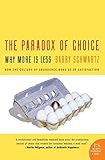
Editors Reads Verdict
Schwartz's provocative argument that more choice makes us worse off counters the liberal economic assumption that more options always help. The maximiser/satisficer distinction is immediately personally applicable.
What We Loved
- The maximiser/satisficer distinction is one of the most self-clarifying concepts in popular psychology
- The opportunity cost and counterfactual thinking sections are genuinely insightful
- Challenges the prevailing economic and political assumption that more choice is always better
- Short, focused, and readable without being superficial
Minor Drawbacks
- The core thesis has faced empirical challenges — not all studies replicate the choice overload effect
- Prescriptions are somewhat abstract
- The argument against abundance can feel uncomfortable in contexts where lack of choice is a real problem
Key Takeaways
- → More options increase the opportunity cost of every choice and amplify regret
- → Maximisers seek the best possible option; satisficers seek the good enough — satisficers report more happiness
- → Choice overload leads to decision paralysis — too many options can prevent any choice
- → Counterfactual thinking (what might have been) fuels dissatisfaction even with good choices
- → Artificially constraining your choices can improve satisfaction
| Author | Barry Schwartz |
|---|---|
| Publisher | HarperCollins |
| Pages | 265 |
| Published | January 6, 2004 |
| Language | English |
| Genre | Psychology, Philosophy, Self-Help |
| Difficulty | Beginner |
| Best For | Anyone feeling overwhelmed by modern abundance of options, or interested in the psychological relationship between freedom, choice, and wellbeing. |
How The Paradox of Choice Compares
The Paradox of Choice at a glance against 3 similar books readers weigh alongside it.
| Book | Author | Rating | Best for |
|---|---|---|---|
| The Paradox of Choice (this book) | Barry Schwartz | ★ 4.2 | Anyone feeling overwhelmed by modern abundance of options, or interested in the |
| Blink | Malcolm Gladwell | ★ 4.3 | Anyone curious about the mechanics of intuition, snap judgment, and the |
| Predictably Irrational | Dan Ariely | ★ 4.4 | Anyone interested in why people make the decisions they do — consumers, |
| Thinking, Fast and Slow | Daniel Kahneman | ★ 4.6 | Investors, doctors, lawyers, managers, policymakers, and any curious person who |
The Downside of Having Everything to Choose From
Barry Schwartz’s provocative thesis runs counter to virtually everything Western liberal culture assumes: more choice does not make people more free or happier — it makes them more anxious and less satisfied. In a consumer society that has expanded choice in almost every domain — from pasta sauce to career paths to relationship options — this argument feels uncomfortable precisely because it challenges something we’ve been told is unambiguously good.
The Paradox of Choice draws on Schwartz’s own research and a broad range of psychology literature to document the psychological costs of excessive optionality: decision paralysis, opportunity cost anxiety, counterfactual regret, and the escalating standards that come with unlimited alternatives.
Maximisers and Satisficers
The book’s most immediately applicable insight distinguishes two decision-making styles. Maximisers seek the best possible option — they survey all alternatives, compare exhaustively, and refuse to settle. Satisficers (a term Herbert Simon coined) seek an option that meets their criteria — “good enough” — and commit once they find it.
Counterintuitively, satisficers report consistently higher life satisfaction than maximisers. This is because maximisers bear higher search costs, suffer greater opportunity cost anxiety, and experience more regret when their choice falls short of the ideals they catalogued during exhaustive comparison. The maximiser always wonders about the option they didn’t choose.
The Opportunity Cost Effect
Every choice implicitly involves the rejection of alternatives, and those alternatives haunt us. When there were two options, the one you didn’t choose was the opportunity cost of your decision. When there were fifty options, you have forty-nine alternatives to regret. Schwartz documents how this arithmetic makes large choice sets psychologically expensive in ways that small ones are not.
Strategies for Coping
Schwartz’s practical suggestions include choosing when to choose (deliberately limiting your own search), satisficing rather than maximising, practising gratitude for what you have, and reducing exposure to alternatives after a decision is made. These are genuinely useful strategies rather than merely abstract insights.
Choice and Modern Unhappiness
The deeper argument beneath Schwartz’s analysis is a striking claim about the relationship between freedom and well-being in affluent societies. Western culture treats the expansion of choice as an unalloyed good, a near-synonym for freedom and a marker of progress, and within limits Schwartz agrees that some choice is vastly better than none. But he contends that the relationship is curvilinear: beyond a certain point, additional options stop adding freedom and start subtracting satisfaction, generating paralysis, regret, and rising expectations that no actual choice can meet. He connects this to a broader puzzle — that as material abundance and personal autonomy have increased dramatically in the developed world, measures of happiness have stagnated and rates of depression have climbed. The proliferation of choice, Schwartz suggests, is one underappreciated culprit, burdening individuals with responsibility for outcomes, multiplying the alternatives they might regret, and making the world feel like a series of tests they are perpetually failing.
Autonomy and Its Burdens
Schwartz extends his analysis from consumer goods to the weightier domains of modern life, where the expansion of options has been most celebrated and its costs least examined. Where previous generations inherited many of life’s defining frameworks — religion, career, community, the structure of relationships — contemporary individuals are increasingly expected to construct their own identities from an open field of possibilities, and Schwartz argues that this unprecedented autonomy is a mixed blessing. The freedom to choose one’s beliefs, partners, careers, and lifestyles from limitless alternatives is genuinely liberating, but it also imposes a heavy and unfamiliar burden: every aspect of a life becomes a decision for which the individual alone is responsible, and every road not taken becomes a potential source of regret. This is a more philosophically ambitious claim than the consumer examples suggest, linking the psychology of supermarket aisles to the existential weight of self-authorship in a culture that has dismantled the traditional structures that once made many choices for us.
Practical Wisdom
What rescues The Paradox of Choice from being merely a diagnosis of a modern malady is its constructive turn toward strategies for living better within an over-optioned world. Schwartz’s recommendations are genuinely actionable: become a satisficer rather than a maximizer in most domains, reserving exhaustive comparison only for the few decisions that truly warrant it; deliberately limit the number of options you consider; make some choices irreversible to silence the noise of second-guessing; practice gratitude for what you have rather than dwelling on what you forwent; and lower the expectations that unlimited choice inflates. The underlying wisdom is that the goal is not the objectively best outcome but a chosen outcome one can be at peace with, and that the discipline of “good enough” is, paradoxically, the route to greater satisfaction. These strategies translate the book’s insight into a usable philosophy, and they are the reason it has remained a reference point long after publication.
More Relevant Than Ever
Published in 2004, The Paradox of Choice has only grown more pertinent in the decades since, as the digital economy has multiplied options to a degree Schwartz could scarcely have imagined. The streaming catalogue with thousands of titles, the dating app with limitless profiles, the e-commerce site with endless variations of every product — each is a vivid confirmation of the dynamics Schwartz described, and the phenomenon of “decision fatigue” he helped popularize has entered everyday vocabulary. It is worth noting the honest caveat that some of the book’s original supporting studies, including the famous jam experiment, have faced replication challenges in subsequent research, and the size of the “choice overload” effect is now understood to be more context-dependent than the book implies. But the core psychological mechanisms — the burden of opportunity cost, the regret that proliferating alternatives generate, the distinction between maximizing and satisficing — remain broadly sound and intuitively recognizable, which is why the book endures as a touchstone for thinking about abundance and well-being.
Final Verdict
The Paradox of Choice makes an important and counterintuitive argument that has become more relevant as choice has continued to expand. Some of the original research has faced replication challenges, but the maximiser/satisficer distinction and the psychological mechanisms Schwartz describes remain broadly valid.
Our rating: 4.2/5 — A thoughtful challenge to the assumption that more choice is always better. The maximiser/satisficer distinction alone is worth reading the book.
Reading Guides
Frequently Asked Questions
What is "The Paradox of Choice" about?
A psychologist argues that the explosion of choice in modern life, while seemingly liberating, actually produces anxiety, paralysis, and dissatisfaction.
Who should read "The Paradox of Choice"?
Anyone feeling overwhelmed by modern abundance of options, or interested in the psychological relationship between freedom, choice, and wellbeing.
What are the key takeaways from "The Paradox of Choice"?
More options increase the opportunity cost of every choice and amplify regret Maximisers seek the best possible option; satisficers seek the good enough — satisficers report more happiness Choice overload leads to decision paralysis — too many options can prevent any choice Counterfactual thinking (what might have been) fuels dissatisfaction even with good choices Artificially constraining your choices can improve satisfaction
Is "The Paradox of Choice" worth reading?
Schwartz's provocative argument that more choice makes us worse off counters the liberal economic assumption that more options always help. The maximiser/satisficer distinction is immediately personally applicable.
Ready to Read The Paradox of Choice?
Check the current price on Amazon.
Check Price on Amazon (paid link)Prices and availability are subject to change. See Amazon for current price.
Review last updated: