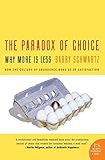
The Paradox of Choice
by Barry Schwartz
4.2
A psychologist argues that the explosion of choice in modern life, while seemingly liberating, actually produces anxiety, paralysis, and dissatisfaction.
Check Price on Amazon (paid link)American · b. 1946
Barry Schwartz is an American social psychologist whose book The Paradox of Choice challenged the assumption that more options always lead to greater happiness and satisfaction.
Barry Schwartz is a professor at UC Berkeley who spent his career studying the psychology of decision-making, and The Paradox of Choice — published in 2004 — was his attempt to bring those insights to a general audience. The central argument is counterintuitive enough to have earned the book a lasting place in popular psychology: more choice, beyond a certain threshold, makes people less satisfied rather than more, because it increases the burden of decision and amplifies regret about what was not chosen.
The book is organized around the psychology of “maximizers” (people who try to make the best possible choice) versus “satisficers” (people who choose when their threshold of good enough is met), and Schwartz argues that maximizers, despite often making objectively better choices, experience less satisfaction because they are more vulnerable to regret and comparison. The framework is genuinely useful, and the examples — from shopping for jeans to choosing healthcare plans — are well-chosen for illustration.
The honest caveats are worth noting: some of the key empirical work Schwartz relies upon, including jam studies and related choice-overload research, has had replication problems, and the relationship between choice abundance and unhappiness is more contested in the current literature than the book implies. Schwartz himself has acknowledged this in subsequent interviews. The book is best read as a thoughtful provocation about consumer culture and modern life rather than a definitive empirical account, but as such, it remains worth reading.
The deeper argument running beneath The Paradox of Choice is a critique of a foundational assumption of modern Western culture: that freedom of choice is an unalloyed good and that more of it is always better. Schwartz, a psychologist who spent decades studying decision-making and the relationship between economics and human wellbeing, does not argue against choice itself — he is careful to acknowledge that some choice is essential to autonomy and welfare. His point is subtler and more provocative: that the relationship between choice and wellbeing is curvilinear, rising at first and then falling, so that a society organised around the relentless multiplication of options can end up making its members more anxious, more regretful, and less satisfied, not freer and happier. This is a critique with teeth, because it cuts against the logic of consumer capitalism and the political rhetoric that equates expanded choice with expanded liberty. Schwartz suggests that the proliferation of options imposes hidden psychological costs — the labour of deciding, the anxiety of opportunity cost, the corrosive habit of comparison — that the culture of abundance refuses to acknowledge.
Schwartz’s work extends well beyond the single famous book, and across it runs a consistent concern with how modern institutions shape human flourishing for better and worse. In Practical Wisdom (2010), co-written with Kenneth Sharpe, he argues that rigid rules and incentive systems are eroding the practical judgement — the Aristotelian phronesis — that doctors, teachers, lawyers, and other professionals need to do their work well, and that no amount of regulation can substitute for the cultivated wisdom of a thoughtful practitioner. In Why We Work (2015), he challenges the reductive assumption that people labour chiefly for money, drawing on research to show that meaning, engagement, and the chance to make a difference matter profoundly to job satisfaction, and that workplaces designed around purely material incentives can crush the very motivation they intend to harness. His widely viewed TED talks distilled these ideas for enormous audiences. Taken together, the body of work amounts to a sustained humanistic argument: that the systems we build — economic, professional, educational — too often ignore what psychology actually tells us about what makes life good.
Schwartz occupies a notable place in the broader movement that brought behavioural psychology and the science of wellbeing into mainstream public conversation, alongside figures studying happiness, decision-making, and the limits of rationality. The Paradox of Choice in particular entered the cultural bloodstream, giving a name and a framework to an experience — the peculiar paralysis and dissatisfaction of standing before forty kinds of salad dressing — that many readers recognised instantly in their own lives. The concepts of the maximizer and the satisficer have become common currency in discussions of decision-making, productivity, and contentment. The scientific qualifications are real and worth keeping in view; the replication difficulties surrounding some choice-overload research mean the empirical story is messier than the book’s confident thesis suggests, and Schwartz has been admirably candid about this. Yet the book’s lasting value lies less in any single experiment than in its central provocation, which remains genuinely useful: that in a world engineered to offer us ever more, the path to satisfaction may lie not in choosing better but in learning, sometimes, to want less and to be content with good enough.
For most readers, The Paradox of Choice is the place to begin, and it remains the clearest entry into Schwartz’s thinking, provided one reads it with awareness of the later debates over the strength of its supporting research. Approached as a thoughtful argument about consumer culture and the psychology of decision rather than as settled empirical fact, it still offers a genuinely useful lens on the dissatisfactions of abundance. Those persuaded by it will find the ideas deepened in Practical Wisdom, which extends the critique to the professions and the corrosive effects of rules and incentives on good judgement, and in Why We Work, his concise and humane case that meaning matters more than money in a working life. His TED talks distill the central provocations into a form accessible to anyone in twenty minutes. Taken together, Schwartz’s work amounts to a sustained and still-relevant argument that the systems shaping modern life too often ignore what actually makes people content.
by Barry Schwartz
A psychologist argues that the explosion of choice in modern life, while seemingly liberating, actually produces anxiety, paralysis, and dissatisfaction.
Check Price on Amazon (paid link)Disclosure: Amazon links on this page are affiliate links. If you purchase through them we earn a small commission at no extra cost to you.