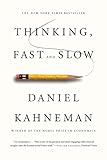
Daniel Kahneman was a Nobel Prize-winning psychologist whose Thinking, Fast and Slow introduced millions of readers to the cognitive biases that shape human judgment and decision-making.
Daniel Kahneman spent his career as a research psychologist — first at Hebrew University and later at Princeton — conducting experiments with his longtime collaborator Amos Tversky that fundamentally changed how economists, psychologists, and policymakers think about human decision-making. Their work demonstrated that people systematically deviate from rational choice in predictable ways — that judgment under uncertainty is shaped by cognitive shortcuts and biases that lead to consistent errors. Kahneman was awarded the Nobel Prize in Economics in 2002 for this work, and Thinking, Fast and Slow, published in 2011, made his life’s research accessible to a general audience.
The book organizes decades of findings around the metaphor of two systems: System 1, the fast, automatic, intuitive mode of thinking, and System 2, the slow, effortful, deliberate mode. The framework is a useful organizing device rather than a literal neurological description, and Kahneman is careful to note its limitations. The experiments he describes — anchoring, framing effects, the availability heuristic, the planning fallacy, prospect theory — are among the most replicated findings in social science, and Kahneman presents them with intellectual honesty about what they do and don’t establish.
Thinking, Fast and Slow is long and demanding, and some readers find the later sections on well-being and memory less compelling than the earlier material on judgment. The replication crisis in social psychology has affected some studies in the book, and Kahneman has been unusually candid about acknowledging this. Despite these caveats, it remains one of the most important works of popular psychology of the past few decades — a book that genuinely changes how readers see their own thinking.
Reading Guides