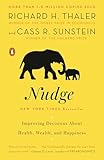
Editors Reads Verdict
Nudge introduces the powerful idea of libertarian paternalism — designing choice environments that make it easier for people to do what is good for them, while preserving their freedom to choose otherwise.
What We Loved
- Accessible introduction to behavioral economics for general readers
- Concrete real-world policy applications across retirement, health, and environment
- Witty writing makes dense social science genuinely enjoyable
Minor Drawbacks
- Some libertarian critics question whether nudging still constrains genuine autonomy
- Policy examples occasionally feel dated given how quickly defaults change
Key Takeaways
- → Default options are the most powerful nudge — most people stick with whatever is pre-selected
- → Choice architecture shapes behavior even when people believe they are deciding freely
- → Libertarian paternalism can improve outcomes without banning any choices
| Author | Richard Thaler & Cass Sunstein |
|---|---|
| Published | January 1, 2008 |
| Language | English |
| Genre | Economics, Psychology, Policy |
| Difficulty | Beginner |
| Best For | Policy makers, business leaders, and anyone curious about how environment shapes human decisions. |
How Nudge Compares
Nudge at a glance against 3 similar books readers weigh alongside it.
| Book | Author | Rating | Best for |
|---|---|---|---|
| Nudge (this book) | Richard Thaler & Cass Sunstein | ★ 4.5 | Policy makers, business leaders, and anyone curious about how environment |
| 12 Rules for Life | Jordan B. Peterson | ★ 4.5 | Anyone seeking a philosophically grounded framework for living responsibly and |
| 1776 | David McCullough | ★ 4.5 | American history readers, students of leadership, and anyone who wants to |
| 21 Lessons for the 21st Century | Yuval Noah Harari | ★ 4.1 | Readers already familiar with Harari's work who want his take on contemporary |
Nudge Review
Richard Thaler and Cass Sunstein began with a simple, unsettling observation: the way choices are arranged matters enormously, even when the options themselves stay the same. Workers enrolled in a 401(k) by default save far more than those who must opt in. Cafeterias that place fruit at eye level sell more fruit without removing a single cookie. Countries with opt-out organ donation have dramatically higher donor rates than those with opt-in. These aren’t manipulations in any sinister sense — they are nudges, and the authors’ central provocation is that any organisation designing a choice environment is already nudging people, whether it realises it or not. There is no neutral way to lay out a cafeteria, a form, or a default. The only real question is whether the design is thoughtful.
Econs, Humans, and Two Systems
The book’s foundation is a quarrel with the economist’s caricature of the rational decision-maker. Thaler and Sunstein distinguish between “Econs” — the flawless optimisers of textbook theory — and “Humans,” the rest of us, who rely on mental shortcuts and make predictable mistakes. They map this onto the now-familiar pair of mental systems: the fast, automatic, intuitive System 1 and the slow, effortful, reflective System 2. Because we lean on System 1 far more than we like to admit, we are systematically swayed by biases — status quo bias, loss aversion, present bias, anchoring, and the sheer power of inertia — and good choice architecture can either exploit those tendencies or gently correct for them.
Choice Architecture and the Power of Defaults
The book’s most practically important lesson is the staggering power of the default. Whatever option is pre-selected becomes, for most people, the option chosen, simply because changing it requires attention and effort that busy Humans rarely spend. From this insight flows the authors’ signature proposal, “Save More Tomorrow,” a programme that nudges workers into committing future pay rises to retirement savings and which has measurably lifted savings rates in the real world. Thaler and Sunstein walk through application after application — mortgages, prescription drug plans, school choice, organ donation, energy use, and environmental policy — showing in each case how a small structural change produces a large behavioural shift without removing anyone’s freedom.
Libertarian Paternalism
What makes the book intellectually durable is its insistence on “libertarian paternalism,” a phrase that sounds at first like an oxymoron and turns out to be a genuine synthesis. The libertarian half preserves freedom: no option is banned, and anyone can opt out of an arrangement they dislike, ideally at minimal cost. The paternalist half is the modest claim that it is legitimate for choice architects to steer people toward decisions that make their lives longer, healthier, or richer — by their own lights, not the planner’s. Institutions simply make the better choice the path of least resistance.
Criticisms and the Debate It Started
The thesis has drawn fire from both flanks. Critics on the right worry that even gentle steering subtly manipulates citizens and erodes autonomy; critics on the left counter that nudges can become a cheap substitute for the harder structural reforms that real problems demand. Thaler and Sunstein engage these objections seriously and with characteristic wit, and in later editions they confront the dark mirror of the nudge — what they call “sludge,” the deliberately obstructive friction that companies and bureaucracies use to trap people in bad arrangements. That even-handedness is part of why the book has aged better than most policy manifestos.
Nudges in Everyday Life
Part of the book’s lasting appeal is how vividly it makes you see the choice architecture all around you. Once you have read it, you cannot un-notice the nudges woven into daily life: the painted fly in the Schiphol Airport urinal that improved aim and cut cleaning costs; the way a menu’s layout steers you toward certain dishes; the automatic enrolment that quietly shapes your pension; the “are you sure you want to leave?” prompts engineered to keep you subscribed. The authors are careful to distinguish nudges that serve the chooser from those engineered to serve the seller, and that distinction — design for people versus design on people — is the ethical heart of the book.
Strengths and Limits as a Read
As a piece of writing, Nudge is unusually approachable for a book grounded in serious social science, leavened by the authors’ dry humour and a generous supply of stories. It is not flawless: some of the original policy examples now feel dated, defaults having shifted in the years since publication, and readers wanting rigorous statistical proof rather than persuasive illustration will need to look to the underlying academic literature. But as an on-ramp to behavioural economics for the general reader, it has no real peer.
Influence and Verdict
Few academic books have had so concrete an impact. Nudge helped seed behavioural-insight teams inside governments worldwide — most famously Britain’s “Nudge Unit” — and its vocabulary of choice architecture is now standard in business, public health, and product design. Thaler went on to win the 2017 Nobel Prize in Economics, and the authors issued a revised “final edition” to update the examples for a digital age. Even readers who reject some of its prescriptions come away with a permanently altered understanding of how humans actually decide and how the systems around them can be redesigned to help. Witty, humane, and genuinely useful, it is essential reading for anyone who designs systems, manages an organisation, or simply wants to understand why people so reliably fail to act in their own interest.
Our rating: 4.5/5 — The accessible landmark of behavioural economics, and the book that put “nudge” into the language.
Reading Guides
Frequently Asked Questions
What is "Nudge" about?
Richard Thaler and Cass Sunstein show how small changes to the way choices are presented can steer people toward better decisions without restricting freedom.
Who should read "Nudge"?
Policy makers, business leaders, and anyone curious about how environment shapes human decisions.
What are the key takeaways from "Nudge"?
Default options are the most powerful nudge — most people stick with whatever is pre-selected Choice architecture shapes behavior even when people believe they are deciding freely Libertarian paternalism can improve outcomes without banning any choices
Is "Nudge" worth reading?
Nudge introduces the powerful idea of libertarian paternalism — designing choice environments that make it easier for people to do what is good for them, while preserving their freedom to choose otherwise.
Ready to Read Nudge?
Check the current price on Amazon.
Check Price on Amazon (paid link)Prices and availability are subject to change. See Amazon for current price.
Review last updated: