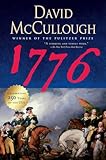
Editors Reads Verdict
1776 is McCullough doing what he does better than anyone: taking an event whose outcome we know and making the contingency of that outcome feel real. His portrait of Washington as a flawed, learning, frequently desperate commander gives the founding year a human texture that hagiographic accounts miss entirely.
What We Loved
- McCullough's narrative drive makes the military campaigns of 1776 as gripping as they should be
- The portrait of Washington as human, fallible, and genuinely at risk of losing everything is the book's most valuable contribution
- The British perspective (drawn from British archives) adds a dimension that most American histories of this period lack
- At 294 pages, it is McCullough's most concentrated and focused work
Minor Drawbacks
- The focus on military history means the political and intellectual dimensions of 1776 are largely absent
- Some readers will want more on the social history — the experience of ordinary soldiers and civilians
- McCullough's prose, while always accessible, occasionally lapses into reverence that edges toward hagiography
Key Takeaways
- → The American Revolution was militarily disastrous for most of 1776 — Washington's army was repeatedly routed and nearly destroyed
- → Washington's greatest quality in 1776 was persistence: the ability to hold an army together through repeated defeat
- → The British prosecution of the war was marked by overconfidence and strategic errors that American success required
- → The crossing of the Delaware and the Trenton victory were militarily minor but psychologically essential
- → Contingency, not inevitability, defined 1776 — at multiple points, a different decision would have ended the revolution
| Author | David McCullough |
|---|---|
| Publisher | Simon & Schuster |
| Pages | 294 |
| Published | May 24, 2005 |
| Language | English |
| Genre | History, Nonfiction, American History |
| Difficulty | Beginner |
| Best For | American history readers, students of leadership, and anyone who wants to understand the military dimension of the founding year through a narrative lens. |
How 1776 Compares
1776 at a glance against 3 similar books readers weigh alongside it.
| Book | Author | Rating | Best for |
|---|---|---|---|
| 1776 (this book) | David McCullough | ★ 4.5 | American history readers, students of leadership, and anyone who wants to |
| A Promised Land | Barack Obama | ★ 4.5 | Political readers interested in the Obama presidency from the inside, those |
| John Adams | David McCullough | ★ 4.6 | American history readers, biography enthusiasts, and anyone interested in the |
| The Power Broker | Robert Caro | ★ 4.8 | Serious readers of biography, history, and politics who want to understand how |
The Year That Could Have Gone the Other Way
One of the persistent distortions of American founding mythology is inevitability: the colonies were always going to win, Washington was always going to prevail, independence was always going to be achieved. David McCullough’s great achievement in 1776 is to restore the contingency that all of that mythology has obscured. The revolution nearly failed. Multiple times. And understanding how close the failure came is what makes the eventual success genuinely meaningful.
McCullough focuses tightly: this is the military story of 1776, from the siege of Boston through the catastrophes in New York and New Jersey and finally to the desperate gamble of the Delaware crossing and the Trenton victory. He draws on British and American archives, private letters, and diaries to reconstruct events at the granular level — what the weather was like, what specific commanders said to each other, what the troops on the ground actually experienced.
Washington as He Actually Was
The most valuable thing 1776 does is render George Washington as a human being rather than a monument. In this year, Washington was a Virginia planter with no serious military experience commanding a Continental Army that was frequently untrained, often drunk, usually ragged, and repeatedly beaten. His strategic judgment was poor for much of the year. His tactical decisions were sometimes disastrous. And his army shrank by desertion every time the situation became genuinely dangerous.
What Washington had — and what McCullough shows with great care — was persistence and the ability to inspire loyalty in people who had every reason to walk away. The Trenton victory was not a masterstroke; it was the survival of a commander who had learned, painfully and through repeated failure, what his actual skills were and where to apply them.
The British Perspective
One of the book’s distinguishing features is its use of British sources — the letters and diaries of British officers who were often contemptuous of the American military effort and genuinely puzzled by their inability to finish it off. This perspective is both illuminating and slightly funny: the British commanders had every material advantage and repeatedly failed to press it to conclusion. The combination of British overconfidence and American stubbornness is what the war actually turned on.
Concentrated History at Its Best
At 294 pages, 1776 is McCullough’s most focused book, and possibly his best. The tight temporal and thematic scope allows him to achieve a narrative intensity that his longer biographies must occasionally sacrifice to coverage. For readers who want to understand what the founding year actually felt like — uncertain, desperate, and far more contingent than any textbook suggests — there is no better starting point.
Our rating: 4.5/5 — McCullough at his most concentrated and compelling, restoring the terror and contingency of 1776 to a story that mythology has made to seem inevitable.
The Most Concentrated of McCullough’s Books
1776 was published in 2005, and among McCullough’s major works it is the most tightly focused — 294 pages devoted not to a whole life but to a single, pivotal year of the American Revolution. The concentration is the point. By narrowing his scope to the military events of one year, McCullough is able to achieve a narrative intensity that his sprawling biographies, with their obligations to cover entire careers, cannot always sustain. The book reads less like a survey than like a campaign told from inside the tent.
Restoring the Contingency
The deepest service the book performs is the restoration of uncertainty to a story that mythology has rendered inevitable. American founding lore tends to treat independence as foreordained, but 1776 was, for much of its length, a military disaster: an inexperienced commander, a Continental Army that shrank with every reverse, a string of defeats around New York that nearly ended the war before it could be won. McCullough makes the reader feel how close the whole enterprise came to collapse, and that recovered sense of contingency is what gives the eventual survival its meaning.
Washington and the British
McCullough’s Washington is a man learning on the job — frequently wrong about tactics, sometimes disastrously so, but possessed of the one quality the year demanded above all others: the persistence to hold an army together through repeated defeat. This is a portrait of leadership as endurance rather than genius, and it is more useful and more honest than the monument it replaces.
The book’s other distinguishing feature is its use of British archives, which let McCullough show the war from the perspective of officers who held every material advantage and could not understand their inability to finish the job. The combination of British overconfidence and American stubbornness, drawn from sources on both sides, is what the year actually turned on. For readers who want to understand the military texture of the founding year — and to feel why the Delaware crossing and the Trenton victory mattered so much out of all proportion to their tactical scale — 1776 is the ideal point of entry, McCullough working at his most disciplined and his most gripping.
What the Narrow Focus Leaves Out
The discipline of 1776 is also its most obvious limitation, and an honest assessment should name it. By confining himself to the military events of a single year, McCullough largely sets aside the political and intellectual dimensions of the Revolution — the arguments, the ideas, the constitutional questions — that animated the cause the soldiers were fighting for. Readers who want to understand why the Revolution happened, as opposed to how its decisive year unfolded on the ground, will need to look to McCullough’s John Adams or to other accounts of the period. The social history is similarly thin: the experience of ordinary soldiers and civilians appears, but it is not the book’s primary concern.
These are choices rather than failures, and they are the price of the concentration that makes the book work so well on its own terms. 1776 is a campaign narrative, and it does that one thing about as well as it can be done. The reverence that occasionally creeps into McCullough’s prose — the tendency to let admiration for Washington edge toward the hagiographic — is the recurring risk of his method, but it rarely overwhelms the more valuable portrait of a fallible commander learning his trade under fire. Taken for what it is, the book is a model of how to make a known outcome feel genuinely uncertain.
Frequently Asked Questions
What is "1776" about?
David McCullough narrates the military history of 1776 — the year of American independence — through the campaigns, retreats, and nearly disastrous reverses that shaped the Revolutionary War's decisive year.
Who should read "1776"?
American history readers, students of leadership, and anyone who wants to understand the military dimension of the founding year through a narrative lens.
What are the key takeaways from "1776"?
The American Revolution was militarily disastrous for most of 1776 — Washington's army was repeatedly routed and nearly destroyed Washington's greatest quality in 1776 was persistence: the ability to hold an army together through repeated defeat The British prosecution of the war was marked by overconfidence and strategic errors that American success required The crossing of the Delaware and the Trenton victory were militarily minor but psychologically essential Contingency, not inevitability, defined 1776 — at multiple points, a different decision would have ended the revolution
Is "1776" worth reading?
1776 is McCullough doing what he does better than anyone: taking an event whose outcome we know and making the contingency of that outcome feel real. His portrait of Washington as a flawed, learning, frequently desperate commander gives the founding year a human texture that hagiographic accounts miss entirely.
Ready to Read 1776?
Check the current price on Amazon.
Check Price on Amazon (paid link)Prices and availability are subject to change. See Amazon for current price.
Review last updated: