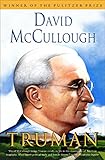
Editors Reads Verdict
Truman is a monumental biography that rescues one of America's great presidents from undeserved obscurity, combining exhaustive research with McCullough's peerless narrative gift to create a portrait of character under pressure.
What We Loved
- Pulitzer Prize winner representing the very pinnacle of American narrative biography
- Extraordinary depth from McCullough's access to Truman family papers and interviews
- Brings to life the atomic bomb decision, the Berlin Airlift, and Korean War with gripping immediacy
Minor Drawbacks
- At nearly 1,000 pages, the book requires a serious time commitment
- McCullough's admiration for Truman occasionally tips toward hagiography in the later chapters
Key Takeaways
- → Character — not genius or charisma — is the most durable foundation for consequential leadership
- → Truman's lack of pretension and directness was a political asset as much as a personal trait
- → The decisions of a single presidency can reshape the entire geopolitical order for generations
| Author | David McCullough |
|---|---|
| Published | January 1, 1992 |
| Language | English |
| Genre | Biography, History, Politics |
| Difficulty | Intermediate |
| Best For | History buffs, biography enthusiasts, and anyone interested in American political history or the dynamics of leadership under extreme pressure. |
How Truman Compares
Truman at a glance against 3 similar books readers weigh alongside it.
| Book | Author | Rating | Best for |
|---|---|---|---|
| Truman (this book) | David McCullough | ★ 4.8 | History buffs, biography enthusiasts, and anyone interested in American |
| 1776 | David McCullough | ★ 4.5 | American history readers, students of leadership, and anyone who wants to |
| 1984 | George Orwell | ★ 4.7 | Every adult in a democracy |
| 21 Lessons for the 21st Century | Yuval Noah Harari | ★ 4.1 | Readers already familiar with Harari's work who want his take on contemporary |
When David McCullough published Truman in 1992, Harry Truman was still widely regarded as a minor president — an accidental successor to FDR who had muddled through one of the most consequential periods in American history. McCullough’s Pulitzer Prize-winning biography demolished that view so thoroughly that it essentially created the modern Truman reputation. Today Truman consistently ranks among the top ten American presidents in scholarly surveys, and McCullough’s 992-page account is a significant reason why.
The book traces Truman’s life from his Missouri childhood — dirt-poor by presidential standards, defined by farm work and voracious reading — through his failed haberdashery, his political education in the corrupt Pendergast machine, his Senate career, his unlikely vice-presidential selection, and his sudden elevation to the presidency on FDR’s death in April 1945. McCullough is especially brilliant on the sheer weight of what Truman inherited in that moment: a war on two fronts, an atomic bomb whose existence he had barely been briefed on, and a cabinet full of men who had expected never to work for him. His account of Truman’s first weeks in office is among the finest presidential narrative writing in existence.
The central chapters dealing with the atomic bomb decision are appropriately complex. McCullough does not shy away from the moral enormity of Hiroshima and Nagasaki, but he contextualizes Truman’s thinking within what was known and believed in August 1945 — the projected casualties of a Japanese land invasion, the emperor’s unwillingness to surrender — without rendering a final verdict. Equally compelling are the Berlin Airlift, the recognition of Israel, the firing of General MacArthur, and the improbable 1948 re-election that everyone except Truman had conceded before the polls opened.
Truman the man is what makes this biography exceptional. McCullough draws a portrait of a fundamentally decent, stubbornly honest, occasionally volcanic man who was not glamorous, did not seek the office he held, and was underestimated at almost every turn by almost everyone. The book’s implicit argument — that character, more than brilliance or charisma, is the truest measure of a president — is made not through assertion but through 992 pages of meticulous, loving evidence.
A Biography That Created a Reputation
Truman was published in 1992 and won the Pulitzer Prize, and its influence on how Americans remember Harry S. Truman is difficult to overstate. Few works of popular history have so thoroughly reshaped the public standing of their subject. The Truman that McCullough recovered — plainspoken, stubborn, fundamentally honest, and far more consequential than his contemporaries had credited — became the Truman of the national imagination, and the steady climb of Truman’s reputation in scholarly and popular rankings tracks closely with the reach of this book.
The Shape of the Life
McCullough’s narrative gift is at its most assured in the architecture of the life itself. He moves from the Missouri farm and the failed haberdashery through the political machine, the Senate, and the abrupt elevation to the presidency in 1945, and he makes the reader feel the vertigo of a man who inherited a world war and an atomic weapon he had barely been told existed. The set pieces — the decision to use the bomb, the Berlin Airlift, the recognition of Israel, the firing of MacArthur, the impossible 1948 re-election — are handled with the pacing of a novelist and the documentation of a historian.
Character as Argument
The book’s central claim is made not by assertion but by accumulation across its great length: that character, more than brilliance or charisma, is the most durable foundation for leadership. Truman’s directness and lack of pretension, McCullough argues, were political assets rather than mere personal quirks, and the decisions of his single presidency reshaped the geopolitical order for generations. The sheer scale of the book — nearly a thousand pages — is part of the method, since the case for Truman’s character can only be made by living alongside him through enough decisions to see the consistency.
The cost of this approach is the one McCullough’s critics most often name: his admiration for Truman occasionally edges toward hagiography, particularly in the later chapters, and readers who want a more skeptical accounting of Truman’s failures will find the book’s sympathies firmly settled. But as a work of narrative biography, Truman remains a high-water mark — a book that demonstrates how thoroughly a great biographer can rehabilitate a misjudged figure simply by paying close, sustained, generous attention to the evidence of a life.
The Research Behind the Portrait
The authority of Truman rests on the depth of McCullough’s research. He drew on the Truman family papers and on extensive interviews, and the texture of the resulting book — its access to private correspondence, its sense of what Truman was thinking in moments the public never saw — gives it an intimacy that more conventional political histories cannot reach. This is biography built from the inside out, and the cumulative effect of so much closely observed detail is to make a president who was long dismissed as ordinary feel, by the end, genuinely knowable.
That intimacy is also what allows McCullough to dramatize the great crises of the presidency with such immediacy. The atomic bomb decision, the Berlin Airlift, and the Korean War are not rendered as abstract policy turning points but as choices made by a specific man under specific, almost unimaginable pressure, with incomplete information and no precedent to guide him. McCullough’s refusal to deliver a tidy verdict on the bomb in particular — his insistence on contextualizing Truman’s thinking within what was known and believed in August 1945 — is characteristic of the book’s larger seriousness. It would have been easier to judge; McCullough chooses instead to understand, and the understanding is harder won and more valuable.
Frequently Asked Questions
What is "Truman" about?
The Pulitzer Prize-winning biography of Harry S. Truman, one of America's most consequential and underestimated presidents.
Who should read "Truman"?
History buffs, biography enthusiasts, and anyone interested in American political history or the dynamics of leadership under extreme pressure.
What are the key takeaways from "Truman"?
Character — not genius or charisma — is the most durable foundation for consequential leadership Truman's lack of pretension and directness was a political asset as much as a personal trait The decisions of a single presidency can reshape the entire geopolitical order for generations
Is "Truman" worth reading?
Truman is a monumental biography that rescues one of America's great presidents from undeserved obscurity, combining exhaustive research with McCullough's peerless narrative gift to create a portrait of character under pressure.
Ready to Read Truman?
Check the current price on Amazon.
Check Price on Amazon (paid link)Prices and availability are subject to change. See Amazon for current price.
Review last updated: