Editors Reads Verdict
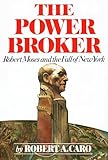
The Power Broker is the greatest American biography ever written — a 1,336-page monument to the proposition that the exercise of power can be understood if you are willing to do the work of understanding it. Caro's portrait of Robert Moses is simultaneously a biography, a history of New York, a theory of power, and a moral argument about what power without accountability costs the people in its path.
What We Loved
- The depth and quality of research is simply unmatched in American biography — Caro conducted thousands of interviews over years
- The portrait of power — how it is accumulated, exercised, and corrupted — is the most complete in the literature
- Caro's prose achieves a quality of sustained moral seriousness that is genuinely rare in popular nonfiction
- The book reveals how cities are actually built — the politics, the money, the displaced communities — in permanent and irreplaceable ways
Minor Drawbacks
- At 1,336 pages, the book requires a significant time commitment that many readers cannot or will not make
- The comprehensiveness that is its greatest strength occasionally produces sections that feel over-reported
- Moses himself is such a compelling villain that some of his genuine accomplishments are slightly undersold
Key Takeaways
- → Power accretes to those who understand its mechanisms better than anyone around them, regardless of elected office
- → The people displaced by urban renewal are the true hidden cost of modernization, and they are rarely counted
- → Institutions can be wielded like weapons by those who understand their rules better than those nominally in charge
- → Caro's Law: power does not corrupt, but it does reveal — and what it revealed in Moses was always latent
- → A biography of a single person can function as a theory of how an entire civilization organizes itself
| Author | Robert Caro |
|---|---|
| Publisher | Knopf |
| Pages | 1336 |
| Published | September 16, 1974 |
| Language | English |
| Genre | Biography, History, Politics |
| Difficulty | Advanced |
| Best For | Serious readers of biography, history, and politics who want to understand how power actually works in democratic societies — and are willing to commit the time required. |
How The Power Broker Compares
The Power Broker at a glance against 3 similar books readers weigh alongside it.
| Book | Author | Rating | Best for |
|---|---|---|---|
| The Power Broker (this book) | Robert Caro | ★ 4.8 | Serious readers of biography, history, and politics who want to understand how |
| A Promised Land | Barack Obama | ★ 4.5 | Political readers interested in the Obama presidency from the inside, those |
| John Adams | David McCullough | ★ 4.6 | American history readers, biography enthusiasts, and anyone interested in the |
| Long Walk to Freedom | Nelson Mandela | ★ 4.7 | Readers of political biography and autobiography, those seeking perspective on |
The Definition of Monumental
There is a case to be made — and it has been made, repeatedly, by people who have read everything — that The Power Broker is the greatest American biography ever written. It is certainly the longest, at 1,336 pages. It is certainly among the most researched: Robert Caro spent seven years interviewing thousands of people and excavating archives that no one had previously thought to examine. And it is certainly the one that best explains how power works in the United States when it is exercised by someone who is never elected to anything.
Robert Moses built, directly or indirectly, virtually every major piece of public infrastructure in New York City and New York State between 1924 and 1968: the highways, the parks, the bridges, the public housing, the beach facilities, the tunnels. He held, at his peak, twelve different appointed positions simultaneously. He controlled billions of dollars in public funds. He answered to no one. He was never elected to anything.
How Power Accumulates
The Power Broker’s deepest intellectual contribution is its theory of how power accumulates outside democratic structures. Moses understood something that most politicians don’t: that the boring, technical, procedural mechanisms of government — the fine print in bond covenants, the structure of public authorities, the control of contracts — are the actual levers of power, not the visible offices that most people fight over.
Caro traces Moses’s acquisition of this understanding from his early career as a Progressive Era reformer through his decades of essentially unaccountable mastery. The transformation — from idealistic young man who wanted to reform government to autocratic builder who regarded ordinary citizens as obstacles — is the book’s biographical arc and its moral argument.
The Human Cost
What prevents The Power Broker from being merely an admiring portrait of a formidable operator is Caro’s unsparing attention to what Moses’s power cost the people in its path. The highways he built through New York’s outer boroughs displaced hundreds of thousands of poor and working-class residents, mostly Black and Hispanic, with minimal compensation and no political recourse. The design of his bridges (low clearance over parkways connecting to his beaches) deliberately prevented buses — and therefore the Black and poor residents who relied on them — from reaching the public parks he built for white Long Island suburbanites.
These chapters are the most morally serious in the book, and they make it impossible to read The Power Broker as a simple story of accomplishment. The question Caro implicitly poses — what did all of this cost, and who paid it? — is one that every society building infrastructure should ask about itself.
Why You Should Read 1,336 Pages
The Power Broker is long. Reading it is a commitment of weeks rather than days. But readers who complete it report something close to the feeling of having understood something fundamental about how the world actually works — not as civics class describes it, but as power actually operates in cities, in democracies, and in the hands of a man who understood both well enough to bend them to his will.
Our rating: 4.8/5 — The greatest American biography ever written, and the most complete account of how power accumulates and is exercised available in any form — worth every one of its 1,336 pages.
Seven Years of Turning Every Page
The research behind The Power Broker is a story in itself, and it is inseparable from the book’s authority. Caro spent roughly seven years on the project, conducting thousands of interviews and excavating archives that no previous researcher had thought to examine. His governing principle — later distilled in his memoir as “turn every page” — meant reading every document in a collection rather than sampling, on the conviction that the decisive fact is usually the one a lazier researcher would miss. The result is a density of evidence that makes the book’s most damning conclusions impossible to wave away. When Caro asserts that Moses deliberately shaped the city to exclude the poor, he has the bond covenants, the memos, and the testimony to prove it. Throughout, his wife Ina Caro served as his sole research assistant, a partnership that would define his entire career.
The Mechanics of Unelected Power
The book’s deepest intellectual contribution is its theory of how power accumulates outside democratic structures. Robert Moses built, directly or indirectly, virtually every major piece of public infrastructure in New York City and State between 1924 and 1968 — the highways, parks, bridges, beaches, tunnels, and public housing — and at his peak he held twelve appointed positions simultaneously, controlled billions in public funds, and answered to no one, despite never being elected to anything. Caro’s explanation for this is that Moses grasped something most politicians never do: that the boring, technical, procedural mechanisms of government — the fine print of bond covenants, the structure of public authorities, the control of contracts — are the actual levers of power, not the visible elected offices that most people fight over.
The biographical arc traces Moses’s transformation from idealistic Progressive Era reformer, determined to clean up government, into an autocratic builder who regarded ordinary citizens as obstacles. That arc is also the book’s moral argument, and it gives rise to what readers have come to call Caro’s Law: power does not corrupt so much as reveal. What it revealed in Moses, Caro suggests, was always latent.
The People in the Path
What keeps The Power Broker from being an admiring portrait of a formidable operator is Caro’s unsparing attention to what Moses’s power cost the people in its way. The highways driven through the outer boroughs displaced hundreds of thousands of poor and working-class residents, disproportionately Black and Hispanic, with minimal compensation and no political recourse. Caro documents how the design of Moses’s parkway bridges — built with low clearances — kept buses, and therefore the poor and Black residents who depended on them, away from the public beaches he built for white suburbanites. These chapters are the most morally serious in the book, and they make it impossible to read the work as a simple story of accomplishment.
Why You Should Read 1,336 Pages
At 1,336 pages, The Power Broker asks for a commitment measured in weeks rather than days, and the comprehensiveness that is its greatest strength occasionally produces sections that feel over-reported. Moses is also such a compelling villain that his genuine accomplishments are sometimes slightly undersold. But readers who finish it describe something close to having understood, for the first time, how the world actually works — not as a civics class describes it, but as power genuinely operates in cities and democracies. The book won the Pulitzer Prize in 1975 and has only grown in stature since, the rare work of popular nonfiction that functions simultaneously as biography, urban history, and a permanent theory of power.
Reading Guides
Frequently Asked Questions
What is "The Power Broker" about?
Robert Caro's Pulitzer Prize-winning biography of Robert Moses, the unelected master planner who shaped New York City for four decades and accumulated more power than any other American in the 20th century.
Who should read "The Power Broker"?
Serious readers of biography, history, and politics who want to understand how power actually works in democratic societies — and are willing to commit the time required.
What are the key takeaways from "The Power Broker"?
Power accretes to those who understand its mechanisms better than anyone around them, regardless of elected office The people displaced by urban renewal are the true hidden cost of modernization, and they are rarely counted Institutions can be wielded like weapons by those who understand their rules better than those nominally in charge Caro's Law: power does not corrupt, but it does reveal — and what it revealed in Moses was always latent A biography of a single person can function as a theory of how an entire civilization organizes itself
Is "The Power Broker" worth reading?
The Power Broker is the greatest American biography ever written — a 1,336-page monument to the proposition that the exercise of power can be understood if you are willing to do the work of understanding it. Caro's portrait of Robert Moses is simultaneously a biography, a history of New York, a theory of power, and a moral argument about what power without accountability costs the people in its path.
Ready to Read The Power Broker?
Check the current price on Amazon.
Check Price on Amazon (paid link)Prices and availability are subject to change. See Amazon for current price.
Review last updated: