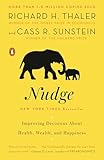
Richard Thaler and Cass Sunstein are American academics whose book Nudge introduced the concept of libertarian paternalism and influenced public policy worldwide.
Nudge, first published in 2008 and significantly updated in a 2021 edition, is rightly counted among the most influential policy books of the past two decades. Richard Thaler (behavioral economist, Nobel laureate) and Cass Sunstein (legal scholar, former Obama regulatory czar) argue that governments and institutions can improve human decision-making not through mandates or bans but through carefully designed “choice architectures” — defaults, orderings, and framings that make better choices easier without restricting freedom. The classic example is enrolling employees in retirement savings by default rather than requiring them to opt in.
The book is accessibly written and full of compelling real-world examples, from organ donation registries to school cafeteria layouts. Its central insight — that how choices are presented shapes what people choose — is both scientifically well-grounded and practically actionable. Nudge had measurable impact on government policy in the UK, US, and elsewhere, spawning “nudge units” in multiple governments.
The criticism of the nudge approach has come from both left and right. Some argue it is too permissive — allowing harmful defaults to persist — while others raise concerns about technocratic manipulation of public behavior without democratic accountability. These are legitimate debates. Nudge deserves to be read, but ideally alongside its critics, who have forced a productive conversation about the ethics and limits of behavioral policy design.
Two Disciplines, One Argument
The power of Nudge derives in large part from the complementary expertise its two authors bring to a shared argument. Richard Thaler is one of the founding figures of behavioral economics, a discipline that challenged the long-dominant assumption that people are rational, self-interested calculators by demonstrating, through decades of research, that human decision-making is systematically shaped by biases, mental shortcuts, and the influence of context. His work, which earned him the Nobel Memorial Prize in Economic Sciences, supplies the empirical foundation of the book: the recognition that real human beings, whom the authors playfully call “Humans” as opposed to the idealised “Econs” of classical theory, predictably deviate from rational choice. Cass Sunstein, one of the most cited legal scholars in the world and a former head of regulatory affairs in the Obama administration, brings the perspective of law and public policy, translating the behavioral insights into concrete questions of institutional design and governance. The collaboration thus joins rigorous social science to practical statecraft, and this fusion is what allowed Nudge to move beyond academic argument into a genuine blueprint for how governments and organisations might structure choices to help people achieve their own goals.
Choice Architecture and Libertarian Paternalism
The central conceptual contribution of Nudge is the idea of “choice architecture,” the recognition that there is no neutral way to present options and that the design of any decision environment inevitably influences the choices people make. A cafeteria must arrange its food in some order, a form must have some default setting, an enrolment system must either opt people in or out by default, and each of these arrangements predictably shapes behavior. The authors argue that since some arrangement is unavoidable, those who design these environments — the choice architects — should arrange them to help people make decisions that serve their own long-term interests, such as saving adequately for retirement or eating more healthily. They give this approach the deliberately paradoxical name “libertarian paternalism”: paternalist because it gently steers people toward better outcomes, libertarian because it preserves complete freedom to choose otherwise, since a nudge by definition must not foreclose any option or impose significant cost. The retirement-savings default, in which employees are automatically enrolled but may freely opt out, became the emblematic example, dramatically increasing participation while restricting no one’s liberty. This framework offered policymakers a middle path between heavy-handed mandates and laissez-faire neglect.
Global Influence and Ongoing Debate
Few works of social science have had so direct and measurable an impact on public policy as Nudge. In the years after its publication, governments around the world established dedicated “behavioral insights” teams — the British government’s unit, often called the “Nudge Unit,” being the most famous — to apply the book’s principles to areas ranging from tax compliance and organ donation to energy use and public health. The vocabulary of nudges, defaults, and choice architecture entered the mainstream of policy discussion, and the approach has been credited with achieving meaningful improvements at low cost and without coercion. Yet the very influence of the ideas has provoked serious and productive debate about their limits and ethics. Critics on one side worry that nudging amounts to manipulation by unelected experts who decide what is best for citizens, raising questions of autonomy and democratic accountability, while others contend that nudges are too modest to address structural problems and can distract from the need for more robust regulation. The authors have engaged thoughtfully with these objections across later editions and writings. The enduring conversation around the book is itself a measure of its importance, marking Nudge as one of the most consequential policy texts of the twenty-first century.
Where to Start
The natural entry point is Nudge itself, ideally the updated “Final Edition,” which revises the examples and responds to more than a decade of debate; it lays out choice architecture, defaults, and libertarian paternalism in accessible, example-rich prose and remains the essential statement of the authors’ shared argument. Readers who want the deeper behavioral science behind it should turn to Richard Thaler’s Misbehaving, a lively and personal history of behavioral economics that explains how the field overturned the assumption of human rationality. Those interested in the policy and legal dimensions can explore Cass Sunstein’s prolific output, including his writings on choice, freedom, and regulation. Crucially, Nudge is best read alongside its critics, who have raised serious questions about paternalism, autonomy, and the limits of behavioral policy; engaging with both the book and the debate it provoked yields a fuller understanding than the book alone. For anyone seeking to understand how the design of choices shapes behavior, and how that insight has reshaped public policy worldwide, Nudge is the indispensable starting point.
Reading Guides