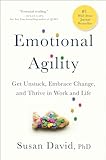
Susan David is a South African-born Harvard psychologist whose book Emotional Agility argues for a flexible, values-driven approach to difficult thoughts and feelings.
Susan David is a psychologist at Harvard Medical School whose work focuses on emotions, resilience, and human flourishing. Emotional Agility, published in 2016, grew from her research into how people relate to their inner lives — and from her observation that most popular self-help advice gets this badly wrong. The book argues against both emotional suppression (pushing feelings away) and emotional hijacking (being controlled by them), proposing instead a middle path in which people learn to notice their thoughts and feelings with curiosity rather than judgment, and make decisions aligned with their deeper values.
The framework has genuine psychological backing — David’s ideas draw on acceptance and commitment therapy as well as broader research on motivation and well-being — and the book is more rigorously grounded than much of the self-help genre. Her writing is accessible and often moving; she opens with her own experience of childhood grief in apartheid South Africa, which gives the abstract concepts personal weight. Some readers find the book too long for the core insight it delivers, and the later chapters on workplace applications can feel thin compared to the personal material.
Emotional Agility is most valuable for readers who have found either rigid emotional control or relentless positivity to be exhausting and unsatisfying. David’s insistence that difficult emotions contain information worth attending to — rather than problems to be solved or suppressed — is both sensible and genuinely freeing.
The Case Against Forced Positivity
One of David’s most valuable and culturally timely contributions is her critique of what she has called “the tyranny of positivity,” the pervasive social pressure to be relentlessly cheerful, optimistic, and upbeat regardless of one’s actual circumstances. She argues that this insistence on forced positivity is not merely ineffective but actively harmful, because it teaches people to suppress, deny, or feel ashamed of legitimate difficult emotions such as grief, anger, fear, and disappointment. Drawing on psychological research, she contends that such emotions are normal, healthy, and informative, signals that point toward what we value and what matters to us, and that bottling them up or papering over them with affirmations leads to greater distress, not less. Her concept of being “rigid” with one’s emotions, whether through brooding suppression or false cheer, stands in contrast to the flexible, accepting engagement she advocates. This message resonated widely precisely because it named an exhausting and widespread experience: the felt obligation to perform happiness. By giving people permission to acknowledge and sit with their full emotional range, David offered a corrective to a self-help culture saturated with positive thinking, and her articulation of this idea has been among the most influential aspects of her work.
Roots in Acceptance and Values
The intellectual rigour that distinguishes David’s work from much of the self-help genre comes from its grounding in established psychological science, particularly acceptance and commitment therapy and the broader research on motivation, resilience, and well-being. The core of emotional agility reflects this lineage: rather than trying to control or eliminate difficult thoughts and feelings, the practice involves noticing them with curiosity and compassion, accepting their presence without being defined or controlled by them, and then deliberately choosing actions aligned with one’s deeper values. This sequence, of facing emotions, gaining a measure of distance from them, and acting in accordance with what one genuinely cares about, gives the framework both psychological validity and practical direction. David’s emphasis on values as the compass for behaviour, rather than on the pursuit of good feelings as an end in itself, is a meaningful distinction, redirecting the goal from feeling better to living better. Her personal history, including the early loss of her father to cancer during her childhood in apartheid-era South Africa, lends the abstract concepts emotional weight and demonstrates that she writes from lived experience as well as clinical research. This combination of scientific foundation and personal authenticity is the source of the book’s credibility and its emotional force.
A Voice in Workplace and Public Psychology
Beyond her bestselling book, David has become an influential voice in organisational psychology and the public conversation about emotions, applying her ideas across business, leadership, education, and everyday life. Her concept of emotional agility was recognised by Harvard Business Review as a leading management idea, reflecting her particular interest in how individuals and organisations can build the emotional flexibility needed to navigate change, stress, and complexity in the workplace. As a psychologist affiliated with Harvard, a sought-after speaker, and a consultant to major organisations, she has carried her framework into corporate and institutional settings, arguing that emotionally agile cultures are more innovative, resilient, and humane. Her widely viewed TED talk on the gift and power of emotional courage brought her message to a vast global audience and helped establish her as a prominent figure in the popular discourse around emotional health. Through these various platforms, David has consistently advanced the same core conviction: that our relationship with our inner lives, our willingness to face difficult emotions honestly and to act from our values, is fundamental to both personal flourishing and effective functioning in the wider world. Her influence reflects a broader shift toward taking emotional life seriously in domains, like business, that have traditionally neglected it.
Where to Start with David
The essential starting point is Emotional Agility, her landmark book and the fullest expression of her thinking; it is the natural first read for anyone seeking a science-grounded, humane alternative to both rigid emotional control and relentless positivity. The book is most rewarding for readers who have found those extremes exhausting and who are open to a more accepting, values-driven approach to their inner lives, and it draws much of its power from David’s willingness to ground the concepts in her own experience of grief and resilience. Those who want a quick and powerful introduction to her ideas before committing to the book should watch her TED talk on emotional courage, which distils the central message into a moving and accessible form. Readers interested in applying her framework to professional life will find her articles and talks on emotional agility in the workplace particularly useful. Whichever the format, David reliably offers a thoughtful, research-based perspective on engaging honestly with difficult emotions. But Emotional Agility is the indispensable place to begin, the book that defined her contribution and that offers the most complete and genuinely freeing account of her approach.
Reading Guides