Where to Start with Susan David: A Reading Guide
Where to start with Susan David — how to approach Emotional Agility, her research-backed framework for moving through difficult emotions with flexibility and self-compassion rather than suppression or rumination. A complete reading guide.
By Lena Fischer
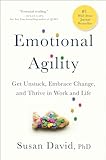
Susan David (born 1973) is a South African-born psychologist, award-winning researcher, and faculty member at Harvard Medical School. She developed the emotional agility concept from two decades of research on resilience, human flourishing, and how people navigate difficult emotions and life transitions. Her 2016 TED Talk on emotional agility has been viewed over ten million times. Emotional Agility (2016) is her first book — a practical guide to the framework that emerged from that research, written with warmth and grounded in clinical experience.
Where to Start: Emotional Agility (2016)
The essential Susan David — and one of the most practically useful psychology books in the self-help field. Emotional Agility opens with an observation that cuts against the dominant current of popular psychology: research consistently shows that the harder you try not to have a particular thought or feeling, the stronger and more persistent it becomes. Telling yourself not to feel anxious before a presentation amplifies the anxiety. Forcing a smile through grief intensifies the grief. The suppression strategy most people use most of the time is not just ineffective; it is actively counterproductive.
The alternative David calls emotional agility is not the opposite extreme. It is not venting, expressing every feeling as it arises, or treating emotional authenticity as the highest value. It is something more specific: a flexible, non-judgmental relationship with your own inner life that allows you to acknowledge what you are feeling, understand what that feeling is telling you, and choose how to respond based on what matters to you rather than what you feel like doing in the moment.
David identifies two dominant patterns of emotional rigidity that most people fall into. Bottlers suppress, deny, and push down difficult emotions — maintaining the appearance of composure while the suppressed material builds pressure. Brooders ruminate, replaying difficult feelings and over-identifying with them until they become defining narratives: “I’m anxious, I’m a failure, I can’t handle this.” Both patterns feel like different things; both produce the same result: difficulty acting effectively in the presence of uncomfortable feelings.
The four-step alternative is the book’s practical core.
Show Up means turning toward difficult thoughts and feelings with curiosity and compassion rather than judgment — acknowledging that you are having these experiences without being overwhelmed by them.
Step Out is what David, drawing on acceptance and commitment therapy, calls defusion: creating a small gap between yourself and your thoughts. The move from “I’m a failure” to “I notice I’m having the thought that I’m a failure” is subtle and enormously consequential. The second phrasing positions you as the observer of the thought rather than the person who is the thought. This is not positive thinking — it doesn’t change the content — but it changes your relationship to the content.
Walk Your Why is the values component. David argues that values — not goals, not feelings, not other people’s expectations — are the stable foundation from which emotionally agile action can be taken. Identifying what genuinely matters to you (courage, creativity, care for family, intellectual integrity) and using those values to guide choices when feelings are pulling in other directions is the discipline that turns emotional agility from an insight into a practice.
Move On translates values into small behavioral actions — what David calls “tiny tweaks” — that move you toward the life you want regardless of your current emotional state. The emphasis on small is deliberate: large behavioral changes require large motivational forces that are often unavailable; small actions require only enough motivation to begin.
Why Emotional Agility Is the Ideal First Book
For a reader new to Susan David, Emotional Agility is the ideal first book because it is her major book and the fullest expression of her distinctive contribution, a research-based approach to navigating our emotions and thoughts with flexibility and skill. Emotional Agility presents David’s concept of emotional agility, the ability to face our emotions and thoughts with openness and to respond to them in ways aligned with our values, drawing on psychology and her own research. As an entry point it is ideal, for it is her defining book and a clear statement of her approach. It welcomes the newcomer with its central concept, its research grounding, and its practical guidance, drawing the reader into a more skillful relationship with their inner life. It is her most important work and the one that best represents her thinking, so the new reader encounters David’s approach directly. For the newcomer interested in emotional well-being, then, Emotional Agility is the natural and ideal starting point.
What to Expect as a New Reader
As a new reader, you can expect Emotional Agility to be a research-based, practical, and insightful book about navigating our emotions. You can expect a central concept, emotional agility, the ability to face our emotions and thoughts with openness and to respond to them with flexibility and skill. You can expect grounding in psychology, for David, a psychologist, draws on research and her own work. You can expect a focus on values, for the goal is to respond to our emotions in ways aligned with what matters to us, rather than being controlled by them or suppressing them. You can expect practical guidance, for the book offers approaches for developing emotional agility. You can expect an accessible, insightful style. You can expect application to work, relationships, and life. Expect, in short, a research-based, practical, and insightful book about navigating our emotions, a fine introduction to David’s approach.
Going Deeper After Your First Book
Once Emotional Agility has introduced you to David’s approach, the reader who wishes to go deeper can carry its ideas into the wider literature of psychology, emotional intelligence, and well-being to which her work belongs. Since Emotional Agility is her central book, the natural next step is outward, into the broad field of writing on emotions, resilience, and psychological flexibility, where the reader can extend and compare her approach with other perspectives. David’s broader work, including her widely viewed talks and her writing on emotions at work and in life, also extends her thinking. Reading more widely deepens your engagement with David’s distinctive contribution, the approach to navigating emotions with flexibility and skill. Her characteristic emphasis on facing emotions and acting on our values runs through her work. Building your reading journey from Emotional Agility is a matter of carrying its ideas into the wider literature on emotions and well-being. The reader who begins here will have a practical, research-based foundation for navigating their inner life.
Reading Susan David
Emotional Agility is David’s essential and defining book. It stands alone. Readers who want to continue with the underlying therapeutic framework should explore acceptance and commitment therapy directly, beginning with Russ Harris’s The Happiness Trap.
For the full Susan David bibliography, reviews, and biography, visit the Susan David author page on Editors Reads.
Affiliate disclosure: Links to Amazon on this page are affiliate links. We earn a small commission at no extra cost to you.
Frequently Asked Questions
Where should I start with Susan David?
Emotional Agility: Get Unstuck, Embrace Change, and Thrive in Work and Life (2016) is David's essential book — a research-backed framework for relating to your own thoughts and feelings with flexibility rather than rigidity. David is a Harvard Medical School psychologist who developed the emotional agility concept from twenty years of research on resilience and positive psychology. The book argues that the goal is not to feel good but to feel appropriately, and to act in alignment with your values regardless of what you're currently feeling.
What is Emotional Agility about?
Emotional Agility argues that the two dominant cultural strategies for managing difficult emotions — suppression (bottling) and over-identification (brooding) — are both counterproductive. The alternative David proposes involves four components: showing up (acknowledging your thoughts and feelings with compassion), stepping out (seeing your thoughts as thoughts rather than facts, a technique drawn from acceptance and commitment therapy), walking your why (connecting your choices to your core values), and moving on (taking small steps toward what matters to you). The framework is designed to allow you to act effectively regardless of what you're feeling.
How does Emotional Agility compare to other emotional intelligence books?
It is more rigorously grounded in psychological research than most, and more specifically focused on the relationship between thoughts, feelings, and action than broad emotional intelligence frameworks. Readers familiar with acceptance and commitment therapy (ACT) or Brené Brown's work on vulnerability will recognise much of the conceptual terrain — David covers similar ground but with a more systematic framework and more explicit research grounding. The book is less comprehensive than Brown's Atlas of the Heart but more practically organised, with clearer tools for changing specific patterns.
What should I read after Emotional Agility?
After Emotional Agility, Brené Brown's Daring Greatly covers the vulnerability dimension of emotional life with comparable warmth and research grounding. Steven Hayes's A Liberated Mind is the foundational work by the creator of ACT, the therapeutic approach that underlies much of David's framework. For the values component of emotional agility, Russ Harris's The Happiness Trap provides the most operational ACT-based approach to identifying values and living by them regardless of emotional state.