BestsellerEditor's Pick
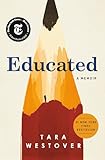
Educated
by Tara Westover
4.7
Tara Westover's memoir of growing up in the mountains of Idaho without formal education, in a survivalist family, and her journey to Cambridge and Harvard.
Check Price on Amazon (paid link)American · b. 1986
Goodreads Choice Award for Memoir/Autobiography (2018), shortlisted for Baillie Gifford Prize
Tara Westover is an American historian and memoirist whose debut Educated recounts her extraordinary journey from an isolated survivalist childhood to a Cambridge PhD.
Tara Westover grew up in rural Idaho in a family that distrusted government, medicine, and formal education to a degree that most readers will find extraordinary. Her father believed the End of Days was imminent and stockpiled for it; her mother worked as a midwife and herbalist outside the medical system; and Tara and her siblings were never enrolled in school, instead working in the family’s junkyard and preparing for a catastrophe that never came. Educated, published in 2018, tells the story of how she eventually left, taught herself enough to sit the ACT, gained entry to Brigham Young University, and went on to earn a PhD from Cambridge — all while navigating a family that could not accommodate her transformation.
The book is riveting and beautifully written, and Westover is honest about the uncertainty of her own memories — she acknowledges that her recollections of abuse and danger are disputed by family members and that her own mind has processed the past imperfectly. This honesty about the instability of memory gives the book a depth that more confident memoirs lack. She does not position herself as a simple triumph-of-the-individual story; she is aware of what she lost as well as what she gained, and the grief of her estrangement from family runs through the book alongside the liberation.
Educated is among the most remarkable memoirs of the past decade — a book about education, self-creation, and the cost of leaving a world behind that transcends genre.
The title of Westover’s memoir is deceptively simple, because the education it describes is not merely the acquisition of facts but a wholesale transformation of consciousness — and one purchased at enormous personal cost. When Westover first sat in a university classroom, she lacked the most basic scaffolding of formal knowledge; in one now-famous episode, she did not know what the Holocaust was, having never been taught it. The book charts her astonishing intellectual ascent from this starting point to graduate study at Cambridge and a fellowship at Harvard, but its deeper subject is what such an education does to a person who undertakes it in adulthood, against the will of her family. To learn to think historically and critically, Westover discovers, is to acquire the tools to reinterpret her own past — to recognize patterns of control, denial, and harm that she had been raised to accept as normal. Education, in her account, is liberation, but it is also a kind of exile, severing her from the worldview and the family that had defined her entire existence. The memoir’s power lies in refusing to treat this transformation as an unambiguous triumph, insisting instead on the grief that accompanies the gain.
One of the qualities that elevates Educated above the many dramatic survival memoirs it superficially resembles is Westover’s scrupulous, almost scholarly honesty about the unreliability of memory itself. Trained as a historian, she brings the discipline’s skepticism to bear on her own recollections, and the book is studded with footnotes and parenthetical acknowledgments where her memory of an event diverges from that of her siblings or where she simply cannot be certain what happened. This refusal of false certainty is both an ethical choice and a literary strength. In a genre frequently troubled by accusations of embellishment, Westover preempts the question by foregrounding it, modeling how a responsible memoirist might handle the gap between lived experience and verifiable fact. Her family has disputed aspects of her account, and rather than suppressing this, the book incorporates the contested nature of its own truth into its very structure. The result is a memoir that is also a meditation on how we construct narratives of the self, how memory serves and betrays us, and how the stories families tell about themselves can become instruments of both love and domination.
Educated became one of the defining nonfiction successes of its time, spending years on bestseller lists, earning widespread critical acclaim, and being championed by readers and public figures across the political spectrum — a rare feat in a polarized era. Its extraordinary reach speaks to how powerfully its themes resonated beyond the specific extremity of Westover’s upbringing. Though few readers grew up in a survivalist family that shunned doctors and schools, vast numbers recognized in her story something universal: the struggle to individuate from family, the tension between loyalty and self-preservation, the disorienting experience of education opening a gulf between a person and the world that raised them. The book has been embraced as a parable of the transformative power of learning and a searching examination of family loyalty, abuse, and estrangement. Westover has largely guarded her privacy in its wake, allowing the work to speak for itself, and Educated stands as a singular contribution to the literature of self-making — proof that the most particular of stories, told with honesty and intelligence, can illuminate the most widely shared of human dilemmas.
Educated is Tara Westover’s only book to date, which makes the recommendation simple: it is both the beginning and, for now, the entirety of her published work, and it requires no prior context to be read with full effect. The guidance instead concerns how to approach it. Readers should come expecting not a straightforward triumph-over-adversity narrative but a more searching and ambivalent meditation on family, memory, education, and the cost of self-creation; the book is at its most powerful when read with attention to its honesty about uncertainty and loss rather than only its dramatic incidents. Those moved by it often find it rewarding to read alongside other memoirs of leaving behind a closed or extreme world, where similar questions of loyalty and individuation recur. For readers who connect with the book’s themes, Westover’s occasional essays and interviews offer further reflection on education, family estrangement, and the divisions that shaped her story. Until she publishes again, Educated remains a complete and self-sufficient introduction to one of the most distinctive memoirists of her generation.
by Tara Westover
Tara Westover's memoir of growing up in the mountains of Idaho without formal education, in a survivalist family, and her journey to Cambridge and Harvard.
Check Price on Amazon (paid link)guide
Educated and The Glass Castle are the two defining dysfunctional-family memoirs. Here's how they differ, what each does best, and which to read first.
guide
Where to start with Tara Westover — how to approach Educated, her essential memoir about self-transformation and the power of learning. A complete reading guide.
list
Tara Westover has published one book — Educated. Reading guide for the essential memoir about family, survival, and the transformative power of education.
list
If Tara Westover's Educated moved you, these memoirs share the same unflinching honesty about family, escape, and the cost of becoming yourself.
Disclosure: Amazon links on this page are affiliate links. If you purchase through them we earn a small commission at no extra cost to you.