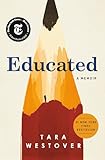
Editors Reads Verdict
One of the most extraordinary memoirs of the twenty-first century. Westover's journey from a childhood in an extremist household to Cambridge and Harvard raises profound questions about education, family, and how we construct knowledge.
What We Loved
- One of the most dramatic self-transformation narratives ever written
- The questions about memory, family loyalty, and self-knowledge are handled with unusual intelligence
- The writing is exceptional — Westover is a gifted prose stylist
- Raises important questions about education, epistemic authority, and who gets to decide what is true
Minor Drawbacks
- The family has disputed some of Westover's account — the truth of contested memories is genuinely complex
- Some readers find the family drama repetitive in the middle section
Key Takeaways
- → Education is not just knowledge acquisition but a transformation of how you understand yourself and the world
- → Family loyalty and individual truth can be in irreconcilable conflict
- → The version of reality we were raised with is not the only version — and discovering this is both liberating and terrifying
- → Formal education is one path; self-directed learning is another; both can lead to genuine transformation
- → Memory is not a recording but a reconstruction — and those reconstructions are contested in families
| Author | Tara Westover |
|---|---|
| Publisher | Random House |
| Pages | 352 |
| Published | January 1, 2018 |
| Language | English |
| Genre | Memoir, Biography |
| Difficulty | Beginner |
| Best For | Anyone interested in memoir, education, or the psychology of escaping constraining environments through learning. |
How Educated Compares
Educated at a glance against 3 similar books readers weigh alongside it.
| Book | Author | Rating | Best for |
|---|---|---|---|
| Educated (this book) | Tara Westover | ★ 4.7 | Anyone interested in memoir, education, or the psychology of escaping |
| Becoming | Michelle Obama | ★ 4.8 | Anyone interested in American political history, the Obama era, or memoir as a |
| Born a Crime | Trevor Noah | ★ 4.8 | Anyone interested in apartheid South Africa, memoir as a form, questions of |
| When Breath Becomes Air | Paul Kalanithi | ★ 4.8 | Anyone confronting mortality — personally or professionally — or seeking to |
Tara Westover was born in 1986 in Buck’s Peak, Idaho, to a survivalist family that did not believe in formal education, doctors, or the authority of the state. She did not have a birth certificate until she was nine. She never attended school. Her childhood was spent on a mountain, working in her father’s junkyard, and preparing for the End Times her father believed were imminent. In 2009, she received a PhD in history from the University of Cambridge. The journey between these two facts is one of the most extraordinary stories of self-transformation in modern memoir, and Westover tells it with a prose style and a moral intelligence that makes it one of the best-written memoirs of her generation.
Westover’s account of her childhood is vivid and disturbing in ways she renders not as a horror story but as the only world she knew. Her father, Gene, was charismatic, brilliant, and mentally ill — his survivalist ideology coexisted with what appear to be bipolar disorder and paranoid delusions. Her older brother Shawn was violent toward her in ways that the family refused to acknowledge. Her mother mixed herbal remedies in place of medicine, attending to injuries that would have sent most families to hospital. What makes the account so compelling is that Westover shows this world having its own logic, beauty, and love — the mountain was genuinely beautiful, her father genuinely loved her, and the damage and the love coexisted without resolving each other.
Her first encounter with formal education came in her late teens through the ACT entrance exam, largely to qualify for a music programme at Brigham Young University. The process of encountering formal history — the Holocaust, the Civil Rights Movement — and comparing it with the history she had been taught by her father was a radicalising experience: her world suddenly had multiple competing descriptions, and she had to decide which to trust. Her account of arriving at Cambridge, of her first lecture, of discovering that words for experiences she had never been able to name actually existed, is among the most moving accounts of intellectual awakening in recent literature.
One of the book’s most intellectually honest qualities is Westover’s acknowledgment that memoir is memory and memory is reconstruction. Her family disputes her account; she disputes theirs; she does not claim certainty where she cannot have it. This epistemic humility — rare in a genre that typically presents the narrator’s version as settled truth — makes the book more rather than less powerful. It raises questions about the nature of contested family histories that are genuinely unresolvable, and about the construction of the self in the face of competing narratives about what happened and who you are. Educated is essential reading — an extraordinary story told with exceptional prose and rare intellectual honesty.
More Than a Survivor’s Story
It would be easy to read Educated as simply a tale of escape — a girl raised off the grid by a survivalist family, kept from school and hospitals, who somehow ends up with a doctorate from Cambridge. But Westover is after something harder and more honest than triumph. The book’s real subject is the cost of that transformation: what it does to a person to remake themselves through education, and what it means to gain a new self at the price of the family that formed you. She is unsparing about her own unreliability as a narrator, footnoting where her memory conflicts with others’, refusing to flatten her parents into villains even as she records real danger and harm. The result is a memoir about epistemology as much as abuse — about how we come to know what is true, especially when those we love insist on a different reality.
Why It Resonates So Widely
Most readers did not grow up as Westover did, yet the book has sold in the millions because its central tension is close to universal: the pull between loyalty to where you came from and fidelity to who you are becoming. Anyone who has been changed by an education, a move, or an idea their family could not follow recognises the loneliness of that crossing. Westover handles the difficult material — the violence, the gaslighting, the slow estrangement — with restraint rather than melodrama, which makes it land harder. It should be read knowing it deals frankly with abuse, but it is finally a book about the liberating and isolating power of learning to think for oneself, which is why it has become a modern classic of the memoir form.
A Modern Classic of the Memoir Form
Educated arrived in a strong decade for the memoir and quickly became one of its defining titles, and the reasons are instructive. Westover writes with a novelist’s control of scene and a scholar’s scruple about evidence, refusing the easy catharsis that the genre often invites. She is as interested in the unreliability of memory as in the events themselves, which lends the book an honesty rarer than its dramatic story alone would suggest. The result has the staying power of literature rather than the quick burn of a sensational story, and it has earned a place beside the best accounts of difficult childhoods and hard-won selfhood — a book readers press on one another precisely because it is about more than one extraordinary family.
Reading Guides
- Books Like Educated: 11 Memoirs About Survival, Family, and Finding Yourself
- Books Like Sapiens: 11 Mind-Expanding Reads for Big-Picture Thinkers
- Books Like Into the Wild: Escape, Nature, and the American Wilderness
- Books Like Man
- Books Like The Glass Castle: Dysfunctional Families, Resilience, and the Memoir of Escape
- Books Like The Immortal Life of Henrietta Lacks: Science, Race, and the Body as Property
- Books Like Thinking, Fast and Slow: Cognitive Science, Bias, and How We Actually Make Decisions
Frequently Asked Questions
What is "Educated" about?
Tara Westover's memoir of growing up in the mountains of Idaho without formal education, in a survivalist family, and her journey to Cambridge and Harvard.
Who should read "Educated"?
Anyone interested in memoir, education, or the psychology of escaping constraining environments through learning.
What are the key takeaways from "Educated"?
Education is not just knowledge acquisition but a transformation of how you understand yourself and the world Family loyalty and individual truth can be in irreconcilable conflict The version of reality we were raised with is not the only version — and discovering this is both liberating and terrifying Formal education is one path; self-directed learning is another; both can lead to genuine transformation Memory is not a recording but a reconstruction — and those reconstructions are contested in families
Is "Educated" worth reading?
One of the most extraordinary memoirs of the twenty-first century. Westover's journey from a childhood in an extremist household to Cambridge and Harvard raises profound questions about education, family, and how we construct knowledge.
Ready to Read Educated?
Check the current price on Amazon.
Check Price on Amazon (paid link)Prices and availability are subject to change. See Amazon for current price.
Review last updated: