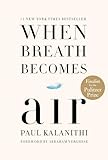
Editors Reads Verdict
One of the most beautiful books ever written about death and the meaning of a life well-lived. Kalanithi's prose is exquisite and his moral seriousness is rare in any genre.
What We Loved
- The prose is exceptional — Kalanithi was a gifted writer as well as a gifted surgeon
- The transition from doctor to patient illuminates both perspectives with unusual clarity
- The questions about meaning and mortality are faced with genuine philosophical depth
- Lucy Kalanithi's epilogue is among the most moving pieces of writing in recent memory
Minor Drawbacks
- Brief — some readers wish for more, though brevity is part of the book's power
- The intellectual sweep of the early chapters gives way to more personal focus later
Key Takeaways
- → The proximity to death clarifies what actually matters in a life
- → Medicine is as much a moral enterprise as a technical one
- → Meaning is not found in the absence of suffering but in the stance taken toward it
- → The human person is not reducible to the neural substrate — but the neural substrate is what we have
- → The question 'What makes life meaningful?' becomes urgent only when the answer is finite
| Author | Paul Kalanithi |
|---|---|
| Publisher | Random House |
| Pages | 256 |
| Published | January 1, 2016 |
| Language | English |
| Genre | Memoir, Medicine, Philosophy |
| Difficulty | Beginner |
| Best For | Anyone confronting mortality — personally or professionally — or seeking to understand what makes a life meaningful. Essential for medical professionals. |
How When Breath Becomes Air Compares
When Breath Becomes Air at a glance against 3 similar books readers weigh alongside it.
| Book | Author | Rating | Best for |
|---|---|---|---|
| When Breath Becomes Air (this book) | Paul Kalanithi | ★ 4.8 | Anyone confronting mortality — personally or professionally — or seeking to |
| Being Mortal | Atul Gawande | ★ 4.6 | Anyone with aging parents |
| Man's Search for Meaning | Viktor E. Frankl | ★ 4.8 | Anyone confronting meaninglessness, loss, suffering, or existential questions |
| The Emperor of All Maladies | Siddhartha Mukherjee | ★ 4.7 | Anyone touched by cancer — patients, families, or medical professionals — and |
Paul Kalanithi was thirty-five years old and completing his neurosurgery residency at Stanford when he was diagnosed with stage IV lung cancer. He died the following year. In between, he wrote When Breath Becomes Air — a meditation on mortality, meaning, and medicine that became one of the most praised books of the decade. The premise is almost unbearably poignant: a doctor who spent his career standing next to patients at the threshold of death, who chose medicine partly to understand that threshold, is suddenly standing on the patient side of it. The question that organised his professional life — what makes a life meaningful? — becomes the question his actual life is now required to answer, under the pressure of finite time.
The first section covers Kalanithi’s intellectual formation — from a childhood shaped by his father’s medical stories, through his studies of literature and the philosophy of mind at Stanford and Cambridge, to his decision to become a neurosurgeon. He wanted to understand what makes us human at the deepest level: the brain, and what happens when it is damaged, and what it means that it can sometimes be healed. His account of surgical training — the impossible demands, the arc of learning, the first times a patient’s life depends entirely on his judgment and his hands — is one of the most honest accounts of medical education available and would be remarkable even without what follows.
The book’s emotional centre is the transition from physician to patient and what Kalanithi discovers on the other side of the threshold. He had told patients for years about prognosis, about treatment options, about what comes next. Now he is the one being told, and the experience of receiving rather than delivering this information reveals dimensions of the medical encounter he had not previously seen from the inside. His relationship with his oncologist Emma Hayward — her directness, her care, the precision with which she navigates his need for information — is one of the most affecting doctor-patient relationships in literature. His decision to have a child with his wife Lucy despite his diagnosis, and his account of that choice, is equally moving.
When Breath Becomes Air draws its philosophical spine from the question of what a life means when its time is measured in months. Kalanithi’s answers reference Samuel Beckett, Tolstoy, and T.S. Eliot as much as neuroscience. He chooses to complete his residency, to become a father, to write — because these are the activities that have always constituted his version of a meaningful life, and illness has not changed what meaning is. Lucy Kalanithi’s epilogue, written after his death, is one of the most extraordinary pieces of writing in recent American literature. This is a book that justifies its own existence with every page.
A Doctor Becomes a Patient
What gives When Breath Becomes Air its unusual authority is that Kalanithi had spent his career on the other side of the diagnosis. As a neurosurgeon he had delivered terrible news to families and watched the line between living and dying up close; when stage IV lung cancer arrived at thirty-six, he had to learn what it meant to receive that news rather than give it. The book moves between these two vantage points — the physician trained to fix the brain that makes us who we are, and the patient discovering how it feels to lose the future he had built toward — and the doubling is what lifts it above the ordinary illness memoir.
A Book About Meaning, Not Just Mortality
For all its sadness, the memoir is less about death than about the question Kalanithi pursued his whole life and now had to answer urgently: what makes a life worth living when its length is suddenly uncertain? His answer is built rather than stated — in the decision to keep operating, to have a child, to write — and the book’s power comes from watching a brilliant, articulate man think his way toward it in real time. The unfinished quality is part of the meaning, completed by his wife’s afterword, which is among the most moving passages in recent nonfiction.
Why It Resonated So Widely
Published after his death, the book became an immediate and lasting bestseller, and its reach says something about a hunger readers have for honest writing about mortality unclouded by either false comfort or despair. Kalanithi writes as someone equally at home in literature and medicine, and the prose carries the weight of both. It is short, and it can be read in a sitting, but it is the kind of book readers return to and press on others, precisely because it treats the hardest subject with clarity, intelligence, and an absence of self-pity that makes its grief bearable and its insights durable.
A Short Book With Lasting Weight
It can be read in an evening, yet few recent memoirs lodge as deeply. Part of the reason is Kalanithi’s refusal of the consolations the genre usually offers — there is no miracle, no tidy lesson, only a clear-eyed man trying to answer, while time runs out, what makes a life meaningful. The prose is unadorned and precise, shaped by a writer equally fluent in literature and neuroscience, and the brief afterword written by his wife completes the book with a tenderness that has moved millions. It belongs on the short shelf of essential modern writing about mortality, alongside the books readers reach for when they need company in the face of loss rather than comfort that explains it away.
Reading Guides
- Books Like When Breath Becomes Air
- 20 Best Sad Books: Novels That Are Worth the Heartbreak
- 25 Best Books for Book Clubs: Reads That Spark Real Discussion (2026)
- 20 Books to Read After a Breakup
- 25 Best Books to Read in Your 40s
- 25 Books to Read in Your 20s That Will Change How You Think (2026)
- 25 Books to Read in Your 30s That Will Change How You Live (2026)
Frequently Asked Questions
What is "When Breath Becomes Air" about?
A neurosurgeon diagnosed with terminal lung cancer at 36 confronts the questions he spent his career preparing to face — and writes a book about mortality, meaning, and what makes a life worth living.
Who should read "When Breath Becomes Air"?
Anyone confronting mortality — personally or professionally — or seeking to understand what makes a life meaningful. Essential for medical professionals.
What are the key takeaways from "When Breath Becomes Air"?
The proximity to death clarifies what actually matters in a life Medicine is as much a moral enterprise as a technical one Meaning is not found in the absence of suffering but in the stance taken toward it The human person is not reducible to the neural substrate — but the neural substrate is what we have The question 'What makes life meaningful?' becomes urgent only when the answer is finite
Is "When Breath Becomes Air" worth reading?
One of the most beautiful books ever written about death and the meaning of a life well-lived. Kalanithi's prose is exquisite and his moral seriousness is rare in any genre.
Ready to Read When Breath Becomes Air?
Check the current price on Amazon.
Check Price on Amazon (paid link)Prices and availability are subject to change. See Amazon for current price.
Review last updated: