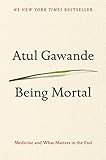
Editors Reads Verdict
One of the most important and humane books about medicine and mortality ever written, combining personal narrative with reporting and research to change how readers think about aging, dying, and what they really want from their final years.
What We Loved
- Gawande writes with both medical authority and human compassion
- The specific case studies make abstract questions viscerally real
- Practical guidance on conversations to have before the crisis arrives
- Challenges the medical profession's assumptions with evidence and empathy
Minor Drawbacks
- The material is inevitably difficult — some readers find it anxiety-inducing
- American medical system context may not translate fully to other countries
- Some readers want more specific guidance on end-of-life planning
Key Takeaways
- → Modern medicine has been optimized for survival rather than quality of life
- → What matters to patients at the end of life is rarely the same as what doctors prioritize
- → Nursing home models developed to serve institutional needs, not patient needs
- → Having the conversation about what matters at the end is itself a form of care
- → Hospice care often results in both better quality of life and occasionally longer survival
| Author | Atul Gawande |
|---|---|
| Publisher | Metropolitan Books |
| Pages | 282 |
| Published | October 7, 2014 |
| Language | English |
| Genre | Non-Fiction, Health, Medicine |
| Difficulty | Beginner |
| Best For | Anyone with aging parents; medical professionals; anyone who will eventually die (everyone). |
How Being Mortal Compares
Being Mortal at a glance against 3 similar books readers weigh alongside it.
| Book | Author | Rating | Best for |
|---|---|---|---|
| Being Mortal (this book) | Atul Gawande | ★ 4.6 | Anyone with aging parents |
| Outlive | Peter Attia | ★ 4.7 | Adults of any age who want to approach their long-term health proactively |
| The Emperor of All Maladies | Siddhartha Mukherjee | ★ 4.7 | Anyone touched by cancer — patients, families, or medical professionals — and |
| When Breath Becomes Air | Paul Kalanithi | ★ 4.8 | Anyone confronting mortality — personally or professionally — or seeking to |
The Problem with Surviving
Gawande opens “Being Mortal” with a deceptively simple observation: medicine has become extraordinarily good at keeping people alive, but it has not kept pace with the question of what kind of life is worth living at the end. Hospitals fight for survival with every tool at their disposal, but they often fail to ask their patients what they actually want — whether they want to spend their last weeks in the ICU hooked to machines or at home with their family, even if the former offers slightly more time.
The Nursing Home
The history of nursing homes in America is one of the book’s central investigations. Gawande traces how these institutions emerged not from a philosophy of elder care but from the practical need to house people who could no longer live independently, and how they evolved into environments designed primarily for the convenience and liability protection of institutions rather than the flourishing of residents. He contrasts this with experiments in assisted living and dementia care that prioritize autonomy, relationship, and meaning even at the cost of some safety.
The Conversations We Avoid
The practical heart of the book is a set of questions Gawande argues doctors, patients, and families should discuss before a health crisis makes the conversation impossible. What does a good day look like for you? What are you afraid of losing? What trade-offs are you willing to make? These questions seem obvious when stated plainly; the book documents how consistently they are avoided, by patients who don’t want to seem pessimistic and doctors who have been trained to focus on solutions rather than goals.
A Personal Book
Gawande writes throughout about his own father’s death from a spinal tumor — the conversations they had, the decisions they made, what he would do differently — and this personal thread gives the book’s research an emotional weight that purely reported nonfiction cannot achieve. The combination of statistical evidence, reported case studies, and personal memoir is executed with the skill of someone equally at home in all three modes.
The Surgeon as Writer
Part of the book’s authority comes from who wrote it. Atul Gawande is a practicing surgeon and a longtime staff writer for The New Yorker, and Being Mortal draws on both vocations: the clinician’s access to the realities of hospitals and the essayist’s gift for turning research and case study into narrative. He had already established himself with Complications and The Checklist Manifesto as a rare physician-writer capable of making medicine legible to a general audience without condescension. Here he turns that skill on the hardest subject in his field — its own limits — and writes with unusual candor about how his training equipped him to fight death but not to help patients face it. The result reads less like advocacy than like a thoughtful practitioner reasoning aloud about where his profession has gone wrong.
The Counterintuitive Case for Hospice
One of the book’s most quietly radical sections concerns hospice and palliative care. Gawande reports research suggesting that patients who stop pursuing aggressive treatment and enter hospice often live as long as — and sometimes longer than — those who fight to the end, while suffering less and reporting greater peace. This finding reframes the central choice of terminal illness: that prioritizing quality of life over the pursuit of marginal extra time is not “giving up” but frequently the wiser and even the more life-preserving path. By marshaling evidence rather than sentiment, Gawande gives families a way to think about end-of-life decisions that resists both the medical default of endless intervention and the fear that choosing comfort means choosing death sooner.
A Book That Changed the Conversation
Published in 2014, Being Mortal became a bestseller and, more unusually, an influence on practice — widely assigned in medical and nursing education, cited in debates over end-of-life care, and credited by many readers with giving them the language to have conversations they had been avoiding. Its appearance on lists like Bill Gates’s recommended reading helped carry it well beyond a medical audience. Its lasting achievement is to have made a culturally taboo subject discussable: by combining rigorous reporting with the intimate story of his own father’s death, Gawande produced a book that is both an argument and a companion, one that readers return to precisely when they need it most.
What Good Care Looks Like
Crucially, Being Mortal is not only a diagnosis but a set of examples of what works. Gawande profiles reformers who reimagined elder care around autonomy and meaning rather than safety and liability: the assisted-living pioneer Keren Brown Wilson, who fought to let frail elders keep control over their own lives, and Bill Thomas, whose “Eden Alternative” introduced plants, animals, and children into a nursing home and watched withdrawn residents revive. He shows palliative-care physicians conducting the hard conversations most doctors avoid, helping patients name their priorities so that medicine can serve those priorities rather than override them. These case studies keep the book from being merely an indictment; they offer a concrete vision of aging and dying in which a person remains an author of their own life to the end. The argument is finally hopeful: the failures Gawande documents are not inevitable, and demonstrably better is possible.
Our rating: 4.6/5 — A necessary, humane, and practically important book about what medicine gets wrong about dying and what we can do to get it right.
Reading Guides
Frequently Asked Questions
What is "Being Mortal" about?
Surgeon Atul Gawande examines how medicine has failed dying patients by prioritizing survival over quality of life, and what better approaches to aging and end-of-life care look like.
Who should read "Being Mortal"?
Anyone with aging parents; medical professionals; anyone who will eventually die (everyone).
What are the key takeaways from "Being Mortal"?
Modern medicine has been optimized for survival rather than quality of life What matters to patients at the end of life is rarely the same as what doctors prioritize Nursing home models developed to serve institutional needs, not patient needs Having the conversation about what matters at the end is itself a form of care Hospice care often results in both better quality of life and occasionally longer survival
Is "Being Mortal" worth reading?
One of the most important and humane books about medicine and mortality ever written, combining personal narrative with reporting and research to change how readers think about aging, dying, and what they really want from their final years.
Ready to Read Being Mortal?
Check the current price on Amazon.
Check Price on Amazon (paid link)Prices and availability are subject to change. See Amazon for current price.
Review last updated: