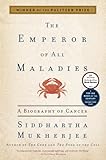
Editors Reads Verdict
Mukherjee's extraordinary biography of cancer is perhaps the finest work of medical narrative ever written. Scientifically authoritative, historically comprehensive, and deeply humane — a book that transforms understanding of the disease.
What We Loved
- Pulitzer Prize-winning narrative medicine at its finest
- Covers four thousand years of cancer history with rigour and compassion
- The scientific and clinical chapters are equally accessible and interesting
- Mukherjee's own patients are woven through the history with devastating emotional effect
Minor Drawbacks
- At 600 pages, it requires serious time investment
- Some readers find the oncology chapters technically demanding
- The book ends before the most recent immunotherapy breakthroughs
Key Takeaways
- → Cancer is not a single disease but hundreds of diseases with a common mechanism: uncontrolled cell division
- → The history of cancer treatment is a history of both extraordinary courage and catastrophic overconfidence
- → Understanding cancer's genetic basis was the key to the era of targeted therapy
- → Prevention (smoking cessation, screening programmes) has saved more lives than any treatment
- → Cancer is ultimately a disease of the genome — of the same mechanisms that make life possible
| Author | Siddhartha Mukherjee |
|---|---|
| Publisher | Scribner |
| Pages | 592 |
| Published | January 1, 2010 |
| Language | English |
| Genre | Science, Medicine, History |
| Difficulty | Intermediate |
| Best For | Anyone touched by cancer — patients, families, or medical professionals — and anyone interested in the history of medicine and biological science. |
How The Emperor of All Maladies Compares
The Emperor of All Maladies at a glance against 3 similar books readers weigh alongside it.
| Book | Author | Rating | Best for |
|---|---|---|---|
| The Emperor of All Maladies (this book) | Siddhartha Mukherjee | ★ 4.7 | Anyone touched by cancer — patients, families, or medical professionals — and |
| Being Mortal | Atul Gawande | ★ 4.6 | Anyone with aging parents |
| The Gene | Siddhartha Mukherjee | ★ 4.6 | Anyone interested in biology, the history of genetics, and the ethical |
| When Breath Becomes Air | Paul Kalanithi | ★ 4.8 | Anyone confronting mortality — personally or professionally — or seeking to |
Siddhartha Mukherjee trained as an oncologist and won a Pulitzer Prize for writing. The Emperor of All Maladies deploys both skill sets in a work of genuine magnitude: a four-thousand-year history of humanity’s encounter with cancer, told through the stories of the patients, physicians, and scientists who defined that encounter. The title comes from a description of cancer by a fourteenth-century Persian physician, and it captures what the disease has been for most of human history: not just incurable but incomprehensible, appearing from nowhere, consuming the body from within, defeating every treatment with what seems like malevolent intelligence. Mukherjee’s project is to trace how that incomprehension was slowly, painfully, and incompletely replaced by understanding.
The book’s historical sweep is astonishing. Mukherjee traces cancer treatment from Edwin Smith’s ancient Egyptian papyrus describing surgical excision through the brutal radical mastectomies of William Halsted in the late nineteenth century — which removed not just the breast but the chest wall and lymph nodes, on the basis of a theory of local spread that was wrong — through the development of chemotherapy from mustard gas research after World War II, the radiation revolution, and the emergence of targeted molecular therapy in the 1990s. Each era’s treatment reflects the understanding of its time, and the errors of each era are as instructive as the successes. When the biological model is wrong, the treatment will be wrong, and patients suffered horrifically for decades on the basis of incorrect theories held with absolute confidence.
The scientific climax is the understanding of cancer as a genetic disease — specifically, a disease of the genome’s own regulatory machinery gone wrong. Oncogenes (genes that, when mutated, drive abnormal cell division) and tumour suppressor genes (genes that, when silenced, fail to brake that division) are the fundamental actors. This understanding, achieved through decades of molecular biology from the 1970s onward, enabled the first genuinely targeted therapies: drugs designed to block the specific molecular aberrations driving specific cancers rather than simply killing all rapidly dividing cells. Gleevec, the first major success of this approach for chronic myelogenous leukaemia, is one of the book’s climactic moments.
Throughout the history, Mukherjee weaves the stories of his own patients — particularly a young woman named Carla, diagnosed with acute lymphocytic leukaemia, whose treatment and uncertain survival he describes with tender clinical precision. These personal threads transform what could be a dry institutional history into something deeply human. At nearly 600 pages, The Emperor of All Maladies requires serious commitment, but it repays it fully. It is one of the great works of narrative medicine, a book that will permanently change how you understand cancer and how you understand the enterprise of science itself.
A Biography of a Disease
The conceit that organises The Emperor of All Maladies is announced in its subtitle: this is a biography of cancer, a book that treats the disease itself as the protagonist whose long life it sets out to chronicle. Siddhartha Mukherjee, an oncologist, traces cancer from its earliest recorded appearances in ancient texts through centuries of misunderstanding, brutal early treatments, and the slow, halting emergence of modern oncology. The biographical frame is more than a device; it lets Mukherjee give shape to an overwhelming subject, following his protagonist across thousands of years as humanity gradually learns what it is fighting.
Science Braided With Human Stories
What lifts the book above a mere history of medicine is how Mukherjee interweaves the science with the people — the patients whose suffering and courage he witnessed in his own practice, the obsessive researchers who devoted careers to the problem, the doctors whose well-meaning treatments sometimes did terrible harm. He moves fluidly between the molecular biology of how cells turn cancerous and the bedside reality of what the disease does to human lives, and that double vision gives the book both intellectual authority and emotional weight. The science is rendered with rare clarity, never condescending and never dry.
Why It Won Its Audience
The Emperor of All Maladies earned the Pulitzer Prize and a wide readership because it makes a forbidding, frightening subject both comprehensible and compelling. Mukherjee writes with the precision of a scientist and the narrative gift of a novelist, and he treats cancer not as a single enemy but as a family of diseases with a long and surprising history. For readers touched by cancer — which is to say, almost everyone — the book offers understanding without false comfort, and a sense of the genuine, hard-won progress that has been made.
Who Should Read It
This is an ambitious, substantial work of science writing for any reader curious about medicine, history, or the disease that shadows so many lives. It demands some attention but rewards it richly, demystifying the biology while honouring the human cost. As a clear, humane, and masterfully told account of humanity’s long struggle against cancer — at once a history, a science primer, and a meditation on illness and care — it stands among the finest works of popular science of recent decades, and a rare example of a doctor who can write — bringing to the page both the rigour of the laboratory and the compassion of the bedside.
A Book That Changed Medical Writing
Part of the significance of The Emperor of All Maladies is the model it set for a whole generation of physician-writers who followed. By proving that a serious, technically rigorous account of a disease could also be a gripping narrative and a bestseller, Mukherjee helped expand what popular medical writing could be. The book treats its readers as intelligent adults capable of understanding real science, while never forgetting the frightened patient at the centre of it all. That respect — for both the complexity of the subject and the humanity of the people it touches — is why it has remained a standard recommendation for anyone seeking to understand cancer, and a touchstone for the art of writing about medicine.
Reading Guides
Frequently Asked Questions
What is "The Emperor of All Maladies" about?
A Pulitzer Prize-winning history of cancer — its origins, treatments, and future — told through the stories of patients, scientists, and physicians across centuries.
Who should read "The Emperor of All Maladies"?
Anyone touched by cancer — patients, families, or medical professionals — and anyone interested in the history of medicine and biological science.
What are the key takeaways from "The Emperor of All Maladies"?
Cancer is not a single disease but hundreds of diseases with a common mechanism: uncontrolled cell division The history of cancer treatment is a history of both extraordinary courage and catastrophic overconfidence Understanding cancer's genetic basis was the key to the era of targeted therapy Prevention (smoking cessation, screening programmes) has saved more lives than any treatment Cancer is ultimately a disease of the genome — of the same mechanisms that make life possible
Is "The Emperor of All Maladies" worth reading?
Mukherjee's extraordinary biography of cancer is perhaps the finest work of medical narrative ever written. Scientifically authoritative, historically comprehensive, and deeply humane — a book that transforms understanding of the disease.
Ready to Read The Emperor of All Maladies?
Check the current price on Amazon.
Check Price on Amazon (paid link)Prices and availability are subject to change. See Amazon for current price.
Review last updated: