Salman Rushdie Books in Order: Complete Bibliography & Best Starting Points
Salman Rushdie's complete bibliography in order — from Midnight's Children and The Satanic Verses to The Ground Beneath Her Feet. Best starting points and reading order.
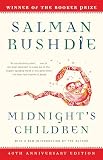
Salman Rushdie is the central figure in postcolonial literary fiction in English — the novelist who did most to establish that the literature of formerly colonised nations could be as formally ambitious and as culturally authoritative as the European modernism it had been forced to defer to. His prose — exuberant, allusive, drawing on South Asian storytelling traditions and the Latin American magical realism of García Márquez — changed what the English novel thought it could do.
Born in Mumbai in 1947, educated at Cambridge, based in London for most of his adult life and subsequently in New York, he has been a major figure in British literary culture since Midnight’s Children (1981) and in global controversy since the fatwa issued against The Satanic Verses in 1989.
Where to Start
Midnight’s Children (1981)
The masterpiece and the essential starting point. Saleem Sinai, born at the moment of Indian independence and telepathically connected to the other children born in that first hour of nationhood, dictates his life story and the history of modern India from his pickle factory in Bombay. Rushdie draws on Gabriel García Márquez’s magical realism, on the oral storytelling traditions of the Indian subcontinent, and on the specific linguistic complexity of a country with twenty-two official languages to create a novel that is simultaneously a personal bildungsroman, a national allegory, and a meditation on the relationship between individual lives and historical forces.
It won the Booker Prize in 1981 and the Booker of Bookers in 1993 (the best Booker Prize winner across the prize’s first twenty-five years).
The Controversial Masterwork
The Satanic Verses (1988)
Rushdie’s most ambitious and most controversial novel. Two Indian men survive the explosion of a hijacked airliner — one undergoes a transformation that makes him appear angelic; the other begins to resemble a devil — and the novel explores questions of identity, migration, religious doubt, and the construction of sacred stories through their experiences in London and in a series of dream sequences set in the world of the prophet Mahound. The novel is a serious literary work examining the human origins and human uses of religious belief; the specific passages that caused the 1989 fatwa are a small part of a complex whole.
Essential for any serious engagement with Rushdie’s work, but best approached after Midnight’s Children.
The More Accessible Work
The Ground Beneath Her Feet (1999)
The most accessible of Rushdie’s major novels — a love story structured around the Orpheus and Eurydice myth, following two Indian rock musicians (Ormus Cama and Vina Apsara) and the photographer who loves them both through decades of global rock music history. The novel uses its mythological structure to examine love, art, and what it means when the world you live in diverges from the world it should have been. Less linguistically challenging than Midnight’s Children, equally ambitious in its emotional scope.
Complete Bibliography in Order
| Title | Year | Note |
|---|---|---|
| Grimus | 1975 | First novel; science fiction; minor |
| Midnight’s Children | 1981 | Masterpiece; Booker Prize |
| Shame | 1983 | Pakistan; darker; good |
| The Satanic Verses | 1988 | Controversial; ambitious; essential |
| Haroun and the Sea of Stories | 1990 | Children’s book; allegory |
| The Moor’s Last Sigh | 1995 | India; painting; family saga |
| The Ground Beneath Her Feet | 1999 | Rock music; Orpheus; accessible |
| Fury | 2001 | New York; Manhattan; lesser work |
| Shalimar the Clown | 2005 | Kashmir; terrorism |
| The Enchantress of Florence | 2008 | Historical; Renaissance Florence |
| Luka and the Fire of Life | 2010 | Sequel to Haroun; children’s |
| Two Years Eight Months and Twenty-Eight Nights | 2015 | Fantasy; genies |
| The Golden House | 2017 | America; Trump-era |
| Quichotte | 2019 | Don Quixote retelling; Booker-shortlisted |
| Victory City | 2023 | Historical India |
| Knife | 2024 | Memoir of the 2022 attack |
A Master of Magical Realism and the Postcolonial
Salman Rushdie is one of the supreme masters of magical realism and postcolonial fiction, a writer whose exuberant, inventive novels blend history, myth, and fantasy to illuminate the experience of India, migration, and the postcolonial world. Rushdie’s fiction combines magical realism with a profound engagement with the postcolonial experience, blending history, myth, fantasy, and the marvelous to illuminate the experience of India and the Indian subcontinent, of migration and displacement, and of the postcolonial world. His celebrated novel of children born at the moment of India’s independence, in particular, exemplifies this blend of magical realism and postcolonial history, weaving the magical and the historical to illuminate the birth and the experience of modern India. This mastery of magical realism and the postcolonial is central to Rushdie’s achievement, for his exuberant, inventive novels blend history, myth, and fantasy to illuminate the experience of India, migration, and the postcolonial world. His combination of magical realism and postcolonial engagement gives his fiction its distinctive richness and significance. For readers, Rushdie offers a master of magical realism and the postcolonial, exuberant and inventive novels that blend history, myth, and fantasy to illuminate the postcolonial world. A master of magical realism and the postcolonial, Rushdie blends history, myth, and fantasy in his exuberant, inventive novels to illuminate the experience of India, migration, and the postcolonial world.
Exuberant Language and Imaginative Abundance
A defining quality of Salman Rushdie’s fiction is its exuberant language and imaginative abundance, the linguistic energy, inventiveness, and sheer profusion that mark his prose and his storytelling. Rushdie’s fiction is distinguished by its exuberant and energetic language, its linguistic inventiveness and play, and its imaginative abundance, the sheer profusion of stories, characters, inventions, and ideas that fill his novels. His prose is marked by its energy, its playfulness, its richness, and its inventiveness, and his storytelling overflows with imaginative abundance, weaving together a profusion of stories, myths, characters, and inventions. This exuberant language and imaginative abundance are central to Rushdie’s distinctive style, for the linguistic energy and inventiveness and the sheer profusion of his storytelling give his fiction its characteristic richness and exuberance. His exuberant prose and his overflowing imagination give his fiction its distinctive energy and abundance. For readers, Rushdie offers exuberant language and imaginative abundance, the linguistic energy and inventiveness and the sheer profusion that mark his fiction. Exuberant language and imaginative abundance are a defining quality of Rushdie’s fiction, the linguistic energy, inventiveness, and sheer profusion that mark his prose and his storytelling.
Migration, Identity, and the Hybrid Self
A central concern of Salman Rushdie’s fiction is migration, identity, and the hybrid self, the experience of migration and displacement and the mixed, hybrid identities that it produces. Rushdie’s fiction is deeply concerned with migration and identity, with the experience of migration, displacement, and exile, and with the mixed, hybrid, and plural identities that arise from the crossing of cultures and the experience of belonging to multiple worlds. His fiction celebrates and explores the hybrid self, the identity formed from the mixture of cultures and the experience of migration, and it illuminates the experience of those who belong to multiple worlds and cultures. This concern with migration, identity, and the hybrid self is central to Rushdie’s fiction, for he explores the experience of migration and displacement and the mixed, hybrid identities that it produces, celebrating the richness and complexity of the hybrid self. His engagement with migration and hybrid identity gives his fiction its distinctive perspective and its contemporary resonance. For readers, Rushdie offers a profound exploration of migration, identity, and the hybrid self, the experience of migration and the mixed identities it produces. Migration, identity, and the hybrid self are a central concern of Rushdie’s fiction, the experience of migration and displacement and the mixed, hybrid identities that it produces, celebrated as a source of richness and complexity.
Reading Order Recommendations
New to Rushdie: Midnight’s Children → The Ground Beneath Her Feet → The Satanic Verses.
Historical approach: Midnight’s Children → Shame → The Satanic Verses — the Indian subcontinent across three novels.
Accessible first: The Ground Beneath Her Feet → Midnight’s Children → The Satanic Verses.
Frequently Asked Questions
What is the best Salman Rushdie book to start with?
Midnight's Children is Rushdie's masterpiece and the most important starting point — it won the Booker Prize, the Booker of Bookers (the best Booker winner over 25 years), and is central to the postcolonial literary tradition. It is demanding but accessible to readers who commit to it. The Ground Beneath Her Feet is a more accessible alternative — a love story using the Orpheus and Eurydice myth, set in the world of rock music, that demonstrates Rushdie's gifts without the historical and linguistic complexity of Midnight's Children.
What is Midnight's Children about?
Midnight's Children (1981) follows Saleem Sinai, born at the moment of India's independence at midnight on August 15, 1947, who discovers he is telepathically connected to all other children born in the first hour of independence (the 'midnight's children'). Narrated as Saleem dictates his life story to Padma, the novel covers three decades of Indian history — partition, the Emergency, the Bangladesh war — through Saleem's increasingly unreliable narration. Rushdie's prose draws on the oral storytelling tradition of the Indian subcontinent, on magic realism, and on modernist fiction to produce a novel that changed how the postcolonial novel thought about its possibilities.
Why was The Satanic Verses controversial?
The Satanic Verses (1988) was interpreted by many Muslims as blasphemous — specifically, its fictional sections depicting the prophet Muhammad (named Mahound in the novel) as a historical figure with human motivations, and sections depicting the wives of the prophet in a brothel. The Ayatollah Khomeini of Iran issued a fatwa (religious ruling) calling for Rushdie's death in February 1989. Rushdie spent nine years under British police protection. The controversy is inseparable from the novel, and reading the book requires understanding that the sections that caused offence are a small part of a complex work about migration, identity, and the construction of religious belief.
Is Salman Rushdie still writing?
Yes — Rushdie survived a knife attack in August 2022, in which he lost sight in one eye and the use of one hand. He continued writing: his memoir about the attack, Knife, was published in 2024. He is one of the most important living novelists in English and his work continues to develop.


