Where to Start with Arthur Conan Doyle: A Reading Guide
Where to start with Arthur Conan Doyle — whether to begin with A Study in Scarlet, The Adventures of Sherlock Holmes, or The Hound of the Baskervilles. A complete reading guide.

Arthur Conan Doyle (1859–1930) created the most famous fictional detective in the world — and one of the most famous fictional characters in any genre. Sherlock Holmes, the consulting detective of 221B Baker Street, with his deductive reasoning, his cocaine habit, his Stradivarius, and his encyclopaedic but selective knowledge, has been portrayed on screen more often than any other fictional character in history, and the stories Doyle wrote about him set the template for detective fiction as it has been practised for 130 years. Doyle himself was ambivalent about his creation — he twice tried to kill Holmes off, once famously failing — but the stories remain endlessly readable, the character permanently compelling.
Where to Start: The Adventures of Sherlock Holmes (1892)
The essential entry point — the first and finest of the Sherlock Holmes short story collections, containing twelve cases that include some of the best detective stories ever written. ‘A Scandal in Bohemia,’ in which Holmes is outmanoeuvred by the opera singer Irene Adler, establishes immediately that Holmes can be defeated. ‘The Red-Headed League’ has the most brilliant and absurd premise in the canon. ‘The Adventure of the Speckled Band’ — a locked manor, a dying woman’s last words, a villain with a swamp adder — is the story most often cited as the single finest. ‘The Adventure of the Blue Carbuncle’ has the warmth of a Christmas story with the pleasure of a perfect puzzle.
The short story form suits Holmes perfectly: each case is self-contained, each displays the method and the character, and the pacing is flawless.
A Study in Scarlet (1887)
The first Holmes story — the novel in which Watson and Holmes meet, 221B Baker Street is established, and the method is introduced for the first time. Watson, returning from Afghanistan with a wound in his shoulder and a wound in his psyche, meets Holmes through a mutual acquaintance and agrees to share rooms. A murder in Brixton gives Holmes his first case and Watson his first experience of the detective’s remarkable reasoning.
The novel is historically important — without it, nothing that follows exists — but it is not Doyle at his best. The long Utah flashback interrupts the London mystery awkwardly, and the story collection Adventures is better as an introduction. Read A Study in Scarlet for completeness, or read it last, as an origin story that the later work has made you eager for.
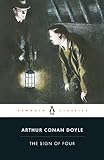
The Sign of Four (1890)
The second Holmes novel — more atmospheric and more romantic than A Study in Scarlet, opening with the famous scene in which Holmes, bored between cases, is injecting cocaine when Watson arrives with a client: Mary Morstan, whose father disappeared a decade ago and who has been receiving, anonymously, one large pearl per year. The mystery involves a stolen treasure, the Andaman Islands, and a murder by blowgun — Gothic and exotic in a way characteristic of the Victorian adventure story — and the case ends with Watson’s engagement to Mary Morstan.
More unified in structure than the first novel; excellent for readers who want the romance and adventure of the Holmes stories along with the detection.
The Valley of Fear (1915)
The last Holmes novel — and, for many readers, the most accomplished of the four. A cipher from Moriarty’s organisation warns Holmes of an imminent murder in a Sussex manor; the subsequent investigation involves a locked-room element of Agatha Christie-level ingenuity. The novel also splits into two halves (a pattern from A Study in Scarlet), but the American backstory — set in the coalfields of Pennsylvania, involving a secret criminal society — is more successfully integrated and more dramatically compelling than the Utah section of the first novel.
A satisfying read for Holmes enthusiasts who have worked through the short-story collections.
Why The Adventures of Sherlock Holmes Is the Ideal First Book
For a reader new to Arthur Conan Doyle, The Adventures of Sherlock Holmes is the ideal first book because it gathers many of the finest Sherlock Holmes stories and is the fullest introduction to his distinctive gifts, the brilliant detective, the ingenious mysteries, and the irresistible, atmospheric storytelling. The Adventures of Sherlock Holmes is a collection of classic short stories featuring the great detective Sherlock Holmes and his companion Dr. Watson, including some of the most famous and beloved cases in all of detective fiction. As an entry point it is ideal, for it offers the Holmes stories at their most concentrated and delightful and a perfect introduction to Conan Doyle’s gifts. It welcomes the newcomer with its brilliant detective, its ingenious mysteries, and its atmospheric storytelling, drawing the reader into the world of Sherlock Holmes. It gathers his most beloved work and best represents his gifts, so the new reader meets Holmes at his finest. For the newcomer, then, The Adventures of Sherlock Holmes is the natural and ideal starting point.
What to Expect as a New Reader
As a new reader, you can expect The Adventures of Sherlock Holmes to be a delightful, ingenious, and atmospheric collection of detective stories. You can expect a brilliant detective, for the stories feature Sherlock Holmes, the master of deduction, and his loyal companion Dr. Watson. You can expect ingenious mysteries, for each story presents a clever puzzle solved by Holmes’s brilliant reasoning. You can expect atmospheric storytelling, for Conan Doyle evokes the world of Victorian London with memorable atmosphere. You can expect classic, beloved cases, including some of the most famous in all of detective fiction. You can expect Holmes’s famous methods of observation and deduction. You can expect short, satisfying, and endlessly entertaining stories. Expect, in short, a delightful, ingenious, and atmospheric collection of detective stories, a perfect introduction to Conan Doyle’s gifts.
Going Deeper After Your First Book
Once The Adventures of Sherlock Holmes has introduced you to the great detective, the reader who wishes to go deeper can explore the rest of the Sherlock Holmes canon, the further collections of stories and the novels that complete the adventures of Holmes and Watson. The other story collections offer more of the ingenious mysteries and atmospheric storytelling, while the novels, including the famous and atmospheric tale of a spectral hound on the moors, give Holmes longer cases to solve. Beyond Holmes, the reader who has enjoyed Conan Doyle’s gifts can explore his other fiction, including his historical novels and his science-fiction and adventure stories, which reveal the range of his storytelling. Reading these after The Adventures of Sherlock Holmes deepens your appreciation of Conan Doyle’s distinctive gifts, the ingenious mysteries and the atmospheric storytelling. Building your reading journey through Conan Doyle is a matter of following Holmes through the rest of the canon and exploring his wider fiction. The reader who begins here will find the creator of the most famous detective in literature to follow.
Reading Arthur Conan Doyle
The Holmes stories are among the most purely pleasurable reading in any language — not demanding, not difficult, but consistently ingenious, consistently atmospheric, and driven by a character whose combination of intellectual arrogance, genuine brilliance, and occasional kindness has remained compelling for 130 years. Begin with The Adventures of Sherlock Holmes for the most immediately satisfying introduction; read A Study in Scarlet to understand where everything began; read the subsequent story collections in publication order. The novels are best approached after the stories.
Frequently Asked Questions
Where should I start with Arthur Conan Doyle?
The Adventures of Sherlock Holmes (1892) is the best starting point for most readers — the first collection of twelve short stories featuring Holmes and Watson, including 'A Scandal in Bohemia,' 'The Red-Headed League,' and 'The Adventure of the Speckled Band,' all of which are among the finest detective stories ever written. The stories are self-contained, perfectly paced, and immediately demonstrate everything that makes Holmes compelling. A Study in Scarlet is the best alternative for readers who want to begin at the absolute beginning with Holmes and Watson's first meeting; The Sign of Four for the most romantic early adventure.
What is A Study in Scarlet about?
A Study in Scarlet (1887) is the first Sherlock Holmes story — the novel in which Dr. John H. Watson, recently returned from the Second Anglo-Afghan War, meets Sherlock Holmes through a mutual acquaintance and agrees to share rooms at 221B Baker Street. A murder investigation in a house in Brixton introduces Watson (and the reader) to Holmes's remarkable deductive methods. The novel interrupts its London mystery with a long flashback to Utah and the early history of the Latter-day Saints, which many readers find jarring — one of several reasons why the story collections are generally preferred as an entry point.
What is the best Sherlock Holmes short story?
There is no consensus, but 'The Adventure of the Speckled Band' (from The Adventures of Sherlock Holmes) is most frequently cited as the single finest Holmes story — a locked-room mystery set in a crumbling English manor, with a dying woman's cryptic last words and a villain of memorable villainy. 'A Scandal in Bohemia' is essential for introducing Irene Adler, the only woman to outsmart Holmes. 'The Red-Headed League' has the most absurd and brilliant premise. 'The Adventure of the Final Problem' introduces Professor Moriarty and ends with what Doyle intended as the permanent death of Holmes.
What is the reading order for Sherlock Holmes?
The Sherlock Holmes canon consists of four novels and five short-story collections, published between 1887 and 1927. Publication order: A Study in Scarlet (1887), The Sign of Four (1890), The Adventures of Sherlock Holmes (1892), The Memoirs of Sherlock Holmes (1894), The Hound of the Baskervilles (1902), The Return of Sherlock Holmes (1905), The Valley of Fear (1915), His Last Bow (1917), The Case-Book of Sherlock Holmes (1927). Most readers begin with the first short-story collection rather than the novels, as the stories are more immediately engaging and self-contained.