Where to Start with John Irving: A Reading Guide
Where to start with John Irving — whether to begin with The World According to Garp, A Prayer for Owen Meany, or The Cider House Rules. A complete reading guide.

John Irving (born 1942) is one of the most beloved American novelists of his generation — a writer whose novels combine Dickensian exuberance of plot with dark, sudden violence, whose characters are eccentric to the point of grotesquerie, and whose recurring themes (wrestling, New England prep schools, bears, artificial limbs, Vienna, mortality) give his work an instantly recognisable texture. His novels are long, warmly comic, and devastatingly sad in equal measure, and they have found millions of readers across five decades.
Where to Start: The World According to Garp (1978)
The essential Irving — and the novel that established him as a major American voice. T.S. Garp is the son of Jenny Fields, a nurse who became a feminist icon by writing a memoir about her decision to have a child without a husband. Garp grows up in a New England prep school where his father was a wrestling coach, becomes a writer, marries a colleague’s daughter, and raises two sons in a world where violence arrives without warning. The novel is Irving’s most exuberant: comic, deeply sad, full of digression and incident, and sustained by a genuine love for its characters even as it visits catastrophe on them.
The combination of wrestling, feminism, Vienna, bears, and sudden violent death is quintessentially Irvingesque; Garp is the best demonstration of how he makes these seemingly incompatible elements cohere into a warm, humane, and deeply felt narrative.
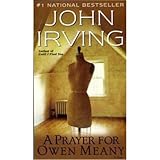
A Prayer for Owen Meany (1989)
The most formally precise Irving — and the novel many readers consider his masterpiece. John Wheelwright narrates his childhood friendship with Owen Meany, a diminutive boy with a voice ‘like a cross between a Chihuahua and an alarm clock’ who believes himself to be an instrument of God and who is certain he knows when and how he will die. The novel is structured around Owen’s prophecy: everything that happens in John’s and Owen’s childhood is a rehearsal for a moment that Owen has foreseen and John does not understand until it arrives.
The friendship between John and Owen is one of the great relationships in American fiction — funny, strange, and utterly devoted. The novel’s ending is among the most emotionally powerful Irving achieves.
The Cider House Rules (1985)
Irving’s most politically explicit novel — a sustained argument, through narrative, for a woman’s right to abortion. Homer Wells grows up in the St. Cloud’s orphanage in Maine, where Dr. Larch runs both an orphanage and an abortion clinic. Homer refuses to become an abortionist himself and goes out into the world — an apple orchard, a love affair, a war — before returning to the orphanage and the vocation he had refused. The novel is Irving’s most Dickensian: large cast, carefully constructed plot, the orphan hero whose parentage and destiny are entangled.
Why The World According to Garp Is the Ideal First Book
For a reader new to John Irving, The World According to Garp is the ideal first book because it is his breakout masterpiece and the fullest expression of his distinctive gifts, the rich storytelling, the memorable characters, the blend of comedy and tragedy, and the recurring themes that mark his fiction. The World According to Garp follows the life of T.S. Garp, a writer, his formidable feminist mother, and his family, in a sweeping, often outrageous, and deeply human story of love, ambition, violence, and fate. As an entry point it is ideal, for it is the novel that made his name and a perfect example of his expansive, tragicomic storytelling. It welcomes the newcomer with its vivid characters, its blend of humor and heartbreak, and its narrative richness, drawing the reader into Irving’s distinctive world. It is among his most famous works and the one that best represents his gifts, so the new reader encounters Irving at his most characteristic. For the newcomer, then, The World According to Garp is the natural and ideal starting point.
What to Expect as a New Reader
As a new reader, you can expect The World According to Garp to be a rich, expansive, and tragicomic novel. You can expect vivid storytelling, for Irving is a born storyteller who fills his novels with incident, character, and narrative momentum. You can expect memorable characters, for the novel is peopled with unforgettable figures, above all Garp and his formidable mother. You can expect a blend of comedy and tragedy, for Irving mixes the outrageous, the funny, and the absurd with sudden violence, loss, and heartbreak. You can expect his recurring themes and motifs, family, writing, sexuality, fate, and the ever-present possibility of sudden catastrophe. You can expect a long, ambitious, and absorbing novel in the Dickensian tradition. You should be prepared for some dark and shocking events. Expect, in short, a rich, expansive, and tragicomic novel, a definitive introduction to Irving’s gifts.
Going Deeper After Your First Book
Once The World According to Garp has introduced you to Irving’s gifts, the reader who wishes to go deeper can explore his other major novels, which continue his rich storytelling, his memorable characters, and his blend of comedy and tragedy. A Prayer for Owen Meany, one of his most beloved books, tells the unforgettable story of an extraordinary boy and questions of faith and fate, while The Cider House Rules explores an orphanage, abortion, and moral responsibility with his characteristic depth and humanity. Reading these after The World According to Garp deepens your appreciation of Irving’s distinctive gifts, the storytelling, the vivid characters, and the tragicomic vision. His characteristic themes and motifs run through his work, and the reader who has enjoyed The World According to Garp will find them across his novels. Building your reading journey through Irving is a matter of following his fiction from The World According to Garp into A Prayer for Owen Meany, The Cider House Rules, and his other novels. The reader who begins here and continues will find one of the great storytellers in modern American fiction.
Reading John Irving
Irving’s novels are long, and their length is part of their design: the digressive energy, the extended subplots, the characters who arrive and stay for 200 pages before their function becomes clear, are all part of his Dickensian inheritance. His combination of comedy and violence is his most distinctive quality — the jokes are very funny and the violence is very sudden, and both are real. Begin with The World According to Garp for the fullest Irving experience; begin with A Prayer for Owen Meany for the most emotionally concentrated. Either choice leads naturally to the rest of his work.
Frequently Asked Questions
Where should I start with John Irving?
The World According to Garp (1978) is both the most widely read and the best starting point — a sprawling, darkly comic novel about the life of T.S. Garp, the son of a feminist icon, from his illegitimate conception to his violent death. It is Irving at his most exuberant and most characteristic: the wrestling obsession, the New England setting, the combination of slapstick comedy with sudden devastating violence, the eccentric extended family. A Prayer for Owen Meany is the best alternative for readers who want Irving's most formally precise and emotionally concentrated novel.
What is The World According to Garp about?
The World According to Garp (1978) follows T.S. Garp, the illegitimate son of a feminist nurse named Jenny Fields who became famous by writing a memoir about her unconventional life. Garp grows up in a New England prep school, becomes a writer, marries, has children, and navigates the violent, absurdist world that Irving constructs around him. The novel is an account of the randomness of violence — accidents, consequences, the sudden destruction of comfortable lives — and of love as the primary human response to that randomness. Irving's most celebrated novel.
What is A Prayer for Owen Meany about?
A Prayer for Owen Meany (1989) is narrated by John Wheelwright, looking back on his childhood friendship with the extraordinary Owen Meany — a tiny, oddly voiced boy in a New Hampshire town who believes himself to be an instrument of God and who knows in advance the exact circumstances of his own death. The novel is Irving's most emotionally intense and most formally controlled: the relationship between John and Owen is one of the great friendships in American fiction, and Owen's certainty about his fate gives the novel a momentum that carries through to its devastating conclusion.
What is The Cider House Rules about?
The Cider House Rules (1985) follows Homer Wells, who grows up in an orphanage in Maine run by Dr. Larch — a committed abortionist — and must eventually decide whether to follow Larch's vocation or find his own path in the world. The novel is Irving's most explicitly political (it is a sustained argument for abortion rights) and his most Dickensian in its plotting and characterisation. Homer's journey from the orphanage to an apple orchard and back is one of the most fully plotted in Irving's work; the relationship between Homer and Dr. Larch is among his most moving.