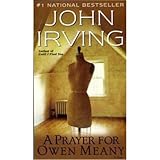
Editors Reads Verdict
A Prayer for Owen Meany is Irving's most beloved novel — a deeply moving examination of faith, friendship, and destiny that manages to be both darkly funny and genuinely spiritually serious in ways that most American novels cannot sustain.
What We Loved
- Owen Meany is one of American fiction's most unforgettable creations
- Irving sustains both comedy and spiritual seriousness across 500+ pages without either undermining the other
- The structure — with its careful foreshadowing — pays off with devastating precision
- The Vietnam War context gives the novel a political seriousness that grounds the spiritual dimension
Minor Drawbacks
- The contemporary narrator sections (set in Canada) are less compelling than the childhood sections
- Irving's authorial presence can be heavy-handed in places
- The novel's length can feel extended in its middle sections
Key Takeaways
- → Faith is most credible when it costs something
- → The shape of a life may only become legible in retrospect
- → Friendship between people of radically different temperaments can be the deepest kind
- → Vietnam's shadow falls over an entire generation's understanding of America
- → Irving's use of sustained foreshadowing is among the most technically accomplished in American fiction
| Author | John Irving |
|---|---|
| Publisher | William Morrow |
| Pages | 543 |
| Published | March 1, 1989 |
| Language | English |
| Genre | Fiction, Literary Fiction |
| Difficulty | Intermediate |
| Best For | Literary fiction readers interested in faith, friendship, and coming-of-age in mid-twentieth century America — particularly readers willing to engage with religious themes. |
How A Prayer for Owen Meany Compares
A Prayer for Owen Meany at a glance against 3 similar books readers weigh alongside it.
| Book | Author | Rating | Best for |
|---|---|---|---|
| A Prayer for Owen Meany (this book) | John Irving | ★ 4.5 | Literary fiction readers interested in faith, friendship, and coming-of-age in |
| Birdsong | Sebastian Faulks | ★ 4.4 | Readers of historical fiction, particularly those interested in the First World |
| Little Women | Louisa May Alcott | ★ 4.8 | Classic Fiction |
| The World According to Garp | John Irving | ★ 4.2 | Literary fiction readers interested in American fiction of the 1970s, readers |
THE INSTRUMENT OF GOD
Owen Meany speaks in capital letters. This is not a stylistic quirk but a fact of his character: his voice, peculiarly pitched, renders everything he says in a register that demands attention. From their first meeting, John Wheelwright understands that Owen is different — and over fifty years of retrospective narration, he traces what that difference meant.
The novel begins with an act of accidental violence that changes everything: Owen hits a foul ball that kills John’s mother. From this moment the friendship between the two boys is sealed by guilt, grief, and an inexplicable sense that the event was not accidental. Owen believes he is God’s instrument. John’s narration — written decades later, from Canada, having left America in protest at Vietnam — is his attempt to reckon with whether Owen was right.
The Comedy and the Faith
Irving is one of American literature’s great comic writers, and A Prayer for Owen Meany is frequently very funny. The scenes of Owen’s nativity play performance, the armadillo, the stuffed duck — the novel’s first half is rich with the particular comedy of New England childhood in the 1950s and 60s. But the comedy is never used to deflate the spiritual seriousness. Owen’s certainty that he knows what he is for, and will do it, is treated with complete respect even by the narrator who struggles his entire life with faith.
The Structural Triumph
The novel’s structure is its greatest technical achievement. Irving deploys foreshadowing across 500 pages with extraordinary precision, planting details that only reveal their significance at the climax. The final scene is among the most emotionally powerful in American fiction — earned by every page that precedes it.
A Friendship at the Centre
For all its grand themes, the novel lives or dies on the relationship between its two boys, and it is one of the great friendships in American fiction. John Wheelwright is a passive, uncertain, fatherless boy — he spends much of the book, and his life, not knowing who his father is — and Owen is his opposite: tiny but ferociously certain, physically fragile but spiritually immovable, the granite-quarry owner’s son who speaks in a voice “not entirely of this world.” Owen does for John what John cannot do for himself: he gives his friend’s shapeless life a center of gravity. Their bond is sealed in tragedy — it is Owen’s foul ball that kills John’s beloved mother — and yet the guilt only deepens their attachment. Irving understands that the deepest friendships often join people of wildly different temperaments, the doubter and the believer, the drifter and the one who knows exactly what he is for, and the tenderness between these two carries the reader through even the novel’s darkest turns.
Fate, Vietnam, and “The Shot”
What lifts the novel above a coming-of-age story is the way Irving threads a single unwavering prophecy through five hundred pages. Owen believes he knows how and when he will die, having seen the date on a tombstone during a performance of A Christmas Carol and his own fate in a recurring dream. Everything he does becomes preparation: the two boys obsessively practising a basketball move they call “the Shot,” in which Owen, hoisted aloft, dunks the ball in under four seconds; Owen’s strange insistence on learning to do it faster; his conviction that he is meant to save children. These details, which seem at first like the eccentricities of an unusual boy, are revealed at the climax to have been training for a single act of sacrifice involving a grenade and a group of Vietnamese children in an airport in Arizona. Irving binds Owen’s private destiny to the public catastrophe of Vietnam, so that the war is not background but the dark engine toward which the whole plot has been moving. The famous final pages reframe every earlier oddity — the armless armadillo, the severed finger, John’s mother’s death — as pieces of a design only legible in retrospect.
Irving’s Craft and Place
A Prayer for Owen Meany is John Irving’s seventh novel and, by his publisher’s account, his all-time bestseller in every language — and it is easy to see why it became his most beloved. It distills the qualities that define him: the Dickensian plotting with its enormous cast and engineered coincidences, the comic set-pieces, the New England settings, the preoccupation with absent parents and bizarre accidents that runs from The World According to Garp onward. Irving has cited Günter Grass’s The Tin Drum as a model, and the debt is visible in Owen, another tiny, uncanny child who refuses to be ordinary. Not everyone loves it; some critics find the relentless foreshadowing heavy-handed and the contemporary Canadian frame, in which an embittered older John rails against American politics, weaker than the luminous childhood chapters. But these are the costs of Irving’s ambition, and they are outweighed by the book’s emotional payoff.
Faith in an Unlikely Form
A Prayer for Owen Meany is not a religious novel in the comfortable sense. Its faith is hard, strange, and purchased at enormous cost — Owen is the rare fictional believer whose certainty is treated with complete seriousness rather than ironised, and the novel dares to suggest that doubt and faith are not opposites but lifelong companions. It is, finally, one of the most serious engagements in American fiction with the question of whether any individual life can have a predetermined shape, and whether meaning is something we find or something we are made for. That it manages this while also being warm, funny, and propulsively readable is the measure of Irving’s achievement.
Our rating: 4.5/5 — Irving’s masterwork: a novel of comedy, grief, faith, and devastating structural precision.
Reading Guides
Frequently Asked Questions
What is "A Prayer for Owen Meany" about?
John Wheelwright narrates his extraordinary friendship with Owen Meany — a tiny, certain-voiced boy who believes he is God's instrument — and the event that will prove him right.
Who should read "A Prayer for Owen Meany"?
Literary fiction readers interested in faith, friendship, and coming-of-age in mid-twentieth century America — particularly readers willing to engage with religious themes.
What are the key takeaways from "A Prayer for Owen Meany"?
Faith is most credible when it costs something The shape of a life may only become legible in retrospect Friendship between people of radically different temperaments can be the deepest kind Vietnam's shadow falls over an entire generation's understanding of America Irving's use of sustained foreshadowing is among the most technically accomplished in American fiction
Is "A Prayer for Owen Meany" worth reading?
A Prayer for Owen Meany is Irving's most beloved novel — a deeply moving examination of faith, friendship, and destiny that manages to be both darkly funny and genuinely spiritually serious in ways that most American novels cannot sustain.
Ready to Read A Prayer for Owen Meany?
Check the current price on Amazon.
Check Price on Amazon (paid link)Prices and availability are subject to change. See Amazon for current price.
Review last updated: