Where to Start with Jonathan Haidt: A Reading Guide
Where to start with Jonathan Haidt — whether to begin with The Righteous Mind, The Coddling of the American Mind, or The Anxious Generation. A complete reading guide.
By Lena Fischer

Jonathan Haidt (born 1963) is the American social psychologist and professor at NYU Stern School of Business whose work on moral psychology, political polarisation, and adolescent mental health has made him one of the most widely read and most frequently cited social scientists writing for a general audience. His Moral Foundations Theory — the framework that identifies six psychological systems underlying human moral judgements — has been influential in political science, sociology, and psychology. The Righteous Mind (2012) and The Coddling of the American Mind (2018) are among the most widely discussed non-fiction books of the 2010s; The Anxious Generation (2024) became an immediate bestseller and policy reference for the debate about smartphones and adolescent mental health.
Where to Start: The Righteous Mind (2012)
The essential Haidt — a sustained argument about why moral disagreement between political liberals and conservatives is so intractable, rooted in a theory of how morality works. Haidt’s central claim is that moral intuitions are primary and moral reasoning is secondary: we feel that something is right or wrong before we reason about it, and our reasoning is primarily the construction of post-hoc justifications for intuitions we already hold. The rider (conscious reasoning) doesn’t control the elephant (intuitions); it rationalises the elephant’s movements.
The political application is Moral Foundations Theory: humans have six psychological foundations that register moral concerns (care, fairness, loyalty, authority, sanctity, and liberty). Liberals prioritise care and fairness; conservatives activate all six. This asymmetry explains why conservatives can understand liberal moral psychology but liberals often cannot understand conservative moral psychology — liberals are working with a subset of the full moral palette.
The Righteous Mind is argued with genuine intellectual generosity — Haidt (who describes himself as a liberal) takes conservative moral psychology seriously as a genuine and not-contemptible system of values. This is the book’s greatest contribution: it makes political disagreement comprehensible rather than simply decrying it.
The Happiness Hypothesis (2006)
Haidt’s earlier and more personally focused book — ten ancient wisdom ideas, tested against the findings of contemporary psychology. The elephant-rider metaphor introduced here became Haidt’s most influential single framework. Each chapter takes an ancient idea (‘what doesn’t kill me makes me stronger’, ‘love and work are what matter’) and asks what psychology says about it. The book is warmer and more personally engaged than his later work; the best entry point for readers who want Haidt’s psychological framework in its most accessible form.
The Coddling of the American Mind (2018)
Haidt and Greg Lukianoff’s account of the three ‘great untruths’ they argue have become embedded in campus culture and produced a generation more anxious and more fragile than its predecessors: ‘What doesn’t kill you makes you weaker’, ‘Always trust your feelings’, and ‘Life is a battle between good people and evil people.’ The book is part cognitive behavioural therapy (the untruths are precisely the cognitive distortions CBT addresses), part campus sociology, and part policy argument. More polemical than The Righteous Mind; influential and contested.
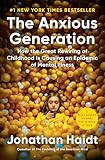
The Anxious Generation (2024)
Haidt’s most recent and most urgent book — an account of the smartphone-driven collapse in adolescent mental health that began around 2012, with particular severity for girls. The argument: the replacement of ‘play-based childhood’ (physically active, unsupervised, rich in genuine social risk) with ‘phone-based childhood’ (sedentary, surveilled, mediated through social media) has produced the mental health crisis. The policy recommendations — delayed smartphone access, no social media before 16, phone-free schools — are now influencing legislation in multiple countries.
Why The Righteous Mind Is the Ideal First Book
For a reader new to Jonathan Haidt, The Righteous Mind is the ideal first book because it is among his most influential works and the fullest expression of his distinctive contribution, the psychology of morality and why good people are divided by politics and religion. The Righteous Mind draws on moral psychology to argue that our moral judgments are driven more by intuition than reason, and that people across the political and religious spectrum rely on different moral foundations. As an entry point it is ideal, for it is one of his best-known books and a clear statement of the ideas for which he is known. It welcomes the newcomer with its compelling argument, its research-grounded insights, and its accessible style, drawing the reader into the psychology of morality and division. Readers will encounter a strong argument that scholars debate, and are wise to engage thoughtfully. It is among his major works and a fine representation of his thinking, so the new reader encounters Haidt directly. For the newcomer, then, The Righteous Mind is an excellent starting point.
What to Expect as a New Reader
As a new reader, you can expect The Righteous Mind to be a compelling, research-grounded, and accessible book about the psychology of morality. You can expect a central argument, that our moral judgments are driven more by quick intuition than by reasoning, which often comes after the fact. You can expect the idea of moral foundations, that people across the political and religious spectrum rely on different sets of moral values. You can expect an explanation of division, for Haidt uses these ideas to illuminate why good people are divided by politics and religion. You can expect grounding in moral psychology, drawing on research and his own work. You can expect a call for greater understanding across moral divides. You can expect a clear, engaging style, and a strong argument the thoughtful reader weighs critically. Expect, in short, a compelling, research-grounded, and accessible book about the psychology of morality, a fine introduction to Haidt’s ideas.
Going Deeper After Your First Book
Once The Righteous Mind has introduced you to Haidt’s ideas, the reader who wishes to go deeper can explore his other books, which continue his engagement with moral psychology, well-being, and the challenges of contemporary society. His earlier book draws on ancient wisdom and modern psychology to explore happiness and meaning, while his later collaborative and solo works examine the state of free inquiry, the effects of social media and smartphones on young people, and other timely concerns, each grounded in psychology and aimed at a wide audience. Reading these after The Righteous Mind deepens your engagement with Haidt’s distinctive contribution, the psychology of morality, well-being, and social division. His characteristic approach, and his strong arguments, run through his work, which the thoughtful reader engages critically. Building your reading journey through Haidt is a matter of following his thought from The Righteous Mind into his other books. The reader who begins here and continues will find one of the most prominent and widely discussed contemporary writers on moral psychology and society.
Reading Jonathan Haidt
Begin with The Righteous Mind for Haidt’s most intellectually rigorous and most influential work. Read The Happiness Hypothesis for the more personal and accessible version of his psychological framework. The Coddling of the American Mind and The Anxious Generation are best approached in sequence as his increasingly urgent argument about what is happening to younger generations.
Frequently Asked Questions
Where should I start with Jonathan Haidt?
The Righteous Mind: Why Good People Are Divided by Politics and Religion (2012) is the essential starting point — Haidt's account of how moral intuitions are formed, how they differ systematically between political liberals and conservatives, and why moral disagreement is so intractable. The central argument: humans are primarily intuitive moral reasoners who rationalise after the fact rather than reasoning to conclusions. The Moral Foundations Theory (six foundations across which liberals and conservatives systematically differ) is the most influential framework Haidt developed. The Happiness Hypothesis is a good alternative for readers who want a less politically focused starting point.
What is The Coddling of the American Mind about?
The Coddling of the American Mind (2018), co-authored with Greg Lukianoff, argues that three 'great untruths' — that fragility is vulnerability, that emotional reasoning is reliable, and that the world is divided into good and evil people — have become embedded in American campus culture, producing anxiety, fragility, and political polarisation among younger generations. The book draws on cognitive behavioural therapy, evolutionary psychology, and campus incident data to argue that the practices of 'safetyism' — protecting children from all risk, discomfort, and opposing views — are psychologically harmful rather than protective.
What is The Anxious Generation about?
The Anxious Generation: How the Great Rewiring of Childhood Is Causing an Epidemic of Mental Illness (2024) extends The Coddling's argument, focusing specifically on smartphones and social media as the primary cause of the mental health crisis among adolescents that began in the early 2010s. Haidt argues that the transition from a 'play-based childhood' to a 'phone-based childhood' has been catastrophic for adolescent mental health, particularly for girls, and proposes specific structural interventions at the level of schools and platforms. His most policy-focused book.
What is The Happiness Hypothesis about?
The Happiness Hypothesis: Finding Modern Truth in Ancient Wisdom (2006) is Haidt's earlier and more accessible book — an account of ten 'ancient wisdom' ideas (from Plato, Buddha, the New Testament, and others) tested against modern psychological research. The metaphor that runs through the book — the conscious mind as a rider on an elephant, trying and failing to fully control the elephant of the unconscious — is one of the most used metaphors in popular psychology. The best entry point for readers who want Haidt's psychological framework without the political application.