Where to Start with Marianne Williamson: A Reading Guide
Where to start with Marianne Williamson — how to approach A Return to Love, her breakthrough work drawing on A Course in Miracles to present love as the only force capable of transforming relationships, careers, and the self. A complete reading guide.
By Lena Fischer
Marianne Williamson (born 1952 in Houston, Texas) is an American author, lecturer, and political figure who became one of the most widely read spiritual writers in America through a series of books drawing on A Course in Miracles, a self-study spiritual curriculum first published in 1975. She encountered the Course in her early thirties during a difficult period and began giving lectures on its teachings in Los Angeles, developing a following that grew into a national audience. A Return to Love (1992), her first book, was endorsed by Oprah Winfrey and became an immediate bestseller. She has published thirteen books and twice run for political office.
Where to Start: A Return to Love (1992)
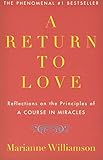
The essential Marianne Williamson — and one of the most emotionally direct spiritual books published in English in the past thirty years. A Return to Love is built around a single, simple, radical claim: that the two fundamental emotions are love and fear, and that every difficult situation in life — every relationship problem, career obstacle, health crisis, and moment of inner darkness — is at its core an invitation to choose one over the other.
The love-fear framework is the book’s most important conceptual contribution. Williamson draws on A Course in Miracles to argue that what we normally call negative emotions — anger, jealousy, resentment, anxiety, depression — are all expressions of fear, and that fear in this sense is not primarily an emotional state but a mode of perception: seeing the world as essentially threatening, other people as essentially competitors or dangers, and oneself as essentially insufficient. Love, in contrast, is not merely warmth toward other people but a fundamental orientation — seeing situations and people through the lens of their inherent worth rather than their threat potential.
The most quoted passage in the book deserves its context: “Our deepest fear is not that we are inadequate. Our deepest fear is that we are powerful beyond measure. It is our light, not our darkness, that most frightens us.” This passage is often misattributed to Nelson Mandela, but it appears here in its original context as an argument about why people make themselves smaller than they are — not from genuine modesty but from fear of what it would mean to fully show up, to claim one’s gifts without apology. Williamson argues that playing small serves no one; that our full expression is itself an act of love.
The forgiveness chapters are the book’s most practically demanding. Williamson uses forgiveness in the Course’s specific sense — not condoning what happened but releasing its hold on the present, choosing to see the person who hurt you through the lens of their own suffering and fear rather than their actions toward you. This is not presented as easy or automatic. It is presented as the central spiritual practice: the specific mechanism by which the past’s grip on the present loosens.
The work and purpose sections are among the book’s most distinctive. Williamson argues that the question “what should I do with my life?” is answered by asking what form of service you are best placed to offer — that meaningful work is not found by optimising for personal satisfaction but by asking what the world needs and what you have been given to provide. This is both spiritually grounded and practically counterintuitive.
Why A Return to Love Is the Ideal First Book
For a reader new to Marianne Williamson, A Return to Love is the ideal first book because it is her landmark work and the fullest expression of her distinctive spiritual teaching, centered on love, forgiveness, and inner transformation. A Return to Love presents Williamson’s reflections on love as a spiritual path, drawing on the spiritual text she is associated with to explore how letting go of fear and embracing love can transform our lives. As an entry point it is ideal, for it is her best-known book and the fullest statement of her spiritual message. It welcomes the newcomer with its central themes, its reflective insights, and its accessible style, drawing the reader into her distinctive spiritual perspective. Readers approach such spiritual writing according to their own beliefs, engaging thoughtfully with ideas that are matters of personal conviction rather than established fact. It is her most famous work and the one that best represents her teaching, so the new reader encounters Williamson directly. For the newcomer drawn to her perspective, then, A Return to Love is the natural starting point.
What to Expect as a New Reader
As a new reader, you can expect A Return to Love to be a reflective, spiritual, and influential book about love and inner transformation. You can expect central themes of love, forgiveness, and letting go of fear as a spiritual path. You can expect reflections drawn from the spiritual text Williamson is associated with, which she interprets and applies to life. You can expect a focus on inner transformation, for Williamson teaches that changing our thinking, from fear toward love, can transform our lives and relationships. You can expect a reflective, earnest, and accessible style. You can expect ideas that are spiritual rather than scientific, which readers engage according to their own beliefs and convictions. You can expect a book that has been influential in contemporary spirituality, including its famous passage on our deepest fear. Expect, in short, a reflective, spiritual, and influential book about love and transformation, an introduction to Williamson’s perspective.
Going Deeper After Your First Book
Once A Return to Love has introduced you to Williamson’s perspective, the reader who wishes to go deeper can explore her other books and the wider literature of contemporary spirituality to which her work belongs, engaging according to their own beliefs. Her other writings apply her spiritual teaching of love, forgiveness, and transformation to many areas of life, from relationships and weight to age and social questions, while the broad world of contemporary spiritual writing offers many further perspectives the reader may explore thoughtfully. Reading more widely deepens your engagement with Williamson’s distinctive spiritual perspective and with the wider conversation it joins. Her characteristic themes run through her work, and the reader who has connected with A Return to Love will find them across her books. Building your reading journey from A Return to Love is a matter of following its themes into her other books and the wider spiritual literature. The reader who begins here will have encountered an influential voice of contemporary spirituality, to engage with according to their own convictions.
Reading Marianne Williamson
A Return to Love is Williamson’s essential book and the natural starting point. Readers who want to continue should explore Illuminata (1994), which applies the framework to prayer and spiritual practice, or A Woman’s Worth (1993), which focuses specifically on femininity and power.
For the full Marianne Williamson bibliography, reviews, and biography, visit the Marianne Williamson author page on Editors Reads.
Affiliate disclosure: Links to Amazon on this page are affiliate links. We earn a small commission at no extra cost to you.
Frequently Asked Questions
Where should I start with Marianne Williamson?
A Return to Love: Reflections on the Principles of A Course in Miracles (1992) is Williamson's essential book — the work that established her as one of the most widely read spiritual writers in America. Williamson discovered A Course in Miracles at a low point in her life and found in its teachings — a blend of Christian language, psychological insight, and metaphysical philosophy — a framework that reorganised how she understood herself and her choices. A Return to Love is not a summary of the Course but a personal meditation on its central proposition: that the two fundamental emotions are love and fear, and that every difficult situation is an invitation to choose one over the other.
What is A Return to Love about?
The book applies its central framework — love versus fear — to every major domain of life: relationships, work, the body, addiction, grief, and the nature of the self. In each case, Williamson identifies the fear-based pattern (competition, control, manipulation, the need to be seen as better than others) and contrasts it with the love-based alternative (humility, forgiveness, genuine service, full presence with another person). The miracle of the title is not supernatural — it is the shift in perception that occurs when you genuinely choose love over fear in a specific situation. Williamson argues that this choice, consistently made, transforms not just individual experiences but the underlying character of a life.
Do I need to know A Course in Miracles to appreciate A Return to Love?
No — Williamson writes for readers who have not read the Course and explains its key concepts clearly. Familiarity with the Course enriches the book but is not a prerequisite. What the book does require is some openness to spiritual language and a framework grounded in the idea that love is a fundamental force rather than simply an emotion. Readers who approach the book from an entirely secular perspective will likely find it too rooted in metaphysical assumptions to fully land, though even skeptical readers will encounter passages of genuine psychological acuity. The book works best for readers who are spiritually curious rather than spiritually committed to a specific tradition.
What should I read after A Return to Love?
After A Return to Love, Williamson's subsequent books — including Illuminata (1994) and A Woman's Worth (1993) — develop the same framework in specific contexts. For the source material, A Course in Miracles itself is the obvious next step, though it is considerably denser and more demanding. Eckhart Tolle's The Power of Now covers overlapping territory — present-moment awareness, the relationship between the ego and suffering — in a more secular register that may be accessible to readers who found the Course's Christian language limiting. Thomas Merton's The Seven Storey Mountain provides a profound account of spiritual transformation within a traditional Christian framework.