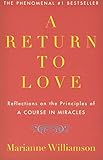
Editors Reads Verdict
A Return to Love translates the dense metaphysical teachings of A Course in Miracles into an emotionally direct guide to choosing love over fear — and finding that the choice itself begins to transform everything.
What We Loved
- Williamson's prose is beautiful and emotionally resonant throughout
- Makes abstract spiritual concepts accessible through personal narrative and vivid examples
- Deeply comforting for readers navigating loss, failure, or spiritual emptiness
Minor Drawbacks
- Grounded entirely in A Course in Miracles theology — secular readers may struggle with its framework
- Less practical than many self-help books; the emphasis is on inner shift rather than outer action
Key Takeaways
- → The fundamental choice in every situation is between love and fear; choosing love is what Williamson calls a miracle
- → Our deepest fear is not that we are inadequate but that we are powerful beyond measure
- → Forgiveness — releasing the past's hold on the present — is the central spiritual practice
| Author | Marianne Williamson |
|---|---|
| Published | January 1, 1992 |
| Language | English |
| Genre | Spirituality, Self-Help, Philosophy |
| Difficulty | Beginner |
| Best For | Spiritually curious readers, especially those going through major transitions, grief, or a search for deeper meaning. |
How A Return to Love Compares
A Return to Love at a glance against 3 similar books readers weigh alongside it.
| Book | Author | Rating | Best for |
|---|---|---|---|
| A Return to Love (this book) | Marianne Williamson | ★ 4.3 | Spiritually curious readers, especially those going through major transitions, |
| $100M Offers | Alex Hormozi | ★ 4.6 | Entrepreneurs, small business owners, and sales professionals looking to |
| 12 Rules for Life | Jordan B. Peterson | ★ 4.5 | Anyone seeking a philosophically grounded framework for living responsibly and |
| 21 Lessons for the 21st Century | Yuval Noah Harari | ★ 4.1 | Readers already familiar with Harari's work who want his take on contemporary |
Marianne Williamson encountered A Course in Miracles at a low point in her life and found in its teachings — a blend of Christian language, psychological insight, and metaphysical philosophy — a framework that reorganized how she understood herself and her choices. A Return to Love is not a summary of the Course but a personal meditation on its central proposition: that the only two fundamental emotions are love and fear, and that every difficult situation in life is an invitation to choose one over the other. The miracle of the title is not supernatural; it is the shift in perception that occurs when you genuinely choose love.
The book moves through relationships, work, body, and the nature of the self with a consistency of vision that is its greatest strength. Whether discussing romantic love, career ambitions, addiction, or the experience of physical illness, Williamson returns always to the same question: are you operating from love, or from fear? Fear in her framework includes not just anxiety but competition, defensiveness, manipulation, and the corrosive need to be seen as better than others. Love, conversely, includes humility, forgiveness, genuine service, and the willingness to be fully present with another person without an agenda.
The book’s most frequently quoted passage — “Our deepest fear is not that we are inadequate; our deepest fear is that we are powerful beyond measure” — appears in its proper context here, as an argument that we shrink ourselves not from true modesty but from the terror of what it would mean to fully show up. Williamson argues that playing small serves neither us nor anyone around us, and that claiming one’s gifts fully is an act of love, not arrogance. This reframing has resonated so widely that the passage is often misattributed to Nelson Mandela.
A Return to Love asks more of readers than most self-help books. It does not offer a productivity system or a set of habits; it asks for a fundamental reorientation of inner life. Readers who are open to its spiritual premises will find it one of the most comforting and clarifying books they have encountered. Those who prefer secular frameworks will likely find it too rooted in the Course’s theology to fully land. But even skeptical readers will encounter passages of genuine beauty and psychological acuity — Williamson at her best is a genuinely gifted writer who earned her following honestly.
The Book That Made Marianne Williamson
A Return to Love was published in 1992, but the moment that turned it into a phenomenon came when Oprah Winfrey praised it on her show and reportedly bought copies by the case to give away. The book vaulted to the top of the bestseller lists and stayed there, and it established Williamson as one of the most visible spiritual teachers in America — a role she has occupied, with various detours, ever since. Before the book, she had spent years lecturing on A Course in Miracles to audiences in Los Angeles and New York; afterward, she became a fixture of the popular-spirituality landscape, eventually expanding into activism and even two campaigns for the United States presidency. None of that later public life is necessary to read A Return to Love, but it helps explain the book’s tone: this is the work of a teacher who had already honed her ideas in front of live audiences, and the prose carries the cadence of someone used to speaking to a room.
It is worth being clear about what A Course in Miracles is, because the entire book rests on it. The Course is a dense, three-volume spiritual text first published in 1976, written in distinctly Christian vocabulary but reinterpreting that vocabulary toward a non-dualist metaphysics in which the material world of separation and fear is, in the deepest sense, an illusion, and only love is real. The Course itself is famously difficult — abstract, repetitive, and demanding. Williamson’s great service in A Return to Love is to translate its forbidding system into emotionally legible terms, illustrated with stories from her own life and from the lives of people she counseled, so that a reader who would never make it through the source material can still grasp and use its central reorientation.
Who Should Read It and How to Approach It
A Return to Love is best approached as a work of devotional and contemplative reading rather than a step-by-step program. It will land most powerfully for readers in the middle of a difficult passage — grief, the end of a relationship, a career collapse, a loss of meaning — who are open to a frankly spiritual reframing of their situation. Readers who need a secular or evidence-based framework should know going in that the book makes no concessions to skepticism; its claims are theological, not psychological, even where they happen to align with sound psychology. The most rewarding way to read it is slowly, a few pages at a time, returning to passages that resonate rather than racing to the end, and treating Williamson’s central question — am I acting from love or from fear? — as a practice to carry into daily life rather than a thesis to evaluate. Read that way, it remains one of the most enduring and accessible doorways into the Course in Miracles tradition, and one of the defining texts of late-twentieth-century American spirituality.
Readers drawn to A Return to Love often find a natural shelf of companions in the broader wisdom-and-meaning tradition: Paulo Coelho’s The Alchemist for its parable of following an inner calling, Viktor Frankl’s Man’s Search for Meaning for a very different but kindred insistence that meaning is chosen rather than found, and the Stoic clarity of Marcus Aurelius’s Meditations for readers who want the same emphasis on what is within our control rendered without the spiritual metaphysics. Williamson’s distinctive contribution within that company is her warmth and her refusal to keep love at an abstract distance — she insists, again and again, that the choice between love and fear is not a lofty ideal but a concrete, repeatable decision available in the most ordinary moments of a life, and that the practice of making it is itself the transformation the book promises.
Frequently Asked Questions
What is "A Return to Love" about?
Marianne Williamson draws on A Course in Miracles to offer a vision of love as the only force powerful enough to heal relationships, careers, and the deepest wounds of the self.
Who should read "A Return to Love"?
Spiritually curious readers, especially those going through major transitions, grief, or a search for deeper meaning.
What are the key takeaways from "A Return to Love"?
The fundamental choice in every situation is between love and fear; choosing love is what Williamson calls a miracle Our deepest fear is not that we are inadequate but that we are powerful beyond measure Forgiveness — releasing the past's hold on the present — is the central spiritual practice
Is "A Return to Love" worth reading?
A Return to Love translates the dense metaphysical teachings of A Course in Miracles into an emotionally direct guide to choosing love over fear — and finding that the choice itself begins to transform everything.
Ready to Read A Return to Love?
Check the current price on Amazon.
Check Price on Amazon (paid link)Prices and availability are subject to change. See Amazon for current price.
Review last updated: