Where to Start with Nedra Glennon Tawwab: A Reading Guide
Where to start with Nedra Glennon Tawwab — how to approach Set Boundaries, Find Peace, the most practical and clinically grounded guide to boundary-setting in popular self-help. A complete reading guide.
By Lena Fischer
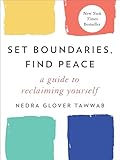
Nedra Glennon Tawwab is an American licensed therapist, bestselling author, and the founder of Kaleidoscope Counseling in Charlotte, North Carolina. She built a following of millions on Instagram by applying clinical concepts to everyday relationship problems with unusual clarity and warmth before publishing Set Boundaries, Find Peace: A Guide to Reclaiming Yourself (2021) with TarcherPerigee. The book became an immediate bestseller, spending weeks on the New York Times list and establishing Tawwab as the most widely read clinical voice on boundaries in popular self-help.
Where to Start: Set Boundaries, Find Peace (2021)
The essential Nedra Glennon Tawwab — and the most practically useful book on boundary-setting in the self-help canon. Set Boundaries, Find Peace begins with a definitional move that distinguishes it from most of the literature on the topic: boundaries are not walls, rejection, or punishment. They are clearly communicated expectations about how you need to be treated and what you will and won’t do in a relationship. They are relational tools, designed to preserve relationships by making your needs legible, not to end relationships by shutting people out.
This reframing — boundaries as information rather than aggression — is one the book returns to throughout, and it is the most important single thing Tawwab offers. Most people who struggle with boundary-setting do so partly because they have unconsciously absorbed the message that limits are inherently aggressive, that communicating a need is equivalent to making a demand, that saying no is a form of rejection. The book’s first task is to dislodge this assumption.
The three boundary styles provide the book’s conceptual framework. Porous boundaries — too permeable, too easily violated, too much willingness to absorb others’ needs — produce chronic exhaustion, resentment, and the sense of being unable to control one’s own life. Rigid boundaries — too hard, too defensive, shutting people out as a protection against the discomfort of connection — produce isolation and a different kind of exhaustion. Healthy boundaries sit between these: communicated, consistent, flexible enough to adapt to context, and informed by genuine knowledge of what one needs. Most people fall into the porous pattern by default; the book is primarily addressed to them.
The emotional obstacle chapters are where Tawwab earns her clinical credential. Most self-help books on boundaries tell readers to say no more often, as if the problem were insufficient instruction. Tawwab addresses why people who know they should set limits still can’t maintain them: guilt (the book is particularly good on why guilt is a normal response to boundary-setting that does not mean you are doing something wrong), fear of conflict and its roots, people-pleasing as a survival adaptation rather than a personality trait, and enmeshment — the pattern in which one person’s emotional state becomes indistinguishable from another’s. These chapters are the most therapeutically rich in the book and will be most useful to readers who are stuck rather than simply uninformed.
The scope distinguishes the book from most competitors. Tawwab covers boundaries across every domain: parents and siblings, friendships, romantic relationships, workplace dynamics with both peers and managers, social media and technology, and the relationship with oneself. Each chapter provides specific language and scenarios — not just “it’s okay to say no” but actual formulations for particular situations, and accounts of what responses to expect and how to handle them. The family chapters are particularly strong. Tawwab is a Black woman writing for a broad audience and is attentive to the cultural pressures — around family loyalty, deference, and obligation — that make boundary-setting feel like betrayal in communities where those values are especially central.
Consistency is identified as the hardest and most important component of boundary maintenance. Setting a limit once and having it ignored, then abandoning it, teaches the other person that your limits are negotiable. The book addresses this directly: the emotional difficulty of consistency, the ways people erode their own boundaries through guilt-driven exceptions, and the process of returning to a limit after it has been violated without treating the violation as a catastrophe.
Why Set Boundaries, Find Peace Is the Ideal First Book
For a reader new to Nedra Glennon Tawwab, Set Boundaries, Find Peace is the ideal first book because it is her best-known work and the fullest expression of her distinctive contribution, a clear, practical guide to setting healthy boundaries in relationships and life. Set Boundaries, Find Peace helps readers understand what boundaries are, why they matter, and how to set and maintain them, drawing on her experience as a therapist, in an accessible and empowering guide. As an entry point it is ideal, for it is her defining book and a clear statement of her approach. It welcomes the newcomer with its clear guidance, its practical tools, and its accessible, compassionate style, drawing the reader into the practice of healthy boundaries. It is her most important work and the one that best represents her thinking, so the new reader encounters Tawwab’s approach directly. For the newcomer interested in boundaries and relationships, then, Set Boundaries, Find Peace is the natural and ideal starting point.
What to Expect as a New Reader
As a new reader, you can expect Set Boundaries, Find Peace to be a clear, practical, and empowering guide to healthy boundaries. You can expect a focus on boundaries, for the book helps readers understand what boundaries are and why they matter. You can expect practical guidance, for Tawwab offers concrete tools for setting and maintaining boundaries in relationships and life. You can expect grounding in her experience, for Tawwab draws on her work as a therapist. You can expect a compassionate, accessible style. You can expect engagement with common challenges, such as guilt, conflict, and difficult relationships. You can expect a focus on improving well-being and relationships through healthy boundaries. You can expect actionable, supportive advice. Expect, in short, a clear, practical, and empowering guide to healthy boundaries, a fine introduction to Tawwab’s approach.
Going Deeper After Your First Book
Once Set Boundaries, Find Peace has introduced you to Tawwab’s approach, the reader who wishes to go deeper can explore her other work and the wider literature of relationships, mental health, and personal growth to which her writing belongs. Her other books extend her practical, compassionate guidance to further areas of relationships, family, and emotional well-being, while her broader work, including her widely followed presence as a therapist and writer, continues her teaching on boundaries and healthy relationships. The wide field of writing on relationships, boundaries, and mental health offers many further perspectives the reader is well prepared to explore. Reading more widely deepens your engagement with Tawwab’s distinctive contribution, the clear, practical teaching of healthy boundaries. Her characteristic compassion and practicality run through her work. Building your reading journey from Set Boundaries, Find Peace is a matter of following its guidance into her other work and the wider literature on relationships and well-being. The reader who begins here will have a practical foundation for setting healthy boundaries.
Reading Nedra Glennon Tawwab
Set Boundaries, Find Peace is Tawwab’s essential and most widely read book. It stands alone and requires no prior psychology background.
For the full Nedra Glennon Tawwab bibliography, reviews, and biography, visit the Nedra Glennon Tawwab author page on Editors Reads.
Affiliate disclosure: Links to Amazon on this page are affiliate links. We earn a small commission at no extra cost to you.
Frequently Asked Questions
Where should I start with Nedra Glennon Tawwab?
Set Boundaries, Find Peace: A Guide to Reclaiming Yourself (2021) is Tawwab's essential book — a comprehensive, clinically grounded guide to identifying, communicating, and maintaining boundaries across every domain of life, written by a licensed therapist with over a decade of clinical experience. The most practical and complete book on boundaries available in popular self-help, addressing not just how to set limits but why most people struggle to maintain them.
What is Set Boundaries, Find Peace about?
Set Boundaries, Find Peace covers boundary-setting in every area of life — family relationships, friendships, romantic partnerships, the workplace, and social media — with specific language, scripts, and scenarios rather than abstract advice. Tawwab defines boundaries clearly (they are communicated expectations, not walls or punishment), identifies the three boundary styles (porous, rigid, and healthy), and spends particular attention on the emotional obstacles that prevent people from setting limits they know they need: guilt, fear of conflict, people-pleasing, and enmeshment.
Who is this book most useful for?
Set Boundaries, Find Peace is most useful for readers who already know they struggle to say no but cannot identify why, and for anyone who feels chronically drained by others' needs or trapped in relationships they cannot seem to change. It is also particularly valuable for people-pleasers, those with emotionally demanding family members, and people navigating workplace dynamics that require clear professional limits. Tawwab's clinical background makes the book more reliable than most self-help on this topic — she addresses personality disorders and severe family dysfunction directly, while recommending clinical support where the book's tools are insufficient.
What should I read after Set Boundaries, Find Peace?
After Set Boundaries, Find Peace, Lindsay C. Gibson's Adult Children of Emotionally Immature Parents provides a framework for understanding the family dynamics that make boundary-setting difficult in the first place — the book Tawwab's chapters on family often prepare readers to need. Susan David's Emotional Agility addresses the emotional processing skills that make consistent boundary maintenance possible. Lori Gottlieb's Maybe You Should Talk to Someone provides a therapist's memoir that contextualises the clinical work behind tools like these.