Where to Start with Peter Frankopan: A Reading Guide
Where to start with Peter Frankopan — how to approach The Silk Roads, his sweeping revisionist history that reorients world civilisation away from Europe and toward the trade routes linking East and West. A complete reading guide.
By Oliver Kane
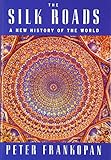
Peter Frankopan (born 1971) is a British historian, Senior Research Fellow at Worcester College, Oxford, and Director of the Oxford Centre for Byzantine Research. The Silk Roads: A New History (2015) was his second book and his breakthrough work: a 645-page revisionist account of world civilisation that became an international bestseller, translated into dozens of languages. Frankopan’s central argument — that Europe’s five hundred years of global dominance are an anomaly in the longer history of a world centred on Asia and its trade routes — is supported by formidable scholarship and delivered in prose accessible to general readers.
Where to Start: The Silk Roads (2015)
The essential Peter Frankopan — and the most significant work of popular revisionist world history of the twenty-first century. The Silk Roads begins from an observation that reshapes everything that follows: when you look at a map of the ancient world not from a European perspective but from the centre of the Eurasian landmass — from Persia, Central Asia, the crossroads where East meets West — the story of human civilisation looks entirely different. The routes historians call the Silk Roads were not decorative curiosities at the margins of the real story. They were the real story.
The revisionist argument is the book’s most powerful contribution. European historiography has placed Europe at the centre of world history by default — treating the rise of Greece and Rome, the Middle Ages, the Renaissance, the Age of Exploration, and the Industrial Revolution as the spine of civilisation. Frankopan does not deny that these events happened. He argues that the organising principle is wrong: that European prominence is roughly five hundred years old, and that for the two thousand years before it, the centre of gravity lay elsewhere. The Persian Empire, the Arab caliphates, the Silk Road city-states, the Mongol Empire, the Ottoman Empire — these were not peripheral to world history. They were world history.
The Silk Roads themselves were never a single road but a shifting web of routes through Central Asia linking the Mediterranean with China, carrying not only silk but spices, precious metals, technologies, religions, languages, and disease. Frankopan traces how control of these routes determined which polities accumulated wealth and power at any given moment. The Roman Empire’s hunger for eastern luxuries drained its treasury. The Arab caliphates of the seventh and eighth centuries built civilisations of extraordinary sophistication on Silk Road commerce. The Mongol conquests of the thirteenth century simultaneously devastated and unified the routes, enabling the transmission of plague — the Black Death — that would kill a third of Europe’s population.
The modern period receives the same reorienting treatment. The scramble for Central Asian resources — the “Great Game” between Britain and Russia in the nineteenth century, the twentieth-century competition for Persian and Gulf oil — is read as the latest chapter in a pattern two millennia old: major powers competing for control of the routes and resources of the Silk Road corridor. Frankopan’s concluding chapters on the twenty-first century, and China’s Belt and Road Initiative as the contemporary iteration of Silk Road strategy, give the historical argument immediate political relevance.
The prose is one of the book’s underrated achievements. Frankopan is an Oxford scholar writing for general readers, and he navigates the full sweep of human history from antiquity to the present — covering Persia, Rome, Byzantium, Islam, the Mongols, the Ottomans, the European empires, and the Cold War — without losing either rigour or accessibility. Events that most Western readers will encounter as unfamiliar become, by the book’s end, the familiar: the revisionism has done its work.
Why The Silk Roads Is the Ideal First Book
For a reader new to Peter Frankopan, The Silk Roads is the ideal first book because it is his acclaimed, ambitious work and the fullest expression of his distinctive gifts, the sweeping global perspective, the deep research, and the fresh retelling of world history from a new vantage point. The Silk Roads offers a new history of the world centered not on Europe but on the networks of trade, culture, and power that ran through Central Asia and the East, arguing for the enduring importance of this region in world history. As an entry point it is ideal, for it is his best-known book and a clear example of his sweeping, global, perspective-shifting approach to history. It welcomes the newcomer with its grand scope, its fresh perspective, and its engaging style, drawing the reader into a new vision of world history. It is his major work and a fine representation of his gifts, so the new reader encounters Frankopan at his most characteristic. For the newcomer, then, The Silk Roads is the natural and ideal starting point.
What to Expect as a New Reader
As a new reader, you can expect The Silk Roads to be a sweeping, ambitious, and perspective-shifting history of the world. You can expect a fresh perspective, for Frankopan retells world history centered not on Europe but on the networks of Central Asia and the East. You can expect a grand scope, for the book ranges across millennia and continents. You can expect a focus on connection, for Frankopan emphasizes the trade, cultural, and power networks, the silk roads, that linked the world. You can expect deep research, for the book is grounded in extensive scholarship. You can expect an argument for the enduring importance of the East in world history. You can expect an engaging, accessible style. You should expect a substantial, ambitious book. Expect, in short, a sweeping, ambitious, and perspective-shifting history of the world, a fine introduction to Frankopan’s gifts.
Going Deeper After Your First Book
Once The Silk Roads has introduced you to Frankopan’s approach, the reader who wishes to go deeper can explore his other books, which continue his sweeping global perspective, his deep research, and his fresh approach to history. His follow-up extends his analysis to the present and near future, examining the shifting balance of global power and the renewed importance of the regions at the heart of The Silk Roads, while his other work explores the deep connections between the environment, climate, and human history on a global scale. Reading these after The Silk Roads deepens your engagement with Frankopan’s distinctive gifts, the sweeping global perspective, the deep research, and the fresh retelling of history. His characteristic approach runs through his work, and the reader who has enjoyed The Silk Roads will find it across his books. Building your reading journey from The Silk Roads is a matter of following his global history into his other books. The reader who begins here will have a sweeping, fresh foundation for understanding world history.
Reading Peter Frankopan
The Silk Roads is Frankopan’s essential and most widely read book. Readers who want to continue should move to The New Silk Roads (2018), which covers the contemporary geopolitical implications of China’s Belt and Road Initiative and is shorter and more topical.
For the full Peter Frankopan bibliography, reviews, and biography, visit the Peter Frankopan author page on Editors Reads.
Affiliate disclosure: Links to Amazon on this page are affiliate links. We earn a small commission at no extra cost to you.
Frequently Asked Questions
Where should I start with Peter Frankopan?
The Silk Roads: A New History (2015) is Frankopan's essential book — a sweeping revisionist account of world civilisation that reorients the historical perspective away from Europe and toward the trade routes linking the Mediterranean with Central Asia, Persia, India, and China. Frankopan argues that the Silk Roads were not a peripheral curiosity but the engine of world history: the channels through which religion, disease, language, technology, wealth, and power moved for two millennia. It became an international bestseller and remains the most influential work of popular revisionist world history of the twenty-first century.
What is The Silk Roads about?
The Silk Roads argues that European dominance of world affairs is a recent historical anomaly of roughly five hundred years, and that for most of recorded history the centre of gravity lay in Asia — in Persia, the Arab caliphates, Central Asia, China, and the trade routes connecting them. Frankopan traces civilisation from antiquity to the twenty-first century with the Silk Roads as the organising principle: who controlled the routes controlled the wealth, and who controlled the wealth shaped the world. Events that European historiography treats as peripheral — the rise of Islam, the Mongol conquests, the Ottoman Empire — are reframed as the central story.
How revisionist is The Silk Roads compared to standard world history?
Substantially revisionist in emphasis rather than in individual facts. Frankopan does not dispute the factual record of Western historiography but argues that its organising principle — placing Europe at the centre — systematically distorts what was actually happening in the world for most of history. The effect of reading the book is a recalibration: events learned as background in standard Western education are reframed as foreground. The scholarship is Oxford-calibre; the argument is accessible to general readers without prior knowledge of Asian or Middle Eastern history.
What should I read after The Silk Roads?
After The Silk Roads, Frankopan's The New Silk Roads (2018) provides the contemporary continuation — how China's Belt and Road Initiative is redrawing the global order along the same routes. For deeper coverage of the Islamic world, Tamim Ansary's Destiny Disrupted covers complementary ground with similar revisionist ambition. Norman Davies's Europe: A History provides the counterpart European perspective — the standard account Frankopan is reacting against — and is the most comprehensive single-volume European history available.